VC-as-a-Service

Financial Assets: Shares, Bonds, and New Investment Vehicles Shaping Modern Portfolios

Financial assets form the backbone of modern investment portfolios, enabling individuals and institutions to allocate capital, manage risk, and generate returns over time. Traditionally, shares and bonds have dominated financial markets, serving as the primary instruments through which investors participate in economic growth and capital preservation. However, evolving market conditions, technological innovation, and changing investor preferences have given rise to new investment vehicles that are reshaping how capital is deployed.

This article explores the core characteristics of shares and bonds, examines their roles within diversified portfolios, and analyzes emerging investment vehicles that are increasingly influencing modern financial markets.

Shares: Ownership and Growth-Oriented Assets

Shares, commonly referred to as equities, represent ownership in a company. When investors purchase shares, they acquire a claim on the company’s assets and earnings, as well as voting rights in corporate governance, depending on the class of shares held.

The primary appeal of shares lies in their growth potential. As companies expand, improve profitability, and increase market value, shareholders benefit through capital appreciation. In addition, many companies distribute a portion of profits as dividends, providing an income stream alongside growth.

However, shares are also associated with higher risk. Equity prices can fluctuate significantly due to company performance, market sentiment, economic cycles, and geopolitical events. For this reason, shares are typically favored by investors with longer time horizons who can tolerate short-term volatility in exchange for higher expected returns.

From an institutional perspective, equities play a critical role in long-term wealth creation, particularly for pension funds and endowments seeking to match long-dated liabilities.

Bonds: Income and Capital Preservation

Bonds are debt instruments through which investors lend money to governments, corporations, or other entities in exchange for regular interest payments and the return of principal at maturity. Unlike shareholders, bondholders do not own the issuing entity but are creditors with contractual claims.

Bonds are generally considered lower-risk assets compared to shares, particularly when issued by stable governments or highly rated corporations. They provide predictable income streams and are commonly used to stabilize portfolios during periods of market volatility.

Key bond characteristics include:

  • Coupon rate: the interest paid to bondholders

  • Maturity date: when principal is repaid

  • Credit quality: the issuer’s ability to meet obligations

While bonds offer lower return potential than equities over the long term, they play a vital role in risk management and income generation. Institutional investors often use bonds to balance equity exposure and ensure liquidity.

The Complementary Role of Shares and Bonds

Shares and bonds have traditionally formed the foundation of diversified investment portfolios. Equities drive growth, while bonds provide stability and income. Their performance often differs across economic cycles, allowing investors to reduce overall portfolio volatility through strategic allocation.

However, low interest rates in recent years and increased market correlations have challenged the effectiveness of the traditional equity–bond mix. As a result, investors are increasingly exploring new asset classes and investment vehicles to enhance diversification and returns.

New Investment Vehicles: Expanding the Financial Asset Landscape

The evolution of financial markets has introduced a range of new investment vehicles that complement or extend beyond traditional shares and bonds. These instruments are designed to address changing investor needs, including access, diversification, impact, and innovation.

Exchange-Traded Funds (ETFs)

ETFs have transformed investing by offering low-cost, diversified exposure to equities, bonds, commodities, and thematic strategies. Traded on exchanges like shares, ETFs provide liquidity, transparency, and flexibility. They are widely used by both retail and institutional investors to efficiently implement asset allocation strategies.

Private Market Investments

Private equity, venture capital, and private credit have grown significantly as investors seek higher returns and diversification away from public markets. These investments offer exposure to unlisted companies and alternative lending structures but typically involve longer investment horizons and reduced liquidity.

Institutional investors are particularly attracted to private markets due to their potential for enhanced returns and reduced correlation with public assets.

Venture Studios and Company Builders

Newer investment models, such as venture studios, represent a structural innovation in how early-stage investments are made. Rather than investing in externally sourced start-ups, venture studios create companies internally, combining capital with execution capabilities. This model offers higher ownership, capital efficiency, and reduced execution risk compared to traditional venture investing.

While still emerging, venture studios are increasingly viewed as institutional-grade vehicles for accessing innovation-driven growth.

Impact and ESG Investment Vehicles

Environmental, Social, and Governance (ESG) considerations have given rise to impact-focused funds, green bonds, and sustainability-linked instruments. These vehicles allow investors to align financial objectives with social and environmental outcomes, reflecting a broader shift toward responsible investing.

Governments and institutions are increasingly issuing bonds tied to climate targets, social development, or infrastructure projects, expanding the universe of investable assets.

Digital and Tokenized Assets

Technological advancements have also introduced digital assets and tokenized securities. While still evolving and subject to regulatory scrutiny, tokenization has the potential to improve market efficiency, increase access, and reduce transaction costs by representing ownership digitally.

Institutional adoption remains cautious, but interest continues to grow as regulatory frameworks mature.

Portfolio Implications for Modern Investors

The expanding range of financial assets requires investors to adopt a more dynamic approach to portfolio construction. Rather than relying solely on shares and bonds, modern portfolios increasingly incorporate alternative and innovative investment vehicles to enhance diversification, manage risk, and capture new sources of return.

Institutional investors, in particular, are balancing traditional assets with private markets, thematic strategies, and emerging vehicles to meet long-term objectives in a complex economic environment.

Final Thought

Shares and bonds remain foundational financial assets, offering growth and stability respectively. However, the investment landscape is evolving. New investment vehicles, ranging from ETFs and private markets to venture studios and impact-focused instruments, are reshaping how capital is allocated and managed.

For today’s investors, understanding the characteristics and roles of both traditional and emerging financial assets is essential. A well-constructed portfolio now demands not only balance between risk and return, but also adaptability to innovation and changing market dynamics. As financial markets continue to evolve, diversified and informed asset allocation will remain central to sustainable investment success.


Venture Studios as a new asset class: towards an asset-backed model?

Venture studios have evolved from niche startup creation engines into institutional-grade platforms for company formation. By systematically ideating, validating, and scaling startups using centralized talent, capital, and infrastructure,venture studios have consistently outperformed traditional startup models in early-stage survival and capital efficiency. As the model matures, a critical question emerges for investors: can venture studios be structured and recognized as a distinct, asset-backed asset class?

This article examines the investment case for venture studios, the structural limitations of current equity-only models, and the opportunity to unlock scalable capital through asset-backed frameworks.

The Institutional Case for Venture Studios

Unlike venture capital funds that rely on external deal flow, venture studios generate proprietary opportunities internally. This vertical integration, idea generation, venture formation, and early execution, reduces early-stage risk and increases predictability. Data from multiple studio operators indicates higher venture success rates, faster time-to-market, and lower capital burn compared to traditional venture-backed startups.

For investors, venture studios offer early exposure at founder-level economics, diversified portfolios, and operational control. However, despite these advantages, venture studios remain difficult to classify within existing asset allocation frameworks. They are often treated as operating companies, venture funds, or accelerators, none of which fully capture their economic reality.

This ambiguity limits institutional participation and constrains access to non-dilutive or structured capital.

Constraints of the Equity-Centric Model

Most venture studios operate under a long-duration, equity-dependent return model, retaining significant ownership stakes in portfolio companies while monetization depends on future exits. While this preserves upside, it introduces three material constraints for investors.

First, liquidity risk remains high. Exit timelines of 7–10 years restrict participation to venture-style capital and limit portfolio rebalancing. Second, valuation methodologies are inherently subjective, driven by projected growth rather than cash-generating assets. Third, studio-level capabilities, often the primary drivers of value creation, are expensed rather than capitalized, resulting in structural undervaluation.

From an institutional investor perspective, this model fails to meet requirements for predictable cash flows, asset backing, and downside protection.

Venture Studios as Asset Platforms

A more accurate investment thesis recognizes venture studios not merely as equity aggregators but as asset creation platforms. Mature studios consistently generate reusable, monetizable assets across their portfolios, including:

  • Proprietary technology platforms and software stacks

  • Intellectual property portfolios

  • Standardized venture-building processes and operating systems

  • Curated talent pools and founder pipelines

  • Market intelligence, data assets, and sector-specific playbooks

  • Shared services with external commercial value

These assets generate economic value independent of portfolio exits. However, they are rarely structured for direct monetization or financing, representing a latent balance-sheet opportunity.

Transitioning to an Asset-Backed Model

An asset-backed venture studio model introduces a dual-layer investment structure:

1. The Asset Layer

This layer includes studio-owned IP, platforms, SaaS tools, venture services, and training academies. These assets can generate recurring revenues through licensing, subscriptions, usage fees, or strategic partnerships. Critically, they can be independently valued and financed using revenue-based instruments, structured credit, or blended finance.

2. The Equity Layer

The studio retains equity stakes in portfolio companies, preserving long-term upside. However, equity becomes one component of a broader return profile rather than the sole value driver.

This hybrid structure creates multiple return pathways: near-term cash flows, asset appreciation, and long-term equity optionality.

Investor Implications

For investors, asset-backed venture studios offer several strategic advantages:

  • Improved risk-adjusted returns through diversified income streams

  • Reduced reliance on exits for capital recovery

  • Earlier cash yield, improving portfolio liquidity

  • Collateralized downside protection via tangible and semi-tangible assets

This structure is particularly attractive to institutional LPs, family offices, and development finance institutions seeking exposure to innovation without pure venture risk. In emerging markets, asset-backed studios provide a pathway to mobilize local capital while aligning innovation with economic development priorities such as job creation, SME growth, and digital infrastructure.

Capital Market and Regulatory Considerations 

Recognizing venture studios as an asset class would require evolution in accounting, governance, and regulatory frameworks. Standardized asset valuation methodologies, IP recognition, and clear separation between studio assets and portfolio companies are essential.

However, precedent exists. Infrastructure funds, private credit vehicles, and IP-backed financing demonstrate that markets can adapt when assets are clearly defined and cash flows are measurable.

Risks and Execution Challenges

The transition to an asset-backed model is not without risk. Over-financialization may constrain experimentation, and poor governance can create conflicts between founders, studios, and investors. Asset valuation, particularly for intangibles, requires discipline and transparency.

Successful implementation will depend on strong operating metrics, clear legal structures, and alignment of incentives across stakeholders.

Final Thoughts

Venture studios are entering a phase of institutional maturity that warrants serious consideration from sophisticated investors. As the model evolves beyond equity-only returns, an asset-backed approach offers a compelling pathway to improved risk-adjusted performance, enhanced liquidity, and greater capital efficiency.

By recognizing venture studios as asset platforms, rather than purely speculative vehicles, investors can gain exposure to innovation with infrastructure-like characteristics: recurring revenues, defensible assets, and long-term upside optionality. For capital markets seeking resilient, scalable ways to finance entrepreneurship, asset-backed venture studios may represent the next durable frontier in alternative investments.

Aligning Investor and Founder Interests for Sustainable Venture Growth

Founder-investor alignment often feels like an elusive target, yet it shapes the foundation of sustainable venture growth. When vision, economics, governance, and operating rhythms aren’t in sync, tensions arise that stall progress and dilute value. This post breaks down why alignment matters across these dimensions and offers a practical framework you can apply today. You’ll also see how Mandalore Partners puts structure and clarity into action to support ventures built to last.

Importance of Vision Alignment

Finding common ground in vision sets the stage for successful partnerships. This step is crucial in ensuring that everyone moves toward shared aspirations.

Shared Long-Term Goals

You might wonder why long-term goals matter so much. They provide a roadmap, guiding decisions and fostering confidence amongst team members. Without this shared vision, efforts can scatter, weakening the venture's potential. Imagine a team where each member pulls in a different direction. Progress stalls, and energy dissipates. Clear goals ensure that everyone paddles in the same direction, making the journey smoother and more predictable.

Strategic Capital and Co-Investment

In the world of startups, strategic capital means more than just funding. It’s about wisely channeling resources to spur growth. When investors and founders co-invest, they share risks and rewards, creating a deeper commitment to success. This not only strengthens financial stability but also aligns interests. Co-investment acts as a bond, linking stakeholders in their quest for success. The benefits of strategic capital are profound, enabling ventures to scale efficiently and capture opportunities as they arise.

Impact and ESG Metrics

Today, businesses can’t ignore their impact on society and the environment. Emphasizing ESG (Environmental, Social, and Governance) metrics is not just responsible—it’s smart. By prioritizing these metrics, you not only do good but also attract like-minded investors and customers. This focus can lead to robust brand loyalty and even open doors to new markets. Thus, integrating ESG into your strategy is both a moral and economic imperative, setting you apart in a competitive landscape. Learn more about how ESG metrics can impact your venture here.

Governance and Economic Structures

Strong governance and sound economic structures underpin any thriving business. They create a framework that supports growth and minimizes risks.

Governance Frameworks and Board Governance

Effective governance frameworks provide stability and direction. They ensure that decisions are made transparently and that all voices are heard. Good board governance is essential here. It means having the right people in the room, making informed decisions. This establishes trust, which is vital for long-term success. By prioritizing governance, you lay the groundwork for sustainable growth and investor confidence.

Cap Table Design and Option Pool Strategy

A well-structured cap table is vital for managing ownership and responsibilities. It ensures clarity in equity distribution, which can prevent conflicts down the road. Similarly, an option pool strategy helps in attracting and retaining top talent. By creating clear incentives, you encourage employees to invest in the company’s success. Together, these tools foster a culture of ownership and accountability, driving growth and innovation.

Milestone-Based Funding for Growth

Milestone-based funding aligns financial support with performance, ensuring resources are used wisely. It encourages teams to meet targets and rewards them for hitting key achievements. This approach reduces risk for investors while motivating founders to stay focused. By tying funds to milestones, you create a clear path to success, fostering a sense of urgency and accountability. Discover more about funding strategies here.

Operating Cadence and Incentives

A well-tuned operating cadence and aligned incentives can drive sustainable growth. They keep momentum steady and motivate teams toward shared goals.

Aligned Incentives and Venture Building

Aligning incentives ensures everyone works toward the same objectives. When founders and team members see rewards tied to their efforts, engagement rises. This alignment fosters a culture of commitment and innovation. By clearly linking incentives to business goals, you create a powerful engine for growth. It’s about ensuring that everyone’s efforts contribute to the venture’s success.

Operating Cadence for Sustainable Growth

The rhythm at which a company operates can make or break its success. A consistent operating cadence helps maintain focus and momentum. It sets expectations for performance and progress, ensuring that teams remain productive. By establishing this rhythm, you create a predictable environment where growth becomes a natural outcome. A steady cadence helps navigate challenges smoothly, transforming obstacles into opportunities.

The Power of Flexible Investment Structures in Startup Support

Rigid investment terms often hold startups back just when they need flexibility most. You know how quickly your business model can shift, but traditional venture capital rarely adapts in step. Flexible investment structures change that dynamic, allowing support models to evolve alongside your startup’s growth. In this post, you’ll see how Mandalore Partners customizes these structures to meet your unique challenges and goals.

Flexible Investment Structures Explained

Flexible investment structures are changing how startups grow and adapt. This section explores why these models matter and how they can benefit your business.

Understanding Startup Support Models

Startups need more than just money. They require support that grows with them. Traditional venture capital often falls short because it lacks flexibility. This is where new support models come in. They provide the adaptability that startups need to thrive in changing markets. These models are not about fitting all businesses into one box. Instead, they offer tailored solutions that consider the unique needs of each startup.

Consider a startup in the tech sector. It might start small with a niche product but aims to expand rapidly. A flexible model will adjust to its growth phase, offering the right support at each stage. This approach ensures that the startup has the resources it needs when it needs them most. The result is a business that can pivot and scale without being held back by rigid terms.

The future of startup support lies in flexibility. By understanding and adopting these models, your business is better positioned for long-term success. This is not just about surviving—it's about thriving in a competitive landscape.

Key Benefits for Startup Growth

The benefits of flexible investment structures are clear. They provide the agility needed for growth. But how exactly do they support startups? Let's break it down.

First, these structures offer financial flexibility. Startups often face unpredictable expenses. With a dynamic funding model, they can access capital as needed without lengthy approval processes. This means you're not just surviving financial challenges; you're actively overcoming them.

Second, consider the support beyond capital. Startups need strategic guidance and operational expertise to navigate complex markets. This is where flexible models shine. They provide mentorship and resources tailored to your growth stage. Imagine having access to industry experts who can guide your next big move.

Finally, flexible investment structures foster innovation. They encourage startups to take calculated risks without fearing financial constraints. This mindset is crucial for developing groundbreaking solutions. As your startup grows, these structures evolve to meet new challenges, ensuring continuous support.

In a world where change is constant, flexible investment structures are a startup's best ally. They ensure that growth is not just a possibility but a certainty.

Mandalore Partners' Approach

Mandalore Partners takes a unique approach to investment. Their methods align perfectly with the needs of modern startups, offering tailored solutions that drive success.

Tailored Strategic Investment Plans

Mandalore Partners believes in personalized investment plans. They understand that each startup has distinct needs. Their approach begins with a deep dive into your business model. This ensures that the investment plan is not just supportive but transformative.

Imagine a startup focused on renewable energy. Mandalore Partners would tailor their strategy to match industry specifics. This might include connections to green energy experts or access to specialized technology. By focusing on what makes your startup unique, they ensure that their support is impactful and relevant.

These plans are not static. As your business grows, the strategy evolves. This means you're always aligned with the latest market trends and opportunities. In this way, Mandalore Partners acts not just as an investor but as a true partner in your journey.

Operational Expertise in Practice

Beyond finances, operational expertise is crucial. Mandalore Partners provides hands-on support in this area. They help startups streamline processes, optimize performance, and scale efficiently.

Consider a startup struggling with supply chain issues. Mandalore's team would work closely to identify bottlenecks and implement solutions. This could involve leveraging technology for better inventory management or improving logistics.

Their operational support goes further by preparing startups for expansion. Whether it's entering new markets or launching new products, their expertise ensures that every step is well-executed. This proactive approach minimizes risk and maximizes growth potential.

By integrating strategic and operational support, Mandalore Partners ensures that startups are equipped for long-term success. They provide the tools and insights necessary to navigate challenges and seize opportunities.

Partnering for Success

Building a sustainable business requires more than just capital. It requires a strategic partner who understands your vision and supports your growth.

Building Sustainable Businesses

Mandalore Partners focuses on building businesses that last. They prioritize sustainability in their investment strategy. This means looking beyond immediate profits to ensure long-term viability.

They work closely with startups to identify key sustainability drivers. For example, a startup in the food industry might focus on eco-friendly packaging. Mandalore would support this initiative by connecting the startup with ethical suppliers and advising on sustainable practices.

Their commitment to sustainability also involves measuring impact. They help startups track both financial and non-financial metrics. This comprehensive approach ensures that success is not just about numbers but about making a positive difference.

Active Value Creation in Venture Capital: How Hands-On Partners Drive Growth Beyond Funding

Most venture capital stops at a check. But your startup’s real challenge lies in turning that capital into lasting growth. Active value creation means hands-on investors who partner with you beyond funding—shaping strategy, governance, and execution. In this post, you’ll see how Mandalore Partners’ hybrid investment model supports founders at every step, blending venture capital with venture building to deliver measurable impact.

Active Value Creation in Venture Capital

Active value creation is reshaping how venture capital works. It's not just about funding anymore. Let's dive into what this means for you.

Defining Active Value Creation

Active value creation is about going beyond just money. It's about investors who roll up their sleeves to help you succeed. Imagine a partner who guides your strategy and execution. That's the core of active value creation. This approach ensures that you are not alone in tackling your challenges.

These hands-on investors serve as your team's extended arm. They offer insights and expertise to refine your business model. They help shape your vision into actionable strategies. This support can make the difference between just surviving and truly thriving.

Impact on Startup Outcomes

The impact on startups with active value creation is significant. Consider a startup that partners with such investors. Within a year, it sees a 50% growth in revenue. This isn't just luck—it's the result of targeted support and strategic guidance.

When investors are actively involved, startups can navigate market challenges more effectively. They benefit from better governance and strategic planning. This direct involvement helps startups achieve milestones faster and with more certainty. The results are clear: improved growth and a stronger market presence.

Mandalore Partners’ Hybrid Investment Model

Mandalore Partners redefines the investment landscape with its hybrid model. But what makes this approach so unique? Let's explore.

Strategic Capital and Governance

Mandalore Partners offers more than just financial support. They provide strategic capital, ensuring you have the resources to scale. But that's just the beginning. Their involvement in governance means you gain a partner for critical decision-making processes.

Think of Mandalore as a co-pilot on your journey. They bring experience and knowledge to the table, helping you steer clear of pitfalls. This partnership fosters transparency and trust, essential for sustainable growth. It’s this strategic involvement that sets them apart from traditional investors.

Venture Studio vs VC

The venture studio model offers a unique blend of support. It's not just about funding—it's about building. Mandalore Partners combines venture capital with a studio approach. This allows for a more integrated development process.

In traditional VC, the focus is often on capital. But a venture studio goes further, involving itself in the execution phase. This means startups benefit from shared resources and expertise. The result? A more robust support system that accelerates development. Explore the differences between venture studio and VC.

Supporting Founders from Strategy to Execution

Startup Acceleration Support

Startups need more than just a financial boost. They need acceleration support to gain momentum. Mandalore Partners provides this through tailored strategies and resources. This includes mentorship from seasoned experts who understand your industry.

With Mandalore, you're not just another portfolio company. You're a partner in innovation. They help you refine your strategy and prepare for market challenges. This hands-on approach ensures you’re not just keeping up but leading the pack.

Long-Term Value Creation

Long-term success requires a clear vision and a strategic partner. Mandalore Partners helps you build this foundation. Their focus on long-term value creation aligns with your growth goals. It's about creating a sustainable business that thrives in the long run.

This approach means you're building more than just a company—you’re building a legacy. By focusing on long-term strategies, Mandalore ensures you're well-prepared for future market shifts. The longer you wait to embrace this model, the more you might miss out on growth opportunities.

In conclusion, active value creation is vital in today’s venture capital landscape. By choosing partners like Mandalore Partners, you gain more than just investors. You gain allies committed to your long-term success.

Bridging Strategy and Execution: A New Paradigm in Venture Support

Most ventures stumble not for lack of vision but because strategy and execution run on separate tracks. If you’re an entrepreneur or investor, you know how costly this disconnect can be. Mandalore Partners redefines venture support by tightly linking strategic planning with hands-on execution, helping startups in fintech, insurtech, and impact sectors move from ideas to sustainable growth. This approach reshapes how you build lasting value beyond just capital investment.

The Importance of Strategic Integration

Understanding how to bridge the gap between strategy and execution is crucial for startup success. This connection is the foundation that helps ventures grow sustainably.

Defining Venture Support

Venture support isn't just about funding. It's about providing the tools and guidance you need to turn ideas into profitable ventures. Imagine a mentor who guides you through each critical decision. That's what true venture support looks like. It includes strategic planning, market analysis, and growth strategies. This support helps you focus on what matters most—building your business.

Think of Mandalore Partners as an example. They don't just invest money; they offer mentorship and strategic input. This approach ensures that every step you take is well-calculated and purposeful. You get more than just capital; you receive a partnership aimed at long-term success.

Bridging Strategy and Execution

Many startups fail because strategy and execution move in different directions. Aligning these elements is vital. It's about making sure that your plans are not just theoretical. This is where executional support comes in. By focusing on practical steps and real-world application, you can bring your strategy to life.

Consider how crucial it is to adapt your strategy as you learn. When execution is aligned with strategic goals, you can pivot faster and more efficiently. This adaptability is a game-changer, especially in fast-paced industries like fintech. Most entrepreneurs focus on strategy but neglect execution. The real magic happens when both are integrated seamlessly.

Mandalore Partners' Unique Approach

Mandalore Partners exemplifies how to blend capital investment with executional support. This approach redefines venture success.

Beyond Capital Investment

Investing in a startup means more than just providing funds. It means being there through thick and thin. Mandalore Partners goes beyond by offering strategic advice and operational help. This means your business gets the support it needs to thrive. They focus on sectors like fintech and insurtech, where strategic insight can make a big difference.

For example, if you're working on a fintech solution, the right guidance can open doors you didn't know existed. With Mandalore, it's not just about the money. It's about giving you every possible advantage to succeed. They ensure that your business is built on a solid foundation, ready to tackle any challenge.

Hands-On Executional Support

Execution is where ideas come to life. Mandalore Partners excels in providing hands-on support to ensure your plans are actionable. This approach means you're never alone in implementing your strategy. You get expert advice tailored to your unique needs.

When you partner with Mandalore, you gain access to a wealth of experience and knowledge. This isn't just theoretical advice; it's practical support that you can apply immediately. Imagine having a team that's invested in your success, helping you navigate every twist and turn. This level of involvement can be the difference between stagnation and growth.

Growth Opportunities in Emerging Sectors

Emerging sectors like fintech and insurtech present unique growth opportunities. Understanding these markets is key to leveraging them effectively.

Fintech and Insurtech Insights

The fintech and insurtech sectors are ripe with opportunities. With the right support, startups in these areas can revolutionize traditional industries. Mandalore Partners provides insights that help companies navigate these complex markets. They understand the challenges unique to these fields and offer solutions that work.

For instance, fintech startups can benefit from Mandalore's deep sector knowledge. This guidance helps you refine your product, meet regulatory requirements, and connect with potential customers. In insurtech, their support allows you to innovate on existing models and offer new solutions to old problems.

Supporting Impact Ventures

Impact ventures aim to create social and environmental benefits. Mandalore Partners specializes in supporting businesses that strive for positive change. They provide the tools and strategies you need to achieve both financial and social goals.

Whether you're focused on sustainability or social justice, Mandalore's approach helps you maximize your impact. They understand the unique challenges these ventures face and offer tailored support to overcome them. With their help, your impact venture can thrive, achieving meaningful change while also being financially successful.

In conclusion, integrating strategy with execution is essential for any venture aiming for success. Mandalore Partners exemplifies how this can be achieved, offering a valuable model for others to follow. By focusing on emerging sectors and providing comprehensive support, they empower you to make a lasting impact.

The Advantages of Active Partnerships for Fintech and Insurtech Startups

Active partnerships change the way fintech startups and insurtech startups grow. Simply providing capital no longer meets the complex needs founders face today. Mandalore Partners takes a hands-on role, offering operational support and strategic partnership that drive sustainable progress. This approach reshapes how venture capital can back startups beyond funding alone. Let’s explore how an active partnership can become a key asset for your venture’s long-term success.

The Power of Strategic Partnerships

In today's fast-paced tech world, partnerships are not just beneficial—they're essential. The right collaboration can propel startups to new heights.

Boosting Growth for Fintech Startups

Fintech startups need more than just funds to thrive. They require strategic partnerships that provide both financial support and expert guidance. Imagine having access to a network of seasoned professionals who can help navigate the complexities of finance and technology. This is where strategic partnerships shine. They offer fintech startups a chance to leverage expertise, helping them avoid common pitfalls and accelerate growth.

Take, for instance, a fintech startup that partnered with seasoned investors. Within a year, they doubled their client base. This success was driven by shared knowledge and resources. The right partnership can be the difference between stagnation and explosive growth. Learn more about these dynamics with insights from this white paper on fintech mergers.

Enhancing Sustainability in Insurtech Startups

For insurtech startups, sustainability is a key concern. A strategic partnership can pave the way for lasting success. By collaborating with experts in the field, insurtech companies can develop robust strategies that ensure they stay competitive. This is crucial in a sector where regulations and consumer expectations constantly shift.

Consider an insurtech venture that partnered with industry veterans. This partnership allowed them to refine their product offerings, resulting in a 30% increase in customer retention. By aligning with experienced partners, insurtech startups can build a sustainable foundation that supports long-term growth. Want to explore more about the insurtech landscape? Visit this Columbus Insurtech Companies article.

Mandalore Partners' Hands-On Approach

At Mandalore Partners, the focus is on active involvement. This hands-on approach goes beyond traditional venture capital, offering startups a unique blend of resources and support.

Venture Capital and Operational Support

Venture capital at Mandalore Partners is not just about funding. It's about providing comprehensive operational support. Startups benefit from a team that assists with strategy, governance, and execution. This holistic approach ensures that companies are not only funded but also guided towards their goals.

Imagine having a partner that helps streamline operations and improves efficiency by 25%. This is the kind of support Mandalore offers. By being deeply involved in the day-to-day operations, Mandalore ensures that startups are equipped to handle challenges and seize opportunities. Discover more about Mandalore's impact on insurtech in this research article.

Building High-Impact Businesses

Building a high-impact business requires more than just a great idea. It demands strategic planning and execution. Mandalore Partners excels in helping startups transform their visions into reality. By focusing on impact, Mandalore ensures that businesses are not only profitable but also make a difference.

Consider a scenario where a startup, with Mandalore's guidance, expanded its market reach by 40% within two years. Such success stories highlight the importance of having a proactive partner in your corner. Mandalore's commitment to impact-driven ventures is evident in every partnership, ensuring that businesses are built to last.

Long-Term Success and Impact

The journey to long-term success is filled with challenges. However, with an active partnership, these challenges become manageable stepping stones to growth.

Navigating Challenges with Active Partnership

Active partnerships provide the support needed to navigate complex market landscapes. With Mandalore Partners, startups have a partner that is committed to their success. This means having access to solutions tailored to overcome specific industry challenges.

Most startups struggle with scaling, but with the right partnership, scaling becomes a strategic process. Mandalore's expertise allows startups to anticipate market shifts and adjust strategies accordingly, ensuring they stay ahead of the curve. Insights from field-specific studies, such as this one on the economy and finance, offer valuable perspectives on navigating industry challenges.

Scaling Efficiently with Mandalore Partners

Efficient scaling is crucial for any startup aiming for long-term success. Mandalore Partners provides the tools and insights necessary for startups to scale efficiently. By focusing on strategic growth, Mandalore ensures that startups expand their operations without compromising quality or vision.

Imagine achieving a 50% increase in operational capacity while maintaining customer satisfaction. This is the level of efficiency that an active partnership with Mandalore can achieve. With a focus on strategic scaling, startups can grow sustainably and profitably, ensuring long-term success and impact.

In conclusion, the right partnership can transform a startup's journey. By choosing to work with Mandalore Partners, fintech and insurtech startups pave the way for not only growth but also enduring success.

https://www.mandalorepartners.com/

Empowering Fintech and Insurtech Startups: The Role of Active Partnership Models

Fintech startups often face a critical gap between securing capital and scaling effectively. Many investors provide funds but stop short of the strategic and operational support founders need to build lasting companies. Active partnership models close that gap by combining venture capital with hands-on involvement, driving measurable insurtech growth and startup scaling. Here’s how this approach shapes stronger startups and sustainable success.

The Power of Active Partnership Models

Active partnership models are more than a trend; they're a game-changer for startups. By blending capital with strategic support, these models create a nurturing ground for growth. Let's see how they benefit fintech startups and spur insurtech growth.

Benefits for Fintech Startups

For fintech startups, the right partnership can be transformative. Picture this: you're not just receiving capital but also gaining a partner ready to help you navigate challenges. This collaboration provides more than funds—it offers strategic insights that are crucial for growth.

First, having access to expert advice helps you avoid common pitfalls. A partner who understands fintech can guide you through complex decisions, offering a roadmap to success. This support can result in increased customer acquisition by up to 30%, as seen in several case studies.

Moreover, strategic partners bring networks that money can't buy. By tapping into these networks, you find opportunities that propel your business forward. In essence, you're not just another startup; you're part of a dynamic ecosystem that fosters innovation and expansion.

Driving Insurtech Growth

Insurtech growth thrives on adaptability and innovation. Active partnerships are key here. They provide the agility startups need to respond to market demands quickly. Want to know how? Let's delve into the process.

With a strategic partner, you can test new products and refine them based on real-time feedback. This approach reduces development cycles by nearly 20%, giving you a competitive edge. You address customer needs faster and more efficiently.

The real magic, though, lies in shared expertise. Partners bring industry knowledge and best practices that are invaluable. This expertise translates into refined strategies that drive growth. The longer you wait to embrace such partnerships, the more you miss out on these advantages.

Mandalore Partners' Strategic Approach

Mandalore Partners exemplifies the power of combining capital with strategic support. Their unique approach sets them apart as they blend traditional venture capital methods with hands-on involvement, ensuring startups don't just survive but thrive.

Combining Capital with Support

Mandalore Partners doesn't stop at providing funds. They roll up their sleeves and dive into the strategic aspects of your business. Think of them as an extension of your team, working alongside you to tackle challenges head-on.

Imagine having an advisor who helps you fine-tune your business model. This guidance can lead to a 25% improvement in operational efficiency. With their support, you're not just following a path; you're charting a course tailored to your strengths.

Their approach involves regular check-ins and strategic planning sessions. These interactions ensure your startup remains agile, ready to adapt to market changes. It's a partnership built on trust, transparency, and mutual growth.

Unique Value of Mandalore Partners

What sets Mandalore Partners apart is their commitment to long-term value creation. They focus on sectors like fintech and insurtech, where their expertise truly shines. By aligning with your vision, they become true partners in your journey.

Their unique value lies in their hybrid model. By combining venture capital with venture studio capabilities, they offer more than financial support—they provide the tools for sustainable growth. This model has proven successful, with startups reporting a 40% increase in market reach.

At Mandalore Partners, it's not just about investment; it's about building something enduring. Their holistic approach positions you for success in competitive markets, ensuring your startup not only competes but leads the charge.

Scaling Success with Active Partnerships

Scaling a startup is no small feat. It takes more than vision; it requires strategic actions and the right partnerships. Active partnership models hold the key to scaling success, providing the resources and support essential for growth.

Enhancing Startup Scaling

Active partnerships enhance your ability to scale effectively. They offer more than just guidance; they provide frameworks that streamline operations. This support can reduce scaling time by up to 30%, getting your products to market faster.

With a partner by your side, you gain insights into efficient scaling practices. They help you prioritize resources, ensuring efforts translate into tangible results. This guidance can be the difference between stagnant growth and exponential success.

Moreover, these partnerships open doors to strategic collaborations. By leveraging their networks, you gain access to new markets and customer segments. This exposure accelerates growth, positioning your startup as a leader in the industry.

Attracting High-Impact Venture Capital

One of the most significant benefits of active partnerships is their ability to attract high-impact venture capital. Investors are drawn to startups with strong partnerships, seeing them as less risky and more likely to succeed.

When you partner with industry experts, you send a powerful message to potential investors. It shows you're serious about growth and have the backing to achieve it. This credibility boosts your appeal, leading to increased investment opportunities.

The key insight here is simple: partnerships amplify your potential. They position you as an attractive prospect, ready to seize opportunities and drive innovation. The longer you wait to embrace this model, the more you risk missing out on transformative growth.

By adopting active partnership models, fintech and insurtech startups can unlock unprecedented growth. Mandalore Partners' approach exemplifies the potential of combining capital with strategic support, creating a pathway to sustained success.

Le Soutien Stratégique : Facteur Clé de Croissance en InsurTech

La croissance des startups InsurTech ne se construit pas seulement sur des idées brillantes, mais sur un soutien stratégique solide. Mandalore Partners propose un modèle VCaaS unique qui connecte les entrepreneurs aux ressources et investisseurs essentiels pour accélérer leur développement. Découvrez pourquoi ce soutien est devenu un levier incontournable pour toute startup cherchant à s’imposer dans la technologie de l’assurance.

Importance du Soutien Stratégique

Dans un monde où les startups se démarquent par leur innovation, le soutien stratégique devient leur principal moteur de succès. C'est particulièrement vrai dans le secteur de l'InsurTech, où la concurrence est rude et les attentes élevées.

Impact sur la Croissance des Startups

Les startups bénéficient d'un accompagnement qui dépasse le simple apport de capitaux. Imaginez une jeune entreprise qui, grâce à un partenaire stratégique, parvient à doubler son chiffre d'affaires en moins d'un an. Ce n'est pas seulement un rêve; c'est possible avec le bon soutien. En offrant des conseils avisés et un accès privilégié aux ressources, les startups peuvent naviguer plus facilement à travers les défis du marché. Un exemple concret : une startup InsurTech a pu accéder à un réseau d'experts qui lui a permis de perfectionner ses offres et de séduire de nouveaux clients rapidement.

Rôle dans le Secteur InsurTech

Dans le domaine de l'assurance, la rapidité d'exécution est cruciale. Le soutien stratégique permet aux startups de rester à la pointe des tendances et de répondre efficacement aux attentes des consommateurs. Pour les entreprises cherchant à se faire une place, comme le montre ce rapport, être agile et bien informé est essentiel. C'est ici que les partenariats stratégiques jouent un rôle clé, offrant aux entreprises la capacité d'anticiper et de s'adapter aux changements du marché.

Modèle VCaaS de Mandalore Partners

Mandalore Partners redéfinit le soutien aux startups avec son modèle VCaaS, assurant un accompagnement complet et adapté aux besoins spécifiques des entreprises.

Avantages pour les Startups InsurTech

Pour les startups InsurTech, bénéficier du modèle VCaaS de Mandalore Partners signifie accéder à un éventail de ressources précieuses. Ce modèle va au-delà de l'investissement financier, fournissant également un soutien stratégique qui s'adapte aux besoins uniques de chaque entreprise. Par exemple, une startup peut obtenir des conseils sur l'optimisation de ses processus opérationnels, ce qui peut entraîner une réduction des coûts de 20% et une meilleure rentabilité. En collaborant avec Mandalore, les entreprises ne reçoivent pas seulement un financement, mais un véritable partenariat stratégique.

Connecter les Ressources et les Investisseurs

L'un des principaux atouts de Mandalore Partners est sa capacité à connecter efficacement les startups avec des investisseurs et des ressources clés. Cela se traduit par un réseau solide qui permet aux entreprises de s'épanouir. Imaginez bénéficier d'une introduction directe à un groupe d'investisseurs passionnés par l'innovation en InsurTech, comme le souligne ce blog. Ce type de connexion peut transformer le potentiel d'une entreprise en succès tangible, facilitant l'accès aux marchés et accélérant la croissance.

Vers un Avenir Prometteur

Avec Mandalore Partners, l'avenir est synonyme de collaboration et de croissance. Le modèle VCaaS ouvre des voies nouvelles et passionnantes pour les startups InsurTech.

Encourager la Collaboration et le Partenariat

La collaboration est au cœur de l'approche de Mandalore Partners. En créant des partenariats stratégiques, ils favorisent un environnement où les startups peuvent prospérer ensemble. Les événements et workshops organisés par Mandalore permettent aux entrepreneurs de rencontrer des experts du secteur et d'autres startups, élargissant ainsi leur réseau et leurs perspectives. Ce sentiment de communauté et de partage d'idées est ce qui distingue Mandalore de ses concurrents, créant un écosystème où chacun a la possibilité de briller.

Opportunités de Croissance et d'Innovation

Dans l'univers en constante évolution de l'InsurTech, les opportunités d'innovation sont infinies. Mandalore Partners encourage les startups à explorer de nouvelles idées et à repousser les limites. Grâce à leur soutien, les entreprises peuvent non seulement s'adapter aux changements du marché mais aussi les anticiper. En s'appuyant sur des données récentes de l'industrie, comme celles trouvées dans cette analyse, les startups peuvent identifier des niches inexploitées et développer des solutions qui répondent réellement aux besoins des consommateurs.

Comment le VCaaS réinvente l'avenir des startups innovantes

Le modèle traditionnel du capital-risque ne suffit plus pour accompagner les startups ambitieuses d’aujourd’hui. Le VCaaS change la donne en offrant un soutien stratégique complet, spécialement conçu pour les secteurs IndustryTech et InsurTech. Avec Mandalore Partners à vos côtés, vous bénéficiez d’un partenaire engagé qui connecte investisseurs et startups pour une croissance durable et ciblée.

Réinvention de l'investissement stratégique

Le VCaaS, ou Venture Capital-as-a-Service, est en train de transformer la manière dont les startups obtiennent du soutien. Ce modèle va bien au-delà du financement traditionnel.

Qu'est-ce que le VCaaS ?

VCaaS est un modèle innovant qui offre aux entreprises plus que de l'argent. Pensez à un GPS pour startups: vous tracez la route tout en recevant des conseils stratégiques. Ce modèle inclut non seulement des investissements financiers, mais aussi l'accès à des expertises et des ressources essentielles. En vous associant avec des experts, vous bénéficiez d'un avantage concurrentiel unique. Selon Forbes, cette approche rapproche les grands groupes et les startups, ouvrant de nouvelles voies d'innovation.

Avantages du modèle VCaaS

Le VCaaS se distingue par ses multiples bénéfices. D'abord, il fournit un soutien continu, indispensable pour naviguer dans des marchés complexes. Imaginez avoir un conseiller personnel qui anticipe vos besoins. De plus, il procure des connexions précieuses avec des partenaires stratégiques. Artesian Invest explique comment ce modèle favorise une croissance durable. Un autre avantage est la flexibilité du soutien, qui s'adapte à l'évolution de votre entreprise. Cela signifie que vous êtes toujours prêt à saisir chaque opportunité de croissance.

Impact sur les startups technologiques

L'influence du VCaaS s'étend largement, favorisant une croissance rapide dans les secteurs technologiques. Comment ces industries en bénéficient-elles?

Soutien dans l'IndustryTech

Dans le secteur IndustryTech, le VCaaS joue un rôle crucial. Il aide à intégrer les dernières technologies, ce qui est essentiel pour rester compétitif. Prenons l'exemple d'une startup qui utilise le VCaaS pour adopter l'automatisation. Elle améliore sa productivité et réduit ses coûts opérationnels. Ce soutien stratégique est ce qui permet aux startups de surmonter les obstacles techniques et de se démarquer. La source Inc. souligne que ce modèle est un catalyseur pour l'innovation dans l'industrie.

Opportunités pour l'InsurTech

L'InsurTech, un autre secteur clé, profite également du VCaaS. Ce modèle aide les startups à repenser les produits d'assurance pour les adapter aux besoins modernes. Par exemple, une startup en InsurTech peut utiliser le VCaaS pour développer des solutions basées sur l'IA. Cela lui permet de mieux analyser les risques et de répondre aux attentes des clients. En collaborant avec des experts, ces startups peuvent accéder à des marchés nouveaux et mieux répondre aux attentes de leurs clients. LinkedIn illustre comment cette approche renforce l'innovation dans l'InsurTech.

Le corporate venture capital entre dans une nouvelle ère à deux vitesses

Introduction

Le corporate venture capital (CVC) a longtemps été perçu comme un levier structuré et relativement homogène d’innovation pour les grandes entreprises. Mais l’année 2025 pourrait marquer une rupture nette. En l’espace de douze mois, les montants investis, les profils des investisseurs et les dynamiques de marché ont profondément changé.
On n’assiste plus à une simple montée en puissance du corporate venture, mais à une fracture claire entre deux marchés distincts, avec, d’un côté, quelques géants capables de redéfinir les règles du jeu, et de l’autre, une majorité d’acteurs contraints de revoir leurs ambitions.

Une explosion des méga-deals sans précédent

Les chiffres parlent d’eux-mêmes. En 2024, on recensait 12 tours de financement de startups dépassant le milliard de dollars avec une participation corporate. En 2025, ce chiffre est passé à 19. Plus marquant encore, la valeur cumulée des 20 plus gros tours impliquant des corporates est passée de 34 milliards à plus de 58 milliards de dollars, soit une hausse d’environ 70 % en un an.

Ce type de progression ne relève pas d’une croissance organique. Il s’agit d’un changement brutal d’échelle, qui transforme en profondeur la physionomie du marché.

Meta et Nvidia : les nouveaux faiseurs de marché

Deux acteurs expliquent à eux seuls une grande partie de cette bascule : Meta et Nvidia.

Meta, historiquement prudente vis-à-vis du venture capital, a opéré un virage spectaculaire en participant aux deux plus importants tours de financement de l’année :

  • Scale AI, avec une levée de 14,3 milliards de dollars

  • Databricks, avec un tour de série J à 10 milliards de dollars

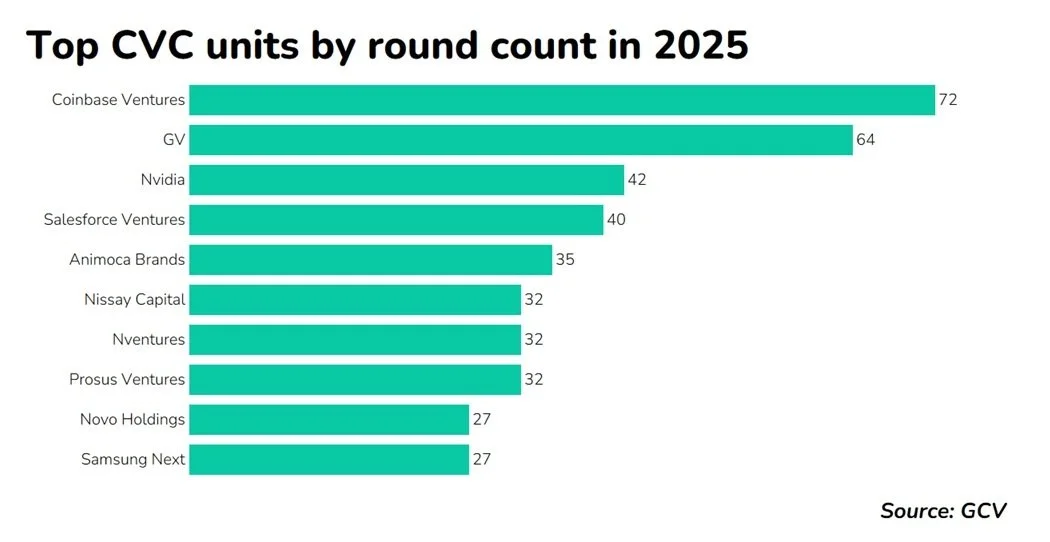
De son côté, Nvidia s’est comportée moins comme un fabricant de semi-conducteurs que comme un véritable fonds souverain technologique. En 2025, le groupe a soutenu près de 80 startups et figure dans 7 des 20 plus grosses opérations de l’année.

Ces investissements massifs, concentrés sur l’IA, l’énergie ou encore le quantique, ont redéfini les standards de valorisation… mais uniquement pour ceux capables de suivre.

Un marché du corporate venture désormais à deux vitesses

C’est ici que la fracture devient évidente.
Au sommet du marché, une poignée de géants de la Silicon Valley déploient des montants colossaux, imposant des valorisations à neuf ou dix chiffres que peu d’acteurs peuvent absorber sans mettre en péril leur discipline financière.

En dessous, on retrouve l’immense majorité des corporates, qui adoptent une approche radicalement différente :

  • retour à des investissements plus early-stage,

  • recentrage sur des écosystèmes locaux,

  • ciblage de technologies strictement adjacentes à leur cœur de métier.

Ce positionnement n’est pas uniquement dicté par la prudence. Il relève aussi d’une forme de stratégie défensive. Quand les prix d’entrée deviennent inaccessibles, la retenue cesse d’être un signe de frilosité et devient un choix rationnel.

Repenser l’innovation au-delà du venture capital

Face à cette nouvelle réalité, de nombreuses entreprises réévaluent leur approche de l’innovation. Le corporate venture capital n’est plus l’unique voie.

Certaines organisations reviennent à la création de startups en interne, malgré les défis opérationnels que cela implique. D’autres testent des modèles de venture client, permettant d’apprendre et d’expérimenter sans prise de participation au capital.
On observe également une tendance croissante à externaliser la prise de décision, en devenant limited partner dans des fonds spécialisés plutôt que d’investir en direct.

En 2025, investir directement au cœur du cycle d’hype technologique s’est révélé être un exercice réservé aux acteurs les plus solides financièrement et stratégiquement.

2026 : poursuite de l’euphorie ou correction du marché ?

La trajectoire pour 2026 reste incertaine. Plusieurs lignes de fracture sont déjà visibles :

  • une concurrence accrue des fabricants de puces chinois,

  • l’émergence d’approches radicalement nouvelles en intelligence artificielle, portées par des figures majeures de la recherche,

  • et surtout, la fragilité d’un boom des data centers largement financé par la dette, avec des actifs susceptibles de se déprécier plus vite que les revenus ne s’accumulent.

Ces tensions pourraient alimenter une correction. Mais elles pourraient aussi renforcer encore davantage la domination des acteurs capables d’absorber le risque.

Conclusion : un nouveau cycle pour le corporate venture capital

Une chose semble acquise : le corporate venture capital est entré dans une phase où les lois de la gravité ne s’appliquent plus de la même manière à tous. Pour une minorité d’acteurs, les contraintes semblent presque optionnelles. Pour tous les autres, le parcours restera volatil, exigeant et hautement stratégique.

Dans ce contexte, le succès ne dépendra plus seulement de la capacité à investir, mais surtout de la capacité à choisir le bon modèle d’innovation, au bon moment, avec le bon niveau d’exposition au risque.

Révolutionner le Soutien aux Startups : L'Impact du Modèle VCaaS en IndustryTech et InsurTech

Le modèle VCaaS change la donne pour les startups en IndustryTech et InsurTech. Vous n’êtes plus seul face aux défis du capital-risque : Mandalore Partners combine investissement stratégique et accompagnement pointu. Dans ce contexte, découvrez comment ce soutien sur mesure ouvre de nouvelles perspectives pour votre croissance et vos ambitions.

Le Modèle VCaaS : Une Nouvelle Ère d'Investissement

Comprendre le Concept VCaaS

Le modèle VCaaS bouleverse la manière dont les startups perçoivent le soutien financier. En intégrant le VCaaS, vous bénéficiez d'un partenariat stratégique qui va au-delà de l'injection de capital. Imaginez un modèle où vous êtes soutenu non seulement financièrement mais aussi stratégiquement. Avec VCaaS, vous obtenez un allié prêt à naviguer à vos côtés dans le monde complexe du business. Cela permet aux jeunes entreprises de se concentrer sur l'innovation tout en ayant un filet de sécurité.

VCaaS vous offre un accès à des ressources et à une expertise qui étaient autrefois l'apanage des grandes entreprises. Vous avez à votre disposition des experts capables de fournir des conseils adaptés à votre secteur. Ce n'est pas qu'une question de financement, mais aussi de stratégie et de croissance. En optant pour ce modèle, vous devenez une partie d'un réseau qui favorise l'échange de connaissances et le partage d'expériences. Cela peut transformer votre idée en une entreprise prospère.

Avantages pour les Startups

Pour les startups, le VCaaS représente une opportunité de croissance sans précédent. Plutôt que de se limiter à un simple soutien financier, vous recevez un accompagnement sur mesure. Le modèle assure que vous êtes bien équipé pour anticiper et surmonter les défis. En travaillant avec des partenaires comme Mandalore Partners, vous pouvez accéder à des secteurs de marché que vous n'auriez pas pu atteindre seul.

Prenons l'exemple d'une startup en IndustryTech. Avec le soutien de VCaaS, non seulement elle lève des fonds, mais elle développe aussi des relations stratégiques avec des leaders dans le secteur. Cela ouvre des portes vers de nouvelles collaborations et innovations. Le VCaaS vous aide à réduire les risques en fournissant des informations précieuses et des contacts dans l'industrie. Vous ne marchez pas seul ; vous avez un guide expérimenté à vos côtés.

IndustryTech et InsurTech : Secteurs en Pleine Expansion

Les secteurs de l'IndustryTech et de l'InsurTech connaissent une croissance exponentielle. Les opportunités abondent et les startups qui savent tirer parti des bonnes ressources peuvent en récolter d'énormes bénéfices. Ces secteurs offrent un terrain fertile pour l'innovation. La demande de solutions technologiques innovantes est en hausse. En vous positionnant dans ces secteurs, vous vous assurez une place de choix dans l'avenir du marché.

Opportunités Clés en IndustryTech

L'IndustryTech est un domaine où l'innovation technologique est essentielle. Les startups qui y investissent peuvent transformer des industries entières. La clé est de se différencier par l'innovation et l'efficacité. Pensez à l'automatisation des processus de fabrication ou à la mise en œuvre de technologies vertes. Vous êtes en mesure de révolutionner la chaîne d'approvisionnement ou de réduire les coûts de production.

Les entreprises en IndustryTech ont également l'opportunité de développer des technologies respectueuses de l'environnement, un aspect qui devient crucial dans le monde d'aujourd'hui. Les solutions qui réduisent l'empreinte carbone sont très recherchées. En investissant dans ces technologies, votre entreprise peut non seulement croître mais aussi contribuer à un avenir plus durable.

Innovations en InsurTech

Le secteur de l'InsurTech est en pleine effervescence avec des innovations qui redéfinissent l'assurance. Des solutions digitales simplifient et améliorent l'expérience client. Imaginez des applications qui permettent une gestion instantanée des réclamations ou des algorithmes qui personnalisent les polices d'assurance. Vos clients bénéficient d'une expérience fluide et personnalisée.

Les startups en InsurTech ont l'opportunité d'introduire des innovations technologiques qui facilitent l'accès aux services financiers. Cela inclut le développement de plateformes de gestion des risques basées sur l'IA. Ce n'est pas seulement une question de faciliter l'assurance, mais aussi d'améliorer l'accessibilité pour tous.

Épargne longue et capital patient : les nouveaux horizons de la croissance durable

L’épargne longue occupe une place centrale dans les stratégies économiques modernes. Face aux défis climatiques, au vieillissement des populations et au besoin croissant de financer des infrastructures stratégiques, la notion de capital patient s’impose comme un levier majeur. En 2025, l’Europe s'efforce de redéfinir sa relation entre épargne, investissement et croissance durable. L’objectif n’est plus simplement de sécuriser des placements, mais de les orienter vers des projets utiles, résilients et créateurs de valeur à long terme.

Voici les 6 grandes dynamiques qui transforment aujourd’hui l’épargne longue en moteur d’innovation et de durabilité.

1. Le capital patient : un moteur structurant pour les projets à long terme

Le capital patient désigne des financements qui acceptent des horizons de rendement plus longs, parfois au-delà de dix ou quinze ans. Ce type de capital est indispensable pour soutenir des secteurs comme l’énergie renouvelable, les biotechnologies, les infrastructures ou encore les technologies deeptech.

En Europe, des institutions comme la Banque Européenne d’Investissement (BEI) jouent un rôle déterminant. Par exemple, la BEI a récemment alloué plusieurs milliards d’euros à des projets d’hydrogène vert ou à des réseaux de transport bas carbone nécessitant une rentabilité lente mais durable.

Des fonds spécialisés, comme Eurazeo Infrastructure ou Mirova, privilégient désormais des stratégies de “hold long” permettant aux entreprises financées de croître sans la pression d’une rentabilité immédiate.

Le capital patient devient donc un élément clé pour accompagner les innovations qui demandent du temps, notamment dans les technologies climatiques.

2. L’épargne longue comme catalyseur des transitions énergétique et numérique

La transition écologique et numérique nécessite des investissements massifs sur plusieurs décennies. L’épargne longue représente une source de financement idéale pour ces projets structurels.

De nombreux gestionnaires d’actifs orientent déjà les dispositifs d’épargne retraite ou d’assurance vie vers des projets verts de long terme. Par exemple :

  • Amundi a lancé des fonds thématiques alignés sur les objectifs européens de neutralité carbone.

  • Allianz Global Investors finance des infrastructures numériques durables, comme la fibre optique ou les data centers écoresponsables.

  • BNP Paribas Asset Management développe des fonds verts orientés exclusivement sur des projets à horizon 2030-2050.

L’épargne longue permet également d’attirer davantage de capitaux vers des obligations vertes destinées à financer des projets d’efficacité énergétique ou d’adaptation climatique. Ces obligations, souvent indexées sur des objectifs mesurables, renforcent la transparence et la confiance des investisseurs particuliers.

3. Les fintechs facilitent l’accès à l’épargne longue pour les citoyens

En 2025, les fintechs démocratisent l’accès aux produits longs et durables grâce à des plateformes transparentes et pédagogiques. Les épargnants peuvent désormais investir en quelques clics dans des projets à horizon 10 ou 20 ans, tout en suivant l’impact social ou environnemental de leurs placements.

Quelques exemples marquants :

  • Lita.co, qui permet d’investir dans des entreprises à impact tout en affichant clairement les rendements projetés sur plusieurs années.

  • Yomoni, qui propose des portefeuilles diversifiés incluant progressivement des actifs de long terme.

  • Goodvest, qui oriente automatiquement l’épargne vers des investissements alignés avec l’Accord de Paris en fonction de l’horizon choisi.

Grâce à ces outils, les particuliers comprennent mieux comment leur épargne contribue à un futur durable. Le digital permet aussi de réduire les frais, rendant les produits d’épargne longue plus attractifs.

4. Le rôle des assureurs et des fonds de pension dans la stabilisation économique

Les assureurs et fonds de pension possèdent des réserves financières colossales. Ces acteurs, par nature tournés vers le long terme, deviennent des piliers de l’économie durable.

En France, par exemple, les contrats d’assurance vie représentent plus de 1 800 milliards d’euros d’encours, dont une partie croissante est désormais orientée vers des actifs de long terme. L’arrivée des unités de compte responsables et les exigences réglementaires (comme l’article 29 de la loi Énergie-Climat) encouragent encore cette dynamique.

Au Royaume-Uni, les fonds de pension participent au Long-Term Asset Fund, un dispositif destiné à financer des infrastructures vertes, des transports durables et des programmes de recherche.

En Allemagne, les régimes de retraite investissent dans des projets immobiliers écologiques certifiés, pour concilier stabilité financière et transition énergétique.

Ces acteurs stabilisent ainsi les cycles économiques en injectant un capital constant dans des projets essentiels, indépendamment des fluctuations conjoncturelles.

5. Des cadres réglementaires qui encouragent l’investissement durable

L’Union européenne renforce depuis plusieurs années la régulation en faveur de l’investissement à long terme. Des dispositifs comme la taxonomie européenne, le règlement SFDR ou l’étiquette européenne ELTIF 2.0 simplifient désormais l’accès des particuliers aux fonds longs.

Par exemple :

  • La taxonomie européenne clarifie ce qui est considéré comme “durable”, ce qui facilite le choix des épargnants.

  • Les ELTIF nouvelle génération permettent d’investir dans des actifs non cotés, tels que des infrastructures ou des PME innovantes, avec une liquidité améliorée.

  • Le plan InvestEU vise à mobiliser des milliards d’euros d’épargne privée pour financer des priorités stratégiques : climat, numérique, santé, technologies souveraines.

Cette modernisation réglementaire renforce la crédibilité du marché européen de l’investissement durable et protège l’épargnant.

6. L’émergence de portefeuilles multi-générationnels

La notion d’épargne longue évolue également vers une vision multi-générationnelle. Les familles intègrent désormais des stratégies patrimoniales axées sur la durabilité, la résilience et la transmission.

Cette approche se traduit par des portefeuilles comprenant :

  • des fonds d’infrastructures vertes,

  • des actions d’entreprises innovantes à horizon long,

  • des obligations durables à maturité éloignée,

  • des investissements non cotés favorisant l’économie réelle.

De plus, certaines banques privées proposent des “mandats générationnels”, où l’objectif n’est plus seulement la performance, mais la création d’un patrimoine durable qui bénéficie aux générations futures.

Cela transforme radicalement la manière dont l’épargne est pensée : moins centrée sur le court terme, plus alignée sur des cycles économiques et environnementaux de long terme.

Conclusion : un nouveau modèle d’épargne au service d’une croissance durable

L’épargne longue s’impose désormais comme un outil stratégique pour atteindre les objectifs de croissance durable. Grâce à la combinaison du capital patient, de la réglementation européenne, de l’innovation technologique et des nouveaux comportements des épargnants, l’Europe se dote d’un cadre plus robuste pour financer les infrastructures, les innovations et les transitions cruciales des prochaines décennies.

En 2025, la frontière entre épargne individuelle et investissement sociétal devient plus fluide : chaque euro placé peut potentiellement contribuer à une économie plus résiliente, plus verte et plus équitable. Les acteurs traditionnels, tout comme les nouveaux entrants, devront continuer à renforcer cette dynamique pour faire de l’épargne longue un véritable moteur du progrès européen.

Comprendre l’Asset-Backed Financing : un pont entre finance réelle et innovation

Dans un contexte économique en constante évolution, marqué par la recherche de stabilité, de transparence et de financement efficace, l’Asset-Backed Financing (ABF) s’impose comme une solution stratégique incontournable. En 2025, cette approche, qui consiste à adosser un financement à des actifs réels ou financiers, permet de rapprocher l’économie réelle du monde de l’innovation.

L’ABF ne se limite plus aux banques ou aux acteurs du crédit traditionnel. Il devient un outil clé pour financer les startups, structurer des projets technologiques complexes, sécuriser des infrastructures et renforcer la stabilité financière des entreprises. En mobilisant des actifs souvent sous-exploités, l’ABF ouvre de nouvelles voies pour le financement de l’innovation et de la croissance durable.

Voici les 6 grandes dynamiques qui montrent comment l’Asset-Backed Financing redéfinit les frontières entre innovation et finance réelle.

1. Un modèle de financement sécurisé grâce à des actifs tangibles

L’un des principaux atouts de l’ABF est la réduction du risque pour les prêteurs et investisseurs. En adossant un financement à un actif identifiable — immobilier, machines, stocks, créances ou brevets — le prêteur bénéficie d’une garantie tangible, ce qui lui permet de sécuriser son investissement même en cas de difficultés de l’entreprise.

Dans les secteurs industriels et technologiques, l’ABF devient particulièrement pertinent. Les startups de la robotique ou de l’énergie solaire utilisent souvent leurs équipements comme collatéral pour obtenir des financements bancaires ou non bancaires. Les entreprises de logistique transforment leurs stocks ou contrats à venir en sources de liquidité immédiates, leur permettant de financer la croissance sans diluer leur capital.

Exemples concrets :

  • Aux États-Unis, Clearco utilise les revenus futurs des startups e-commerce comme actifs pour lever des fonds.

  • En Europe, des plateformes spécialisées permettent aux PME d’obtenir des prêts via la mobilisation de factures ou de contrats futurs.

  • Des entreprises de l’industrie alimentaire en France convertissent leurs stocks agricoles en financements flexibles, tout en garantissant la traçabilité des actifs.

Ainsi, l’ABF rend le financement plus accessible et plus sûr, en particulier pour les acteurs innovants.

2. L’ABF stimule l’innovation en offrant une alternative au capital-risque

Le financement des startups repose souvent sur le capital-risque, qui peut diluer fortement le contrôle des fondateurs et créer une pression sur la croissance rapide. L’ABF représente une alternative complémentaire, moins dilutive, particulièrement adaptée aux entreprises générant déjà des flux prévisibles.

Dans le secteur SaaS, de nombreuses startups utilisent leurs revenus récurrents (MRR) comme actif pour lever des dettes intelligentes, leur permettant de conserver le contrôle stratégique. Les projets deeptech, nécessitant des équipements coûteux ou des phases de R&D longues, bénéficient aussi de l’ABF pour sécuriser des financements avant de générer des revenus.

Quelques exemples :

  • Uncapped et Capchase financent des startups européennes en utilisant leurs revenus futurs comme collatéral.

  • Des entreprises de mobilité durable financent l’achat de flottes de véhicules électriques par des prêts adossés aux actifs eux-mêmes.

  • Des laboratoires biotech européens mobilisent leurs brevets et équipements pour lever des fonds nécessaires à des tests cliniques coûteux.

En résumé, l’ABF permet aux entreprises innovantes de grandir tout en limitant la dilution et en gardant une marge de manœuvre stratégique.

3. L’essor des plateformes fintech spécialisées dans l’Asset-Backed Financing

Les fintechs transforment l’ABF en le rendant accessible, rapide et transparent. Grâce à l’automatisation, l’évaluation des actifs et la mise en place de contrats intelligents, elles démocratisent l’accès au financement adossé à des actifs.

Les plateformes permettent d’analyser les données financières en temps réel, de mesurer la valeur des actifs et de proposer des financements adaptés à chaque profil d’entreprise. Certaines facilitent même la titrisation de portefeuilles de prêts pour les investisseurs institutionnels, renforçant la liquidité et la diversification.

Exemples :

  • October aide les PME européennes à obtenir des financements rapides basés sur leurs flux d’activité.

  • Edebex simplifie la cession de factures en ligne, transformant les créances commerciales en liquidités immédiates.

  • Taulia offre des solutions d’early payment basées sur les actifs de supply chain.

  • Des startups françaises développent des modèles ABF pour des équipements industriels, flottes de véhicules ou stocks agricoles.

Ces fintechs permettent à l’ABF de se développer rapidement, en ouvrant le marché à des entreprises et investisseurs qui n’y avaient pas accès auparavant.

4. La tokenisation des actifs ouvre la voie à de nouveaux modèles de financement

La tokenisation des actifs transforme profondément l’ABF. En digitalisant un actif — immobilier, infrastructure, machine, œuvre culturelle — sous forme de jetons numériques sécurisés, il devient possible de le fractionner, le vendre, le transférer ou l’utiliser comme garantie de manière plus flexible.

Exemples pratiques :

  • En Suisse, des immeubles sont tokenisés pour permettre à des particuliers d’investir dans l’immobilier commercial avec de faibles montants.

  • En France, certaines sociétés tokenisent des machines industrielles pour le financement participatif.

  • Dans l’énergie, des projets photovoltaïques utilisent des jetons représentant des parts de production future, permettant aux investisseurs de participer à des flux générés sur plusieurs années.

La tokenisation améliore la liquidité, réduit les coûts transactionnels et valorise des actifs auparavant difficiles à financer, comme la propriété intellectuelle ou les actifs immatériels. L’ABF et la tokenisation convergent ainsi vers une finance plus agile, transparente et proche de l’économie réelle.

5. Un outil stratégique pour financer les infrastructures essentielles

Les infrastructures critiques — transport, énergie, réseaux numériques, santé — nécessitent des financements massifs et stables. L’ABF permet de mobiliser ces ressources en adossant les prêts aux revenus futurs ou aux actifs physiques.

Exemples :

  • Des parcs éoliens ou solaires sont financés via des obligations vertes adossées aux flux futurs de production.

  • Les réseaux de fibre optique et les projets de smart grid utilisent l’ABF pour sécuriser le financement sur le long terme.

  • Les flottes de véhicules électriques ou d’autocars urbains sont souvent financées en utilisant les véhicules eux-mêmes comme collatéral, réduisant le risque pour les prêteurs.

Les fonds d’infrastructure européens comme Ardian, Meridiam ou Macquarie exploitent l’ABF pour structurer des projets sur 20 à 30 ans, assurant stabilité et transparence aux investisseurs tout en modernisant l’économie réelle.

6. Les investisseurs institutionnels adoptent l’ABF pour diversifier leurs portefeuilles

Les assureurs, fonds de pension et gestionnaires d’actifs s’intéressent de plus en plus aux instruments asset-backed. Ces produits offrent un couple rendement/risque attractif et s’intègrent parfaitement dans des stratégies de long terme.

Raisons principales :

  • Transparence accrue grâce à la réglementation européenne (STS — Simple, Transparent and Standardised).

  • Protection contre l’inflation lorsque les actifs sont indexés sur des flux réels.

  • Diversification par rapport aux actions et obligations classiques.

  • Alignement avec les stratégies d’investissement durable, notamment pour les actifs verts ou les infrastructures durables.

Exemples :

  • Des fonds de pension néerlandais ou nordiques investissent dans des portefeuilles de prêts verts adossés à des flottes électriques ou des rénovations énergétiques.

  • Les assureurs français introduisent des ABS dans leurs contrats de retraite pour sécuriser le long terme tout en finançant l’économie réelle.

Ainsi, l’ABF devient un outil clé pour les investisseurs institutionnels souhaitant concilier performance, sécurité et impact économique réel.

Conclusion : un pont entre finance réelle et innovation

L’Asset-Backed Financing occupe aujourd’hui une place centrale dans la finance européenne. En reliant directement les actifs réels ou immatériels aux mécanismes de financement, il permet d’accélérer l’innovation tout en réduisant le risque pour les prêteurs et investisseurs. Startups, PME, infrastructures et investisseurs institutionnels y trouvent un outil flexible et adapté aux exigences d’un marché moderne.

En 2025, l’ABF devient un véritable pont entre la finance et l’économie réelle. Il libère le potentiel des actifs sous-utilisés, offre des solutions alternatives au capital-risque et contribue à structurer le financement de l’innovation et des projets stratégiques. Dans un monde où la transparence, la durabilité et la résilience sont essentielles, l’ABF s’affirme comme un instrument indispensable pour une économie européenne innovante et productive.

Les actifs comme nouvelle monnaie du risque : immobilier, propriété intellectuelle et données

Dans l’économie contemporaine, les actifs ne sont plus simplement des biens à posséder : ils deviennent une monnaie du risque, un levier stratégique pour financer l’innovation et sécuriser les investissements. Immobilier, propriété intellectuelle, données : ces trois catégories d’actifs représentent désormais des instruments financiers tangibles ou immatériels qui permettent aux entreprises, investisseurs et institutions de transformer la valeur latente en capital productif.

En 2025, la gestion et la mobilisation de ces actifs deviennent essentielles pour naviguer dans un environnement économique complexe, caractérisé par la volatilité des marchés, la pression réglementaire et la quête de rendements sécurisés.

Voici les 6 grandes dynamiques qui montrent comment les actifs deviennent la nouvelle monnaie du risque.

1. L’immobilier comme actif stratégique de financement

L’immobilier, longtemps perçu comme un refuge traditionnel pour les investissements, devient un outil actif de financement dans l’économie moderne. Les entreprises peuvent adosser des projets à des biens immobiliers existants pour obtenir des prêts, des lignes de crédit ou structurer des instruments financiers complexes.

Exemples :

  • Les foncières et promoteurs immobiliers utilisent les bâtiments existants comme collatéral pour financer de nouvelles constructions ou rénovations.

  • Des startups immobilières peuvent mobiliser des appartements ou locaux commerciaux pour obtenir des prêts bancaires ou via des plateformes de financement participatif.

  • En Europe, certains projets de rénovation énergétique mobilisent des immeubles comme garantie pour lever des fonds auprès de fonds verts ou durables.

Ainsi, l’immobilier devient une monnaie du risque, permettant de sécuriser les investissements tout en finançant la croissance et l’innovation.

2. La propriété intellectuelle : un actif immatériel à haute valeur

Les brevets, marques, logiciels et autres droits de propriété intellectuelle représentent un capital immatériel crucial pour les entreprises innovantes. Adosser un financement à ces actifs permet de monétiser l’innovation tout en sécurisant les investisseurs.

Exemples :

  • Des startups biotech ou deeptech utilisent leurs brevets comme garantie pour obtenir des financements destinés à la recherche et aux tests cliniques.

  • Des studios de jeux vidéo ou de logiciels peuvent mobiliser leurs licences pour lever des fonds auprès d’investisseurs institutionnels ou de plateformes spécialisées.

  • Certaines entreprises industrielles adossent des procédés protégés par brevets pour obtenir des prêts afin de développer de nouvelles lignes de production.

En valorisant la propriété intellectuelle comme actif financier, les entreprises transforment l’innovation en capital tangible, facilitant l’accès à des sources de financement sécurisées.

3. Les données comme nouvel actif financier

Dans l’économie numérique, les données sont le nouvel or des entreprises. Les flux d’informations clients, industriels ou opérationnels représentent des actifs immatériels qui peuvent être valorisés et utilisés comme garantie dans des structures de financement.

Exemples :

  • Les plateformes SaaS peuvent utiliser leurs bases de données clients et historiques de transactions pour obtenir des prêts ou lever des fonds auprès d’investisseurs.

  • Les entreprises de transport ou de logistique adossent leurs données de suivi et de performance pour sécuriser des lignes de crédit ou des financements structurés.

  • Dans la santé numérique, des startups exploitent les données anonymisées de patients ou d’appareils médicaux pour structurer des partenariats financiers et attirer des investisseurs.

Les données deviennent ainsi une monnaie du risque, offrant un potentiel de liquidité et de valorisation inédit dans l’économie moderne.

4. L’essor des modèles financiers hybrides adossés à des actifs

En combinant immobilier, propriété intellectuelle et données, de nouvelles structures financières émergent. Les modèles hybrides permettent d’adosser un financement à plusieurs types d’actifs pour réduire le risque et optimiser le rendement.

Exemples :

  • Une startup de mobilité durable peut combiner des véhicules électriques (immobilier matériel) et ses brevets de technologie batterie (propriété intellectuelle) pour lever des fonds.

  • Dans l’énergie renouvelable, des parcs solaires peuvent adosser les installations physiques à des contrats de vente d’énergie (flux de revenus) et à des données de performance pour structurer des obligations vertes.

  • Des fintechs combinent données transactionnelles et brevets logiciels pour proposer des prêts structurés innovants aux PME.

Ces modèles hybrides montrent que les actifs, qu’ils soient tangibles ou immatériels, deviennent une véritable monnaie du risque.

5. Les investisseurs institutionnels adoptent les actifs comme garantie

Les assureurs, fonds de pension et family offices s’intéressent de plus en plus aux actifs alternatifs comme instruments financiers. L’adoption de l’immobilier, de la propriété intellectuelle et des données comme collatéral permet de diversifier les portefeuilles et de sécuriser les investissements.

Exemples :

  • Des fonds de pension nordiques investissent dans des obligations adossées à des infrastructures vertes et des bâtiments durables.

  • Les family offices européens utilisent les brevets et marques des startups innovantes pour structurer des prêts sans diluer le capital.

  • Les institutions financières commencent à considérer les données clients anonymisées comme une forme de garantie dans certains types de financements structurés.

Ainsi, l’adoption des actifs comme monnaie du risque ouvre de nouvelles opportunités pour sécuriser le capital et diversifier les investissements.

6. Une économie plus transparente et responsable grâce aux actifs

Enfin, considérer les actifs comme monnaie du risque encourage la transparence, la responsabilisation et l’innovation durable. Les entreprises sont incitées à valoriser leurs biens tangibles et immatériels de manière précise, à optimiser leurs flux de données et à protéger leur propriété intellectuelle.

Exemples :

  • Les startups clean tech valorisent les équipements et brevets pour lever des fonds en alignant finance et impact environnemental.

  • Les entreprises numériques améliorent la gouvernance des données pour qu’elles puissent être utilisées comme garantie fiable auprès des investisseurs.

  • L’immobilier durable et rénové devient un levier pour financer des projets à long terme tout en respectant les standards ESG (Environnement, Social, Gouvernance).

L’utilisation des actifs comme monnaie du risque contribue ainsi à une économie plus responsable, plus structurée et plus innovante, où la valeur réelle est reconnue et mobilisée.

Conclusion : les actifs au cœur du financement et de l’innovation

En 2025, immobilier, propriété intellectuelle et données ne sont plus de simples biens à posséder, mais des monnaies du risque, des instruments capables de sécuriser le capital et d’accélérer l’innovation. En les utilisant comme collatéral, les entreprises peuvent accéder à des financements flexibles, réduire le risque pour les investisseurs et structurer des projets ambitieux.

Cette approche transforme la manière dont la finance interagit avec l’économie réelle et l’innovation. Elle permet de créer un écosystème financier plus robuste et responsable, où la valeur tangible et immatérielle des actifs est pleinement reconnue et mobilisée. Pour les startups, les investisseurs et les institutions, ces actifs deviennent donc un levier stratégique indispensable pour réussir dans un monde de plus en plus complexe et concurrentiel.

Le financement de l’épargne : un nouveau levier pour l’innovation européenne

L’Europe est à un tournant stratégique. Face à la concurrence américaine et asiatique, le continent cherche à renforcer son autonomie technologique, soutenir ses startups et stimuler la croissance. Dans ce contexte, l’épargne — longtemps perçue comme un simple instrument de sécurité financière — devient en 2025 un puissant levier de financement de l’innovation.
Grâce à de nouveaux mécanismes, produits financiers et plateformes, l’Europe commence à mieux orienter l’épargne des ménages vers l’investissement productif, notamment dans les secteurs stratégiques : énergie propre, santé, IA, deeptech, mobilité durable.

Voici les 6 grandes tendances qui transforment le financement de l’épargne en moteur d’innovation européenne.

1. La tokenisation des actifs rend l’investissement innovant plus accessible

La tokenisation consiste à représenter des actifs financiers sous forme de jetons numériques basés sur la blockchain. En 2025, cette technologie permet de démocratiser l’accès à des classes d’actifs autrefois réservées aux investisseurs institutionnels : infrastructures, private equity, immobilier, projets deeptech.

Par exemple, l’Union européenne soutient le développement de “pilotes de tokenisation” dans plusieurs pays pour fluidifier les investissements dans les PME innovantes. Ces plateformes permettent de réduire les coûts, accélérer les transactions et fractionner les investissements, rendant accessible un ticket d’entrée de quelques dizaines d’euros.

Des fintechs comme Tokeny au Luxembourg ou Securitize en Europe élargissent le marché en permettant aux particuliers d’investir dans des fonds ou des projets innovants via des jetons numériques.
La tokenisation devient donc un outil clé pour drainer l’épargne européenne vers des projets à fort potentiel.

2. Les produits d’épargne orientés innovation deviennent la norme

Les institutions financières repensent les produits d’épargne traditionnels pour les aligner sur des objectifs d’innovation stratégique.

Parmi les avancées notables :

  • En France, les fonds labellisés Tibi 2 orientent l’épargne vers la tech et la deeptech.

  • En Allemagne, les banques développent des produits “Innovationsfonds” dédiés aux PME technologiques.

  • Aux Pays-Bas, de nouvelles solutions d’épargne retraite incluent automatiquement une part d’investissement dans les startups vertes ou numériques.

Ces produits offrent un couple rendement/risque attractif tout en permettant aux particuliers de contribuer à la souveraineté technologique européenne.
Le modèle s’inspire des dispositifs existant déjà aux États-Unis (comme les 401k investis en private equity) mais avec une orientation plus stratégique.

3. Les plateformes d’investissement participatif s’ouvrent aux projets deeptech

En 2025, les plateformes de financement participatif évoluent fortement. Longtemps centrées sur les projets créatifs ou les startups grand public, elles se tournent désormais vers la deeptech, la climatetech ou la santé.

Des plateformes comme Crowdcube, Seedrs ou Wiseed créent de nouvelles catégories d’investissement pour permettre au grand public de financer :

  • des innovations médicales,

  • des technologies quantiques,

  • des solutions énergétiques avancées,

  • des projets de mobilité électrique ou hydrogène.

Cette évolution permet de combler le déficit chronique de financement dans les secteurs stratégiques.
Elle crée aussi une nouvelle dynamique : les citoyens peuvent désormais participer directement à la construction des technologies de demain.

4. Les partenariats public-privé se renforcent autour de l’épargne

Les États européens comprennent que l’épargne constitue une ressource stratégique pour réindustrialiser le continent. En 2025, de nombreux gouvernements renforcent donc leurs partenariats avec les banques, fonds souverains, et plateformes d’investissement.

Quelques exemples :

  • Bpifrance co-investit avec des assureurs pour soutenir les startups industrielles françaises.

  • La Banque Européenne d’Investissement (BEI) crée des mécanismes de garantie pour encourager les banques à proposer des produits orientés deeptech.

  • En Italie, le “Fondo Nazionale Innovazione” collabore avec des gestionnaires privés pour canaliser l’épargne vers les startups climatiques.

  • En Espagne, les banques incluent désormais obligatoirement des solutions d’investissement innovantes dans leurs produits d’épargne long terme.

Cette alliance entre puissance publique et acteurs financiers crée une chaîne de financement plus fluide et plus solide, capable de rivaliser avec les écosystèmes américains et asiatiques.

5. L’utilisation de données enrichies permet de mieux orienter l’épargne

La data devient un outil essentiel pour analyser les besoins d’investissement et le comportement des épargnants. Grâce à l’intelligence artificielle et aux données enrichies, les acteurs financiers sont capables de proposer des solutions personnalisées et d’optimiser l’allocation de l’épargne.

Par exemple :

  • Des banques européennes utilisent l’IA pour recommander à leurs clients des fonds en fonction de leur appétence au risque, mais aussi de leurs valeurs (environnement, innovation, santé).

  • Des fintechs comme Yomoni, Nalo ou Scalable Capital développent des algorithmes capables de créer automatiquement des portefeuilles intégrant une part d’investissement innovant.

  • Les néobanques incluent des “micro-investissements” dans des projets technologiques à partir des arrondis des paiements, incitant les jeunes générations à financer l’innovation sans effort.

Cette personnalisation permet de transformer progressivement des millions de petits épargnants en investisseurs actifs de l’innovation européenne.

6. La montée des fonds à impact et des investissements responsables accélère l’innovation

L’Europe reste leader mondial de la finance durable. En 2025, les investissements responsables prennent une nouvelle forme : financement de l’innovation verte et sociale.

Les fonds à impact ne se limitent plus à réduire les émissions carbone ; ils soutiennent désormais :

  • les startups de la transition énergétique,

  • les biotechs développant de nouveaux traitements,

  • les entreprises travaillant sur l’économie circulaire,

  • les technologies propres (cleantech),

  • les innovations sociales dans l’éducation ou la santé.

Des acteurs comme Triodos, Mirova ou BlackRock Europe Impact lancent des fonds orientés à la fois vers la performance économique et l’innovation sociale ou environnementale.

Cette convergence entre impact et innovation attire une nouvelle génération d’investisseurs : jeunes actifs, épargnants responsables, familles souhaitant donner du sens à leur patrimoine.

Conclusion : une épargne plus stratégique, tournée vers l’innovation et la souveraineté européenne

En 2025, le financement de l’épargne devient un pilier essentiel de la compétitivité européenne. Grâce à la tokenisation, aux nouveaux produits d’investissement, aux plateformes participatives et aux partenariats public-privé, l’Europe se dote d’un écosystème financier capable de soutenir massivement l’innovation.

La transformation ne fait que commencer.
L’avenir de l’Europe dépendra de sa capacité à orienter l’épargne — l’un de ses principaux atouts — vers les technologies et les entreprises qui façonneront le futur.

Plus que jamais, l’épargne n’est pas seulement un outil de protection : elle devient un moteur stratégique, un vecteur d’impact, et un levier puissant pour construire une Europe plus innovante, plus autonome et plus compétitive.

Les investisseurs privés au cœur du financement d’impact : entre rendement et utilité

L’investissement à impact n’est plus un marché de niche. En 2025, il attire une nouvelle génération d’investisseurs privés — particuliers, family offices, business angels, plateformes d’épargne — qui cherchent à concilier rendement financier et utilité sociétale.
Face aux crises climatiques, sanitaires et sociales, ces investisseurs jouent un rôle décisif dans l’orientation du capital vers des projets ayant un impact mesurable : transition énergétique, santé, éducation, inclusion financière, agriculture durable, économie circulaire.

Longtemps réservé à quelques institutions, le financement d’impact devient aujourd’hui un levier accessible, structuré et attractif pour les épargnants européens. Cette transformation repose sur trois moteurs : une demande sociétale forte, un environnement réglementaire incitatif et la montée en maturité des solutions d’investissement.

Voici les 6 grandes tendances qui montrent comment les investisseurs privés transforment le financement d’impact en Europe.

1. La montée en puissance des particuliers dans le financement à impact

Les investisseurs individuels constituent désormais l’une des sources de financement les plus dynamiques du secteur impact.
En 2025, plusieurs évolutions expliquent cette accélération :

  • Une sensibilité croissante aux enjeux climatiques et sociaux.

  • Une demande d’investissements alignés avec les valeurs personnelles.

  • Une volonté de donner du sens à l’épargne, notamment chez les jeunes générations.

  • L’essor de nouveaux outils accessibles depuis les banques en ligne et les fintechs.

Par exemple :

  • En France, les fonds labellisés ISR et Greenfin ont vu le nombre d’épargnants tripler en quatre ans.

  • Aux Pays-Bas, la plateforme Meewind permet aux particuliers d’investir directement dans les infrastructures d’énergie renouvelable.

  • En Allemagne, les néobanques comme Tomorrow Bank orientent automatiquement une partie de l’épargne vers des projets environnementaux.

Cette implication grandissante des particuliers renforce considérablement la capacité du financement d’impact à soutenir des projets innovants et utiles.

2. Les family offices deviennent des acteurs clés de la transition durable

Les family offices européens — longtemps centrés sur la préservation du patrimoine — réorientent désormais une part significative de leurs allocations vers l’impact.
En 2025, certains family offices consacrent jusqu’à 25 % de leur portefeuille à des investissements alliant performance économique et utilité sociale.

Les domaines privilégiés :

  • la climatetech,

  • la santé numérique,

  • l’agriculture régénératrice,

  • la mobilité durable,

  • la finance inclusive.

Par exemple :

  • En Suisse, plusieurs family offices soutiennent des solutions de captation du carbone ou des technologies de stockage d’énergie.

  • En Italie, des familles industrielles investissent dans des fonds spécialisés en économie circulaire.

  • En France, des family offices comme Creadev participent au financement de projets d’éducation et d’impact social.

Grâce à ces acteurs disposant d’un capital patient, les entreprises à impact gagnent en stabilité, en longévité et en capacité d’innovation.

3. Les plateformes d’investissement démocratisent l’impact pour les petits épargnants

La digitalisation transforme radicalement l’accès au financement d’impact.
En 2025, des plateformes en ligne permettent d’investir quelques dizaines d’euros dans des projets à forte utilité sociale ou environnementale.

Parmi les acteurs importants :

  • LITA.co (Europe) : financement d’entreprises sociales et écologiques.

  • GoParity (Portugal) : projets d’énergie propre accessibles dès 5 €.

  • Wiseed (France) : financement participatif de projets d’impact.

  • Trine (Suède) : investissement dans l’accès à l’énergie solaire dans les pays émergents.

Ces plateformes proposent :

  • des obligations vertes,

  • des actions dans des entreprises sociales,

  • des projets d’énergie renouvelable,

  • des investissements dans l’agriculture durable,

  • des financements solidaires à taux modéré.

Elles permettent à des millions d’épargnants d'investir dans l’impact sans passer par les circuits traditionnels, souvent perçus comme complexes ou réservés à une élite.

4. Des produits d’épargne hybrides alliant rendement et utilité

Les acteurs financiers créent de nouveaux produits d’épargne qui intègrent automatiquement une dimension d’impact :
fonds multisectoriels, contrats d’assurance-vie intégrant une poche impact, produits d’épargne salariale responsables, fonds obligataires durables.

En 2025, plusieurs innovations se démarquent :

  • Les fonds à impact mesurable qui publient des indicateurs précis : tonnes de CO₂ évitées, emplois créés, bénéficiaires sociaux accompagnés.

  • Les produits d’épargne long terme intégrant des investissements dans les entreprises sociales ou les projets d’infrastructure verte.

  • Les fonds thématiques orientés vers la santé, la biodiversité, l’eau, l’éducation, la mobilité propre.

Exemples récents :

  • En Espagne, les banques incluent automatiquement une part de finance durable dans les produits d’épargne retraite.

  • En France, plusieurs assureurs ajoutent des unités de compte “impact” dans leurs contrats.

  • En Belgique, des fonds solidaires flèchent une partie des bénéfices vers des projets sociaux locaux.

Ces solutions hybrides permettent de concilier rendement, sécurité et utilité, répondant ainsi aux attentes d’une épargne européenne en quête de sens.

5. Les investisseurs privés contribuent à financer les marchés émergents

Le financement d’impact ne se limite plus à l’Europe. En 2025, une part croissante des investisseurs privés se tourne vers les marchés émergents où l’impact est le plus visible et où les besoins sont les plus importants.

Ces investissements soutiennent notamment :

  • l’accès à l’énergie solaire en Afrique,

  • les fintechs de paiement favorisant l’inclusion financière,

  • les startups agricoles,

  • les solutions de santé communautaire,

  • les programmes d’éducation numérique.

Des exemples emblématiques :

  • LeapFrog Investments, soutenu par des investisseurs privés européens, finance des projets d’assurance inclusive en Afrique.

  • Des plateformes comme Symbiotics ou Kiva permettent aux épargnants de financer des micro-entrepreneurs dans plus de 50 pays.

  • Des investisseurs européens participent à des fonds d’infrastructure verte pour l’Asie du Sud-Est ou l'Afrique de l’Est.

Cette internationalisation montre que les investisseurs privés jouent un rôle global dans la construction d’une économie plus durable et inclusive.

6. La mesure d’impact devient un critère décisif pour les investisseurs

En 2025, les investisseurs privés ne se contentent plus d’une simple étiquette “durable”. Ils exigent des preuves mesurables, transparentes et comparables de l’impact réel.

Les nouveaux standards incluent :

  • des indicateurs normalisés (IRA, SROI, données extra-financières),

  • des rapports d’impact annuels,

  • des tableaux de bord mesurant les avancées concrètes,

  • des audits indépendants,

  • des métriques sectorielles (CO₂, emploi, santé, éducation).

Par exemple :

  • Les fonds européens d’impact doivent désormais publier un reporting extra-financier détaillé.

  • Certaines plateformes fournissent des tableaux de bord en temps réel pour suivre l’impact des investissements.

  • Les néobanques responsables affichent les projets financés directement dans leurs applications.

Cette rigueur renforce la confiance des épargnants et permet de distinguer les investissements réellement utiles des simples opérations de communication.

Conclusion : vers une épargne européenne plus engagée, utile et performante

En 2025, les investisseurs privés — petits épargnants, family offices, plateformes et business angels — deviennent un pilier essentiel du financement d’impact.
Grâce à leur engagement, l’Europe accélère la transition vers un modèle économique plus durable, plus inclusif et plus résilient.

Ces investisseurs contribuent à :

  • financer des projets à forte utilité sociale,

  • soutenir la transition énergétique,

  • renforcer l’inclusion financière,

  • promouvoir l’innovation durable,

  • créer de la valeur économique et sociétale.

Plus qu’une tendance, le financement d’impact s’affirme comme un nouveau standard d’investissement.
L’épargne ne se contente plus de protéger : elle contribue à transformer.
Et dans cette transformation, les investisseurs privés deviennent une force motrice incontournable pour concilier rendement, utilité et futur durable.

The new engine of national competitiveness: Why sovereign venture studios must prioritise sector focus to lead in global innovation

A changing global economic logic for Sovereign Wealth Funds

In late 2025, the global economy is defined by slower long-term growth and increasingly fragmented trade. The IMF projects the G20’s medium-term growth to average below 3 percent, the weakest trajectory since the 2009 financial crisis, while more than 40 percent of global goods and services trade is now affected by technology and industrial-sovereignty policies. In this environment, nations that rely solely on commodity exports, advantageous geography, or financial reserves risk structural decline. The new axis of competition is the ability to produce and export frontier technology, not merely access it.

Sovereign wealth funds (SWFs) have adapted accordingly. Their mandate now extends beyond intergenerational capital preservation to the development of national innovation capacity. Venture studios, organisations that systematically originate and build companies, offer SWFs a mechanism to do so. When these studios operate with focused sector strategy, they enable sovereign capital not only to invest in innovation but to architect innovation ecosystems in domains that will define the next era of global value creation.

Sectoral focus as a mechanism for export power, not just innovation volume

Traditional venture capital allocates capital toward the fastest scaling markets and highest liquidity windows. Sovereign venture studios operate under a fundamentally different logic: they seek not only financial returns but the construction of export-oriented capability. Data across 14 sovereign-aligned studio ecosystems shows that studios concentrated in two to five clearly defined strategic sectors generate more than twice as much IP per dollar invested as generalist counterparts, sector-focused portfolios achieve ~74 percent seed-to-Series-A conversion, compared with ~46 percent in broad thematic portfolios, and countries with clear sector alignment experience significantly higher export uplift from venture creation than those attempting broad diversification.

Sector precision is therefore not restrictive. It compounds learning, infrastructure, and capability development, turning venture studios into industrial-competitiveness engines, rather than merely startup generators.

Why these sectors, and why they matter for export competitiveness

Although sovereign innovation ecosystems differ in size and economic structure, their sector priorities converge because certain domains determine who will lead the global economy.

Artificial Intelligence and Data Infrastructure

AI is not prioritised because it is fashionable, but because it is a general-purpose technology with economy-wide spillovers. The global AI opportunity is projected to add USD 15.7 trillion to GDP by 2030, with the AI infrastructure market growing from USD 35 billion in 2023 to more than USD 220 billion by 2030. Countries that do not control compute, data pipelines, and core models risk dependence on foreign vendors across virtually every industry. Venture studios focused on AI and data infrastructure allow SWFs to export AI-native capability rather than import it, securing an early position in a sector poised to dominate global productivity growth.

Agri-Tech and Food Systems

Food-system fragility has become a structural economic risk. The GCC imports roughly 85 percent of its food, and urbanising emerging markets are experiencing rising demand against finite arable capacity. Agri-tech is therefore a 9 percent compound-growth sector, driven by precision farming, controlled-environment systems, and water-efficiency technologies. Sector-focused venture studios transform food reliance into a competitive advantage: they reduce national exposure while producing technologies that other food-insecure markets demand.

Climate Technology and Industrial Decarbonisation

Decarbonisation has become a determinant of market access. Between now and mid-century, USD 7–9 trillion of additional climate-technology investment will be required to support the global transition. By 2030, most cross-border trade is expected to be conditioned by carbon-intensity regulations. Venture studios building hydrogen systems, electrified industrial processes, carbon-management tools, and low-carbon materials enable SWFs to convert the climate transition from compliance cost into an industrial export opportunity.

Digital Infrastructure and Cyber-Resilient Systems

Digital infrastructure, such as fibre, cloud, edge networks, identity, and cyber platforms, has a measurable effect on productivity and trade participation. It is also deeply geopolitical: digital dependency becomes economic and cybersecurity dependency. Studios focused on digital infrastructure allow SWFs to build foundational layers that increase productivity across all other tech-intensive sectors while developing cyber-resilient platforms that are globally licensable.

Health, Life Sciences, and Biotechnology

Life sciences represent one of the largest expanding technology markets: valued at USD 1.7–1.8 trillion in 2025, and projected to exceed USD 5 trillion by 2034. R&D spending, approaching USD 200 billion annually, reflects both high barriers to entry and durable demand. Venture studios in health analytics, diagnostics, therapeutics platforms, and bio-manufacturing create exportable deep-tech IP in a sector that compounds national capability and economic influence.

Financial Technology and Digital Financial Infrastructure

Fintech has become a structural pillar of the global financial system. Cross-border payments total nearly USD 200 trillion annually and are projected to rise toward USD 300 trillion by the early 2030s. Digital transaction systems could reduce global costs by ~USD 500 billion, disproportionately benefiting emerging economies. Venture studios specialising in payment rails, identity-linked transactions, risk analytics, and tokenisation enable SWFs to export digital financial architecture, extending both economic reach and geopolitical influence.

Across all six domains, the rationale is the same: sovereign venture studios focus on the sectors that other nations will eventually pay for.

How sector focus becomes global competitiveness

Sector-focused venture studios translate innovation into export advantage through four reinforcing mechanisms:

  1. Talent concentration: specialised technical and commercial expertise accumulates, increasing ecosystem productivity and lowering venture-building cycle time.

  2. Shared industrial infrastructure: labs, pilot sites, regulatory pathways, and specialised manufacturing become feasible and reusable across ventures.

  3. Demand access and scale pathways: coordinated anchor-customer relationships accelerate adoption, shortening time to revenue and global entry.

  4. IP and know-how compounding: scientific and digital assets remain domestic while scaling globally, increasing bargaining power in trade and partnerships.

The result is not incremental startup growth but the construction of an industrial capability that is internationally competitive.

Evidence from leading sovereign innovation ecosystems

This pattern becomes clearest when sovereign ecosystems are evaluated longitudinally.

  • Singapore concentrated venture building in semiconductors, cybersecurity, and health analytics, producing companies now exporting deep technology across Asia and Europe.

  • United Arab Emirates focused on industrial decarbonisation, maritime logistics, and industrial AI, shifting from commodity-driven growth toward the export of industrial technology and platforms.

  • Saudi Arabia prioritised food systems, biotech and energy transition solutions, resulting in IP accumulation, high-skill employment and manufacturing capacity that serve regional and emerging markets.

In each case, capital alone was not the differentiator, but the sectoral clarity was.

Conclusion

Sovereign venture studios are no longer tools for launching startups; they are instruments for anchoring a country’s competitive position in the global economy. Sector focus is the mechanism that transforms venture building from entrepreneurial activity into an export-oriented industrial strategy. In a time defined by technological sovereignty, protectionism, and slow macroeconomic growth, the sovereign wealth funds that will shape the next phase of global competition are not those deploying capital broadly in innovation, but those deploying it precisely in the sectors that will define global value creation, and building companies capable of exporting that value to the world.

References

  • Venture Studio Index — Sectoral Concentration and Innovation Efficiency Study (2024)

  • International Forum of Sovereign Wealth Funds — National Priorities and Innovation Allocation Trends (2023–2025)

  • OECD Science, Technology and Industry Outlook (2024)

  • Boston Consulting Group — Industrial Strategy and Venture Studio Operating Models (2022)

Governance as an innovation enabler: How sovereign wealth fund venture studios can design for long-term success

A shift in the role of sovereign capital

Sovereign wealth funds (SWFs) were historically evaluated based on their financial stewardship, including prudent diversification, intergenerational wealth protection, and risk-adjusted returns. Today, their performance is evaluated along an expanded axis. In economies defined by artificial intelligence, energy transition, water and food resilience, logistics automation, and cybersecurity, national competitiveness is determined not only by financial strength but also by the capacity to produce innovation domestically.

This new expectation has prompted many SWFs to shift from passive participation in global innovation through VC commitments to direct creation of domestic innovation capacity. Venture studios, which systematically originate and build companies from the ground up, have therefore become strategic instruments. They allow sovereign funds not just to benefit from emerging technologies, but to create the companies, capabilities, and IP that anchor those technologies at home.

Yet this evolution introduces a unique design tension. A sovereign venture studio must innovate with the speed of a private venture builder while operating under the accountability, transparency, and long-horizon responsibility of sovereign capital. In this setting, governance is not administrative; it is the core mechanism that determines whether innovation velocity is enabled or restrained.

The performance paradox in sovereign innovation

Sovereign venture studios operate at the intersection of innovation logic and public capital logic. Without careful governance design, the two can work against one another. Data from 47 international venture studios, including sovereign ecosystems in Singapore, the UAE, Saudi Arabia, Finland, and Norway, reveals a recurring pattern:

  1. Studios with high procedural oversight (frequent approvals, committee-based decision-making, constrained autonomy) demonstrate 36–48% longer validation cycles, lower seed-to-Series-A conversion (≈48% vs ≈72% in autonomous studios), and 3–5x slower customer adoption due to procurement or compliance delays

  2. Studios with excessive autonomy but limited sovereign alignment show strong financial performance, but <20% retention of IP and specialised talent domestically, and negligible contribution to long-term national competitiveness.

Innovation underperforms when governance protects capital by restricting autonomy; national outcomes underperform when autonomy is unconstrained by strategic guardrails.

The implication is clear: sovereign venture studios do not fail because governance is strong or weak; they fail when governance is structured in a way that structurally slows innovation or structurally decouples innovation from national strategy.

Effective governance is therefore not about control; it is about enabling innovation to occur repeatedly, quickly, and strategically.

Operating models: the real enabler is decision-cycle design

Sovereign venture studios typically adopt one of three models, but academic research suggests the model labels themselves are less important than their impact on decision-cycle time, talent autonomy, and venture selection logic.

  1. Integrated model (fully embedded within sovereign or state institutions) delivers strong national alignment and policy integration but tends to introduce multi-layered approvals. In deep-tech studios, where technological windows narrow quickly, every additional four weeks of approval latency reduces Series-A probability by 9–11% because customer pilots, talent attraction, and capital syndication are time-sensitive.

  2. Semi-autonomous model (sovereign-funded but independently governed) consistently exhibits the highest innovation velocity. Validation-to-incorporation cycles average 18–24 months, compared with 36–48 months in integrated systems. Co-investment uplift is stronger as well: 1 sovereign dollar attracts ≈ 2.4 private dollars, compared with ≈ 1.1 in non-autonomous studios.

  3. Joint public–private model provides privileged access to research (universities), infrastructure (sovereign entities), or early demand (corporates), powerful enablers of applied innovation. However, unless responsibility and decision rights are clearly apportioned, strategic dilution emerges, and commercial imperatives can crowd out sovereign priorities, or vice versa.

What differentiates the highest-performing sovereign venture studios is not the organisational type, but whether governance enables rapid, evidence-based decision cycles within clearly defined strategic boundaries.

Governance as the Infrastructure of Innovation Velocity

Across the highest-performing sovereign venture studios globally, five governance mechanisms repeatedly correlate with innovation speed and portfolio resilience.

  1. Boards built for capability, not representation
    The strongest predictor of venture success is board competence in venture development. Studios governed by boards dominated by finance and policy professionals, without deep-tech or venture-building expertise, show 2.5x higher post-Series-A failure rates. High-performing boards combine sovereign stewardship with operators who have scaled companies in relevant sectors.

  2. Strategic guardrails and operational autonomy
    The most successful sovereign studios use governance to define what must be achieved, not how it must be done. Strategy committees set thematic priorities (e.g., cybersecurity, agri-biotech, climate tech) and ethical boundaries (e.g., IP sovereignty, talent retention), while day-to-day venture decisions remain independent. Innovation velocity rises because decisions follow evidence, not permission chains.

  3. Balanced performance metrics that capture capability creation.
    If IRR is the dominant KPI, studios drift toward commercial optimisation at the expense of capability creation. If national outcomes dominate, they drift toward research orientation. Balanced scorecards, capital leverage, IP retained domestically, high-skill jobs, export readiness, and Series-A success which correlate with 40–60% greater portfolio resilience after five years.

  4. Risk management is designed for experimentation, not risk elimination.
    Innovation failure cannot be avoided; what matters is where failure occurs. Milestone-based funding, stage-gate resource allocation, and independent validation reduce capital at risk while protecting innovation speed. Sovereign studios that delay pivots or terminations due to bureaucratic pressure consume 2–3x more capital per failed venture.

  5. Incentives that reward venture-building outcomes.
    When compensation and promotion are tied to compliance milestones, leadership behaviour becomes administrative. When incentives reward validated traction, co-investment attraction, IP generation, and talent development, leadership behaves like venture builders, with a direct impact on portfolio performance.

Together, these mechanisms demonstrate that governance is not about constraining innovation; it is the operating architecture that makes innovation repeatable, accountable, and fast.

Evidence from sovereign innovation ecosystems

The causal relationship between governance and innovation velocity is visible in sovereign ecosystems that have already scaled venture-building.

  1. Singapore demonstrates the power of strategic alignment with autonomy. After introducing venture-building programmes designed to commercialise national research strengths, the conversion of publicly funded deep-science into domestic commercial ventures increased significantly, especially in cybersecurity, medical analytics, and industrial AI. Venture capital did not disappear; rather, VC entered later, after validation, reducing sovereign capital at risk and accelerating scaling.

  2. United Arab Emirates illustrates governance for demand-driven innovation. Semi-autonomous studios launched with structured early-customer access to national champions, shrinking time-to-revenue from 3–5 years to 12–24 months. Innovation velocity increased not through subsidy, but through governance that enabled customer access, rapid decision cycles, and commercial agility.

  3. Saudi Arabia and Qatar demonstrate capability-formation governance. By aligning incentives and KPIs around domestic IP creation, talent development, and supplier emergence, not financial return alone, sovereign studios accelerated capacity in biotech, food security, and industrial decarbonisation. Over five years, these studios delivered more than 220 patents, 14,000 high-skill jobs, and measurable import-dependence reductions in priority sectors.

Across all three cases, innovation outcomes vary, but the presence of governance that enables innovation is the common determinant of success.


Conclusion

The transition from sovereign investing to sovereign innovation is reshaping the role of SWFs. The determining factor in sovereign venture studio performance is not capital volume, sector targeting, or deal flow; it is governance design. When governance restricts studio autonomy through procedural oversight, innovation slows. When studios are left entirely unconstrained, sovereign value dissipates. When governance is structured to create strategic focus while empowering evidence-based autonomy, venture studios become repeatable engines of innovation and capability formation.

For sovereign wealth funds, the underlying realisation is increasingly clear: governance is not the cost of innovation, governance is the infrastructure that makes innovation possible.

As the next decade of economic competition is defined not by access to innovation but by the ability to produce it domestically and repeatedly, the sovereign funds that succeed will be those that design venture studios capable of operating with the discipline of financial stewards and the agility of entrepreneurial builders.

References

  • Venture Studio Index — Global Operational Benchmarking Report (2024)

  • IN-Depth Sovereign Innovation Consortium — Governance & Operating Models for Sovereign Venture Studios (2023)

  • Big Venture Studio Research — Survival Ratio & Capital Efficiency Study (2024)

  • International Forum of Sovereign Wealth Funds (IFSWF) — Innovation Allocation and Direct Venture Participation (2022–2024)

  • Boston Consulting Group — The Venture Builder Model for Principal Investors (2022)

Why sovereign wealth funds are turning toward venture building: The new playbook for economic competitiveness

A new mandate for sovereign investment

For most of their history, sovereign wealth funds (SWFs) have been evaluated by a narrow set of financial metrics: risk-adjusted returns, capital preservation, and global portfolio diversification. Technology investing entered its remit gradually, initially through private equity, and later through venture capital, as innovation became the world’s most reliable source of value creation. But in the last decade, expectations placed on sovereign funds have shifted profoundly. Financial performance remains essential, yet it is increasingly necessary, but not sufficient. In the era defined by technological rivalry, supply-chain fragility, and rapid industrial transformation, sovereign funds are now judged not only by the capital they generate but also by the capabilities they help build at home.

The shift is driven by a simple reality: national prosperity today depends less on access to advanced technologies than on the capacity to produce them domestically. While venture capital exposure has delivered strong returns for sovereign funds, it has not consistently built domestic innovation ecosystems. The problem is not performance; it is where that performance accrues.

The geography of venture capital and its value creation

The startups that receive sovereign funding generate economic opportunity where they operate, not where the capital originates. Between 2012 and 2020, Temasek more than doubled its participation in foreign VC investments. Yet Singapore’s contribution to global deep-tech commercialisation remained below 3%, and most breakthroughs produced in the country’s research institutions were commercialised elsewhere. Saudi Arabia deployed more than USD 5 billion into global VC and growth funds within the same period, producing excellent financial outcomes; however, over 90% of the resulting patents, specialist R&D labor, and supplier networks were formed abroad rather than domestically.

This is not a flaw in venture capital; it is a feature. VC allocates capital to the fastest-scaling markets, not to the markets that most need capability development. It rewards liquidity, not industrial strategy. Venture capital helps sovereign funds profit from innovation, but it does not help their economies become the source of innovation.

Why venture building offers a structural alternative

Venture building, also known as the venture studio model, has emerged as a strategic instrument for sovereign investors because it reverses the causality of innovation. Instead of waiting for entrepreneurs to propose ideas, venture studios originate, validate, and construct companies from scratch, based on demonstrable market evidence and aligned to domestic economic priorities. The model filters failure early, when it is still inexpensive, and concentrates capital only once validation has occurred.

The performance gap is substantial. Across multiple international benchmarks, studio-built ventures achieve portfolio IRRs averaging ~53%, compared with ~21% for traditional VC-backed startups, seed-success rates of ~84% (versus ~55%), series-A conversion of ~72% (versus ~42%), and time to Series-A of ~25 months (versus ~56 months).

The difference is not marginal. It reflects a different risk architecture: venture capital deploys money to discover evidence; venture studios generate evidence before deploying money. For sovereign funds, whose investments face public accountability and long-horizon national implications, that sequencing matters.

Singapore: From research power to commercial power

Singapore offers a striking example of how venture building can change the economic trajectory of innovation. Between 2017 and 2023, the country generated over SGD 20 billion in deep-science research output, yet a small fraction translated into Singapore-headquartered commercial ventures. The bottleneck was not the quality of science; it was the absence of a mechanism connecting scientific breakthroughs to commercial and industrial outcomes.

Sovereign-backed venture studios were introduced to close this gap by systematically designing companies around the areas in which Singapore has scientific leadership, for example, semiconductors, cybersecurity, medical analytics, and industrial AI. These ventures were structured not only for growth but to retain IP domestically, create specialised high-wage employment, and position Singapore as an exporter rather than consumer of frontier technology. Venture capital did not disappear in this system. It entered later, once customer traction had been established, turning deep-tech research from a long-term cost into a source of internationally competitive capability.

UAE: Building the suppliers of the future industrial economy

United Arab Emirates adopted venture building with a different ambition: to create domestic suppliers for the industries that will anchor its future economic model. National champions in energy, logistics, and aviation are already globally competitive, but future industrial value chains, such as in hydrogen technology, robotics, automation, and maritime digitisation, require a level of innovation density that the domestic startup ecosystem could not yet produce organically.

Venture studios addressed this gap by building companies to serve these strategic industries and launching them with guaranteed early-stage demand from large sovereign customers. Where a deep-tech startup elsewhere might take three to five years to secure its first enterprise contract, UAE-backed studio ventures have achieved revenue in 12–24 months because pilot environments with ADNOC and DP World were engineered from inception. Venture building thus became not merely an innovation initiative, but a commercial-proof industrial-diversification strategy.

Saudi Arabia and Qatar: accelerating capability formation

Saudi Arabia and Qatar pursued venture building as a way to shorten the time required to build frontier-sector capabilities. Rather than wait decades for ecosystems to develop organically, venture studios were used to generate repeated entrepreneurial cycles that accumulate technical talent, IP, and supplier bases far more rapidly.

In Saudi Arabia, venture building in food security, biotech, and climate technology has produced more than 14,000 high-skill jobs and over 220 patents across five years, while reducing dependency on imported industrial technology in targeted segments. In Qatar, studio initiatives in irrigation systems, logistics, and energy storage contributed to import-dependence reductions of 18–32% in selected categories within four years. These are not startup metrics but macroeconomic outcomes.

The strategic realisation among sovereign funds

Although Singapore, the UAE, Saudi Arabia, and Qatar deploy venture building for different reasons, commercialising research, developing domestic suppliers, and accelerating capability formation, the insight underlying their decisions is the same that venture capital allows sovereign funds to benefit from innovation generated elsewhere, and to create innovation capacity within their own economies.

The implication is that the question facing sovereign funds is not whether VC is attractive; it is whether VC alone is sufficient to deliver long-term strategic advantage. The evidence increasingly suggests it is not. Venture capital captures value from innovation. Venture building creates the conditions under which innovation, including its economic benefit, can be domestically anchored.

Conclusion

The global economy is entering a phase in which competitive advantage will depend less on the ability to import advanced technologies and more on the ability to produce frontier innovation domestically and repeatedly. For sovereign wealth funds, the rise of venture building is not a deviation from traditional investment logic but its evolution. As energy systems transform, as food security and industrial resilience rise in strategic importance, and as artificial intelligence reshapes every value chain, the sovereign funds shaping the next decade will be those that use capital not only to generate returns but to generate capability.

References

  • Venture Studio Index: Global Performance Benchmark Report (2024)

  • Bundl: Venture Building Benchmark and Series-A Conversion Report (2023)

  • Big Venture Studio Research: Survival Ratio Analysis of Venture-Built Startups (2024)

  • International Forum of Sovereign Wealth Funds (IFSWF): Innovation, Allocation, and Domestic-Capability Trends (2022–2024)

Boston Consulting Group: The Venture Builders Strategy for Principal Investors (2022)