InsuranceTech

The Advantages of Active Partnerships for Fintech and Insurtech Startups

Active partnerships change the way fintech startups and insurtech startups grow. Simply providing capital no longer meets the complex needs founders face today. Mandalore Partners takes a hands-on role, offering operational support and strategic partnership that drive sustainable progress. This approach reshapes how venture capital can back startups beyond funding alone. Let’s explore how an active partnership can become a key asset for your venture’s long-term success.

The Power of Strategic Partnerships

In today's fast-paced tech world, partnerships are not just beneficial—they're essential. The right collaboration can propel startups to new heights.

Boosting Growth for Fintech Startups

Fintech startups need more than just funds to thrive. They require strategic partnerships that provide both financial support and expert guidance. Imagine having access to a network of seasoned professionals who can help navigate the complexities of finance and technology. This is where strategic partnerships shine. They offer fintech startups a chance to leverage expertise, helping them avoid common pitfalls and accelerate growth.

Take, for instance, a fintech startup that partnered with seasoned investors. Within a year, they doubled their client base. This success was driven by shared knowledge and resources. The right partnership can be the difference between stagnation and explosive growth. Learn more about these dynamics with insights from this white paper on fintech mergers.

Enhancing Sustainability in Insurtech Startups

For insurtech startups, sustainability is a key concern. A strategic partnership can pave the way for lasting success. By collaborating with experts in the field, insurtech companies can develop robust strategies that ensure they stay competitive. This is crucial in a sector where regulations and consumer expectations constantly shift.

Consider an insurtech venture that partnered with industry veterans. This partnership allowed them to refine their product offerings, resulting in a 30% increase in customer retention. By aligning with experienced partners, insurtech startups can build a sustainable foundation that supports long-term growth. Want to explore more about the insurtech landscape? Visit this Columbus Insurtech Companies article.

Mandalore Partners' Hands-On Approach

At Mandalore Partners, the focus is on active involvement. This hands-on approach goes beyond traditional venture capital, offering startups a unique blend of resources and support.

Venture Capital and Operational Support

Venture capital at Mandalore Partners is not just about funding. It's about providing comprehensive operational support. Startups benefit from a team that assists with strategy, governance, and execution. This holistic approach ensures that companies are not only funded but also guided towards their goals.

Imagine having a partner that helps streamline operations and improves efficiency by 25%. This is the kind of support Mandalore offers. By being deeply involved in the day-to-day operations, Mandalore ensures that startups are equipped to handle challenges and seize opportunities. Discover more about Mandalore's impact on insurtech in this research article.

Building High-Impact Businesses

Building a high-impact business requires more than just a great idea. It demands strategic planning and execution. Mandalore Partners excels in helping startups transform their visions into reality. By focusing on impact, Mandalore ensures that businesses are not only profitable but also make a difference.

Consider a scenario where a startup, with Mandalore's guidance, expanded its market reach by 40% within two years. Such success stories highlight the importance of having a proactive partner in your corner. Mandalore's commitment to impact-driven ventures is evident in every partnership, ensuring that businesses are built to last.

Long-Term Success and Impact

The journey to long-term success is filled with challenges. However, with an active partnership, these challenges become manageable stepping stones to growth.

Navigating Challenges with Active Partnership

Active partnerships provide the support needed to navigate complex market landscapes. With Mandalore Partners, startups have a partner that is committed to their success. This means having access to solutions tailored to overcome specific industry challenges.

Most startups struggle with scaling, but with the right partnership, scaling becomes a strategic process. Mandalore's expertise allows startups to anticipate market shifts and adjust strategies accordingly, ensuring they stay ahead of the curve. Insights from field-specific studies, such as this one on the economy and finance, offer valuable perspectives on navigating industry challenges.

Scaling Efficiently with Mandalore Partners

Efficient scaling is crucial for any startup aiming for long-term success. Mandalore Partners provides the tools and insights necessary for startups to scale efficiently. By focusing on strategic growth, Mandalore ensures that startups expand their operations without compromising quality or vision.

Imagine achieving a 50% increase in operational capacity while maintaining customer satisfaction. This is the level of efficiency that an active partnership with Mandalore can achieve. With a focus on strategic scaling, startups can grow sustainably and profitably, ensuring long-term success and impact.

In conclusion, the right partnership can transform a startup's journey. By choosing to work with Mandalore Partners, fintech and insurtech startups pave the way for not only growth but also enduring success.

https://www.mandalorepartners.com/

Empowering Fintech and Insurtech Startups: The Role of Active Partnership Models

Fintech startups often face a critical gap between securing capital and scaling effectively. Many investors provide funds but stop short of the strategic and operational support founders need to build lasting companies. Active partnership models close that gap by combining venture capital with hands-on involvement, driving measurable insurtech growth and startup scaling. Here’s how this approach shapes stronger startups and sustainable success.

The Power of Active Partnership Models

Active partnership models are more than a trend; they're a game-changer for startups. By blending capital with strategic support, these models create a nurturing ground for growth. Let's see how they benefit fintech startups and spur insurtech growth.

Benefits for Fintech Startups

For fintech startups, the right partnership can be transformative. Picture this: you're not just receiving capital but also gaining a partner ready to help you navigate challenges. This collaboration provides more than funds—it offers strategic insights that are crucial for growth.

First, having access to expert advice helps you avoid common pitfalls. A partner who understands fintech can guide you through complex decisions, offering a roadmap to success. This support can result in increased customer acquisition by up to 30%, as seen in several case studies.

Moreover, strategic partners bring networks that money can't buy. By tapping into these networks, you find opportunities that propel your business forward. In essence, you're not just another startup; you're part of a dynamic ecosystem that fosters innovation and expansion.

Driving Insurtech Growth

Insurtech growth thrives on adaptability and innovation. Active partnerships are key here. They provide the agility startups need to respond to market demands quickly. Want to know how? Let's delve into the process.

With a strategic partner, you can test new products and refine them based on real-time feedback. This approach reduces development cycles by nearly 20%, giving you a competitive edge. You address customer needs faster and more efficiently.

The real magic, though, lies in shared expertise. Partners bring industry knowledge and best practices that are invaluable. This expertise translates into refined strategies that drive growth. The longer you wait to embrace such partnerships, the more you miss out on these advantages.

Mandalore Partners' Strategic Approach

Mandalore Partners exemplifies the power of combining capital with strategic support. Their unique approach sets them apart as they blend traditional venture capital methods with hands-on involvement, ensuring startups don't just survive but thrive.

Combining Capital with Support

Mandalore Partners doesn't stop at providing funds. They roll up their sleeves and dive into the strategic aspects of your business. Think of them as an extension of your team, working alongside you to tackle challenges head-on.

Imagine having an advisor who helps you fine-tune your business model. This guidance can lead to a 25% improvement in operational efficiency. With their support, you're not just following a path; you're charting a course tailored to your strengths.

Their approach involves regular check-ins and strategic planning sessions. These interactions ensure your startup remains agile, ready to adapt to market changes. It's a partnership built on trust, transparency, and mutual growth.

Unique Value of Mandalore Partners

What sets Mandalore Partners apart is their commitment to long-term value creation. They focus on sectors like fintech and insurtech, where their expertise truly shines. By aligning with your vision, they become true partners in your journey.

Their unique value lies in their hybrid model. By combining venture capital with venture studio capabilities, they offer more than financial support—they provide the tools for sustainable growth. This model has proven successful, with startups reporting a 40% increase in market reach.

At Mandalore Partners, it's not just about investment; it's about building something enduring. Their holistic approach positions you for success in competitive markets, ensuring your startup not only competes but leads the charge.

Scaling Success with Active Partnerships

Scaling a startup is no small feat. It takes more than vision; it requires strategic actions and the right partnerships. Active partnership models hold the key to scaling success, providing the resources and support essential for growth.

Enhancing Startup Scaling

Active partnerships enhance your ability to scale effectively. They offer more than just guidance; they provide frameworks that streamline operations. This support can reduce scaling time by up to 30%, getting your products to market faster.

With a partner by your side, you gain insights into efficient scaling practices. They help you prioritize resources, ensuring efforts translate into tangible results. This guidance can be the difference between stagnant growth and exponential success.

Moreover, these partnerships open doors to strategic collaborations. By leveraging their networks, you gain access to new markets and customer segments. This exposure accelerates growth, positioning your startup as a leader in the industry.

Attracting High-Impact Venture Capital

One of the most significant benefits of active partnerships is their ability to attract high-impact venture capital. Investors are drawn to startups with strong partnerships, seeing them as less risky and more likely to succeed.

When you partner with industry experts, you send a powerful message to potential investors. It shows you're serious about growth and have the backing to achieve it. This credibility boosts your appeal, leading to increased investment opportunities.

The key insight here is simple: partnerships amplify your potential. They position you as an attractive prospect, ready to seize opportunities and drive innovation. The longer you wait to embrace this model, the more you risk missing out on transformative growth.

By adopting active partnership models, fintech and insurtech startups can unlock unprecedented growth. Mandalore Partners' approach exemplifies the potential of combining capital with strategic support, creating a pathway to sustained success.

Le Soutien Stratégique : Facteur Clé de Croissance en InsurTech

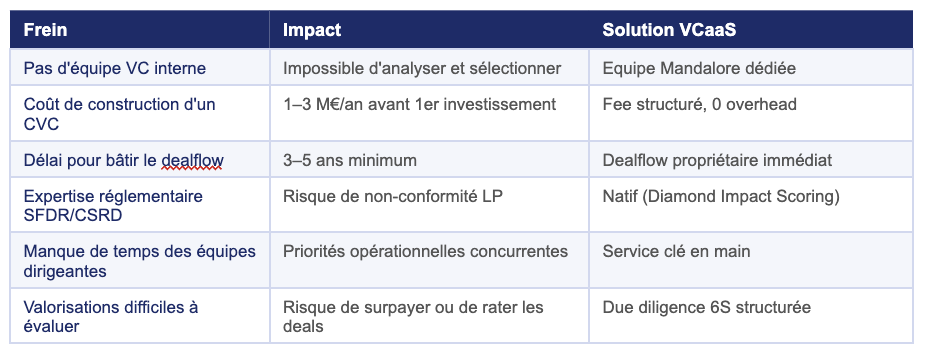
La croissance des startups InsurTech ne se construit pas seulement sur des idées brillantes, mais sur un soutien stratégique solide. Mandalore Partners propose un modèle VCaaS unique qui connecte les entrepreneurs aux ressources et investisseurs essentiels pour accélérer leur développement. Découvrez pourquoi ce soutien est devenu un levier incontournable pour toute startup cherchant à s’imposer dans la technologie de l’assurance.

Importance du Soutien Stratégique

Dans un monde où les startups se démarquent par leur innovation, le soutien stratégique devient leur principal moteur de succès. C'est particulièrement vrai dans le secteur de l'InsurTech, où la concurrence est rude et les attentes élevées.

Impact sur la Croissance des Startups

Les startups bénéficient d'un accompagnement qui dépasse le simple apport de capitaux. Imaginez une jeune entreprise qui, grâce à un partenaire stratégique, parvient à doubler son chiffre d'affaires en moins d'un an. Ce n'est pas seulement un rêve; c'est possible avec le bon soutien. En offrant des conseils avisés et un accès privilégié aux ressources, les startups peuvent naviguer plus facilement à travers les défis du marché. Un exemple concret : une startup InsurTech a pu accéder à un réseau d'experts qui lui a permis de perfectionner ses offres et de séduire de nouveaux clients rapidement.

Rôle dans le Secteur InsurTech

Dans le domaine de l'assurance, la rapidité d'exécution est cruciale. Le soutien stratégique permet aux startups de rester à la pointe des tendances et de répondre efficacement aux attentes des consommateurs. Pour les entreprises cherchant à se faire une place, comme le montre ce rapport, être agile et bien informé est essentiel. C'est ici que les partenariats stratégiques jouent un rôle clé, offrant aux entreprises la capacité d'anticiper et de s'adapter aux changements du marché.

Modèle VCaaS de Mandalore Partners

Mandalore Partners redéfinit le soutien aux startups avec son modèle VCaaS, assurant un accompagnement complet et adapté aux besoins spécifiques des entreprises.

Avantages pour les Startups InsurTech

Pour les startups InsurTech, bénéficier du modèle VCaaS de Mandalore Partners signifie accéder à un éventail de ressources précieuses. Ce modèle va au-delà de l'investissement financier, fournissant également un soutien stratégique qui s'adapte aux besoins uniques de chaque entreprise. Par exemple, une startup peut obtenir des conseils sur l'optimisation de ses processus opérationnels, ce qui peut entraîner une réduction des coûts de 20% et une meilleure rentabilité. En collaborant avec Mandalore, les entreprises ne reçoivent pas seulement un financement, mais un véritable partenariat stratégique.

Connecter les Ressources et les Investisseurs

L'un des principaux atouts de Mandalore Partners est sa capacité à connecter efficacement les startups avec des investisseurs et des ressources clés. Cela se traduit par un réseau solide qui permet aux entreprises de s'épanouir. Imaginez bénéficier d'une introduction directe à un groupe d'investisseurs passionnés par l'innovation en InsurTech, comme le souligne ce blog. Ce type de connexion peut transformer le potentiel d'une entreprise en succès tangible, facilitant l'accès aux marchés et accélérant la croissance.

Vers un Avenir Prometteur

Avec Mandalore Partners, l'avenir est synonyme de collaboration et de croissance. Le modèle VCaaS ouvre des voies nouvelles et passionnantes pour les startups InsurTech.

Encourager la Collaboration et le Partenariat

La collaboration est au cœur de l'approche de Mandalore Partners. En créant des partenariats stratégiques, ils favorisent un environnement où les startups peuvent prospérer ensemble. Les événements et workshops organisés par Mandalore permettent aux entrepreneurs de rencontrer des experts du secteur et d'autres startups, élargissant ainsi leur réseau et leurs perspectives. Ce sentiment de communauté et de partage d'idées est ce qui distingue Mandalore de ses concurrents, créant un écosystème où chacun a la possibilité de briller.

Opportunités de Croissance et d'Innovation

Dans l'univers en constante évolution de l'InsurTech, les opportunités d'innovation sont infinies. Mandalore Partners encourage les startups à explorer de nouvelles idées et à repousser les limites. Grâce à leur soutien, les entreprises peuvent non seulement s'adapter aux changements du marché mais aussi les anticiper. En s'appuyant sur des données récentes de l'industrie, comme celles trouvées dans cette analyse, les startups peuvent identifier des niches inexploitées et développer des solutions qui répondent réellement aux besoins des consommateurs.

Is There Still Room for Disruption in the European Insurance Market?

The European insurance landscape stands at a fascinating crossroads. While traditional players have dominated for centuries, a new wave of technological innovation is reshaping the very foundations of how insurance operates. The question isn't whether disruption is possible, it's whether incumbents will adapt fast enough to survive the transformation already underway.

The Digital Revolution is Just Beginning

The numbers tell a compelling story. The insurance technology market size in Europe is estimated to grow by USD 19.72 billion from 2024-2028, according to Technavio, with the market estimated to grow at a CAGR of almost 36.5% during the forecast period. This explosive growth signals that we're witnessing the early stages of a technological revolution, not its conclusion.

What makes this particularly striking is the stark contrast with traditional growth patterns. While the broader European insurance market maintains steady single-digit growth, insurtech is expanding at rates that would make Silicon Valley envious. This disparity reveals massive opportunities for companies willing to embrace digital-first approaches.

Where Traditional Models Show Vulnerability

European insurance has historically relied on intermediaries, complex underwriting processes, and lengthy claim settlements. These legacy systems create friction points that modern consumers increasingly refuse to tolerate. Consider the average home insurance claim in Germany, which can take 30-45 days to process through traditional channels, compared to digital-first insurers who promise resolution within 48 hours.

  • The protection gap presents another compelling opportunity. Climate change has created new risks that traditional models struggle to assess and price accurately. The insurance industry is transforming, driven by new tech, tax laws, and expectations, yet many European insurers remain reactive rather than proactive in addressing emerging risks like cyber threats and extreme weather events.

  • Young Europeans represent perhaps the largest untapped market. Digital natives aged 25-35 show significantly lower insurance penetration rates than previous generations at the same age, not because they don't need coverage, but because existing products don't align with their lifestyle and expectations. They demand instant quotes, transparent pricing, and seamless mobile experiences, areas where traditional insurers often fall short.

Successful Disruption Models Already Emerging

Several European companies have proven that disruption isn't just possible, it's profitable. Lemonade, while originally American, has successfully expanded into European markets by offering renters and homeowners insurance through an AI-powered platform that can process claims in seconds rather than weeks.

  • Sweden's Hedvig has revolutionized home and contents insurance by eliminating deductibles and offering transparent, flat-rate pricing. Their model shows how removing traditional insurance complexity can attract younger demographics who previously avoided coverage altogether.

  • In the UK, Zego has transformed commercial vehicle insurance by providing flexible, pay-as-you-go coverage for delivery drivers and ride-share operators. This micro-insurance model addresses the gig economy's unique needs, a market segment traditional insurers largely ignored.

Technology as the Great Enabler

Artificial intelligence and machine learning have matured to the point where they can now handle tasks that previously required human expertise. Modern AI can analyze satellite imagery to assess property damage, process natural language to understand claim descriptions, and detect fraud patterns with greater accuracy than human investigators.

  • IoT devices create unprecedented data streams that enable real-time risk assessment. A smart home system can prevent water damage by automatically shutting off pipes when leaks are detected, then instantly notify insurers to update coverage terms. This shift from reactive claim processing to proactive risk prevention represents a fundamental business model transformation.

  • Blockchain technology, while still emerging, promises to streamline multi-party insurance transactions and create tamper-proof claim histories. European regulatory frameworks like GDPR actually position the region well for blockchain adoption, as the technology aligns with data sovereignty requirements.

Regulatory Environment Creates Opportunities

European insurance regulation, often viewed as constraining innovation, actually creates moats for disruptors who can navigate compliance effectively. Solvency II requirements, while complex, establish trust frameworks that tech-savvy companies can leverage more efficiently than traditional insurers burdened by legacy systems.

  • The EU's Digital Single Market strategy actively encourages cross-border insurance innovation, making it easier for successful models to scale across the continent. This regulatory support contrasts sharply with the fragmented approach in other regions, giving European disruptors a significant advantage.

  • Open Banking regulations have also created precedents for data sharing that could extend to insurance. When customers can seamlessly share their financial and behavioral data with insurers, it enables more accurate risk assessment and personalized pricing, core advantages for innovative players.

The Path Forward

The European insurance market isn't just ripe for disruption, it's demanding it. Consumer expectations, technological capabilities, and regulatory frameworks have aligned to create an environment where innovative approaches can thrive. While investments in insurtech saw both deal volume and funding decline in 2023, this consolidation phase often precedes breakthrough innovations as the strongest players emerge.

The companies that will define the next decade won't be those trying to digitize existing processes, but those reimagining insurance from first principles. They'll use data to predict and prevent losses rather than just compensate for them. They'll create products that adapt to individual lifestyles rather than forcing customers into standardized categories. Most importantly, they'll build trust through transparency and speed rather than complexity and tradition.

The question facing European insurance isn't whether disruption will continue, it's whether established players will lead the transformation or be swept aside by it. For entrepreneurs and innovators, the answer is clear: the opportunities have never been greater, and the time to act is now.

Top 5 Insurtech Startups to Watch in 2025

The insurance technology sector is experiencing unprecedented growth, with artificial intelligence driving a fundamental transformation across the industry. According to Beinsure Data, 35 insurtech unicorns (>$1 bn) raised up to 2025 more than $20.2 bn venture capital with cumulative valuation ~$106 bn. More remarkably, the global artificial intelligence (AI) in insurance market size is projected to hit around USD 141.44 billion by 2034 from USD 8.13 billion in 2024 with a CAGR of 33.06%.

This explosive growth signals a paradigm shift where traditional insurance models are being disrupted by data-driven, customer-centric approaches. Here are the five insurtech startups positioned to lead this transformation in 2025.

1. Shift Technology: Revolutionizing Fraud Detection with AI

Shift Technology stands at the forefront of AI-powered insurance solutions, specializing in fraud detection and claims automation. The company's advanced AI solutions enable real-time fraud detection and automated claims handling, significantly boosting efficiency, accuracy, and cost savings for insurance providers worldwide.

What sets Shift Technology apart is their sophisticated machine learning algorithms that can identify fraudulent claims patterns in real-time, reducing false positives by up to 70% compared to traditional methods. Their platform processes over 78 million claims annually across 300+ insurance organizations globally, demonstrating the scalability and reliability of their AI infrastructure.


The company's recent expansion into predictive analytics for underwriting represents a natural evolution of their fraud detection capabilities, positioning them to capture additional market share in the risk assessment segment.

2. Altana AI: Leading the Equity Efficiency Revolution

Altana AI and Next Insurance lead among the winners, each having raised $1.6M in equity funding per employee. This remarkable capital efficiency metric highlights Altana AI's lean operational model and strong investor confidence in their technology platform.

Altana AI focuses on supply chain risk intelligence, providing insurers with unprecedented visibility into global trade networks and potential risk factors. Their AI-powered platform analyzes millions of supply chain data points to predict disruptions, enabling insurers to price policies more accurately and reduce claims volatility.

The startup's proprietary algorithms can identify hidden connections between suppliers, manufacturers, and distributors, creating comprehensive risk profiles that traditional assessment methods miss. This capability is particularly valuable for commercial insurance lines, where supply chain disruptions can trigger massive claims events.

3. INARI: Blockchain-Powered Insurance Management

Spanish startup INARI provides a cloud-based blockchain platform for end-to-end insurance management. The platform's machine learning (ML) algorithms utilize a broad variety of insurance data to provide automated insurance operations, from quotation to portfolio management.

INARI's innovative approach combines blockchain transparency with AI efficiency, creating a seamless insurance ecosystem that reduces operational costs by up to 40%. Their platform enables real-time policy adjustments based on risk changes, automated claims processing, and transparent premium calculations.

The company's focus on emerging markets, particularly in Latin America and Southeast Asia, positions them to capture the growing demand for digital insurance solutions in regions with traditionally underserved populations. Their mobile-first approach and multilingual capabilities make insurance accessible to previously untapped demographic segments.

4. Coterie Insurance: Small Business Insurance Reimagined

Coterie Insurance is a pioneering insurtech startup that is revolutionizing the way small businesses access and manage insurance. Founded in 2018, Coterie leverages cutting-edge technology and data analytics to streamline the insurance process.

  • Coterie's AI-driven platform can generate customized business insurance quotes in under 60 seconds, compared to the industry average of 2-3 days. Their technology analyzes over 500 data points per business, including social media presence, online reviews, and financial indicators, to create accurate risk profiles without lengthy application processes.

  • The startup's focus on underserved small business segments, particularly in professional services and e-commerce, addresses a $50+ billion market opportunity. Their API-first architecture enables seamless integration with business management platforms, creating embedded insurance experiences that feel natural to modern entrepreneurs.

5. Loovi: Vehicle Intelligence and Fleet Management

Brazilian insurtech Loovi represents the next generation of specialized insurance technology. Brazilian insurtech Loovi raised US$9 million in funding from prominent investors Marçal Holding and Oliveira Participações. Specialising in vehicle tracking, security, theft warranty, and fleet management services, Loovi, which was founded by Quézide Cunha and William Naor, aims to transform vehicle insurance through IoT integration and real-time monitoring.

  • Loovi's comprehensive platform combines telematics, AI-powered risk assessment, and proactive theft prevention to reduce vehicle insurance claims by up to 35%. Their IoT sensors provide real-time vehicle health monitoring, predictive maintenance alerts, and immediate theft response capabilities.

  • The company's expansion into fleet management services creates additional revenue streams while providing deeper insights into commercial vehicle operations. This data advantage enables more accurate pricing models and proactive risk management strategies.

The Agentic AI Revolution

  • AI adoption will climb in 2025, with agentic AI platforms becoming essential. These systems will handle complex tasks independently alongside human workers, redefining workflows and client interactions. This technological evolution represents a fundamental shift from reactive to proactive insurance services.

  • Agentic AI systems will autonomously adjust policies based on real-time risk changes, initiate claims processing upon detecting incidents, and provide personalized risk mitigation recommendations to policyholders. This level of automation and personalization will become the new standard for competitive insurtech companies.

Market Outlook and Investment Trends

  • The insurtech sector's resilience is evident in recent funding patterns. Q3 2024 closed with an investment in insurtech of $3.2 bn, 7% less than in 2023. However, the trend is positive and suggests a rebound in funding activity as investors recognize the long-term potential of AI-powered insurance solutions.

  • Forty-one of the 50 winners have a CB Insights Mosaic score, a proprietary measure of private company health and growth potential, of at least 700 out of 1,000, indicating strong fundamentals across leading insurtech companies.

Final Thoughts 

The insurtech landscape in 2025 is characterized by AI-first platforms that prioritize customer experience, operational efficiency, and predictive capabilities. These five startups represent different aspects of the insurance value chain transformation: fraud detection, risk intelligence, blockchain integration, small business solutions, and IoT-enabled vehicle services. The future of insurance lies in the hands of these innovative startups that understand the power of data, artificial intelligence, and customer-centric design. As the industry continues its digital transformation, these companies are not just adapting to change, they're driving it.

Pourquoi les insurtechs attirent autant les investisseurs ?

L’assurance n’a jamais été un secteur synonyme d’innovation rapide. Pourtant, depuis quelques années, les startups de l’insurtech bouleversent ce paysage traditionnel avec des approches digitales, agiles et centrées sur l’expérience utilisateur. Résultat : elles attirent des milliards d’euros d’investissement à travers le monde, et l’Europe n’est pas en reste.

Mais qu’est-ce qui rend les insurtechs si séduisantes aux yeux des investisseurs ? Voici les raisons clés.

Un marché colossal en attente de disruption

Le secteur de l’assurance représente des milliers de milliards d’euros de primes chaque année, avec une forte concentration d’acteurs historiques. C’est un marché immense, mais souvent lent, opaque et peu centré sur le client. Pourtant, l’insurtech connaît une croissance rapide : en 2023, les investissements mondiaux dans ce secteur ont dépassé les 4 milliards de dollars, malgré un contexte macroéconomique difficile. 

Cette dynamique s’est poursuivie en 2024, avec plus de 1,4 milliard de dollars levés au premier semestre, signe d’un intérêt soutenu des investisseurs pour des acteurs capables de digitaliser et transformer un marché encore largement traditionnel. Comme la fintech avant elle, l’insurtech promet d’ouvrir un secteur longtemps verrouillé à l’innovation, attirant ainsi des capitaux à la recherche de nouvelles opportunités de croissance.

Une transformation digitale enfin lancée

Les consommateurs veulent désormais souscrire, gérer et résilier leurs contrats d’assurance en ligne, en quelques clics. Les insurtechs répondent à cette attente avec des interfaces intuitives, des tarifs transparents, et parfois même une personnalisation en temps réel.

En automatisant les processus, en utilisant l’intelligence artificielle pour l’évaluation des risques ou le traitement des sinistres, ces startups réduisent drastiquement les coûts d’exploitation. Un levier très attractif pour les investisseurs en quête de rentabilité.

Des modèles hybrides et scalables

Les insurtechs n’ont pas toutes le même modèle. Certaines créent leurs propres produits d’assurance en tant que porteurs de risque, d’autres s’associent à des assureurs traditionnels pour distribuer des offres sous marque blanche, ou encore proposent des infrastructures tech en marque grise (B2B).

Ce niveau de flexibilité permet d’adapter le modèle économique à chaque marché local, tout en gardant une ambition d’expansion rapide à l’international. Les investisseurs apprécient ces modèles scalables, capables de croître sans exploser les coûts.

Un alignement avec les nouvelles attentes sociétales

Les jeunes consommateurs veulent des services simples, accessibles, et plus transparents, mais aussi des entreprises qui partagent leurs valeurs. De nombreuses insurtechs proposent des assurances à impact : mobilité douce, assurance santé mentale, couverture pour freelances, micro-assurance pour les populations exclues…

Ces approches rendent l’assurance plus inclusive et plus moderne, ce qui séduit non seulement les clients finaux mais aussi les fonds à impact ou les family offices sensibles aux enjeux sociétaux.

Des exemples de succès qui rassurent le marché

Des startups comme Alan (France), Wefox (Allemagne) ou Zego (Royaume-Uni) ont levé des centaines de millions d’euros ces dernières années. Elles prouvent que le modèle fonctionne, et qu’il est possible de combiner croissance rapide et innovation réglementée.

Ces success stories créent un effet d’entraînement : en voyant d’autres fonds entrer au capital, de nouveaux investisseurs veulent aussi prendre position tôt dans les prochaines pépites du secteur.

Une réglementation de plus en plus ouverte à l’innovation

Les régulateurs européens sont de plus en plus ouverts à l’expérimentation, notamment via des "sandboxes réglementaires" qui permettent aux insurtechs de tester de nouveaux produits en conditions réelles tout en restant encadrées.

Cela réduit le risque juridique pour les investisseurs et accélère la mise sur le marché des nouvelles offres. Un cadre qui rend l’investissement plus sûr et plus prévisible.

Conclusion : une vague structurelle, pas un effet de mode

L’insurtech n’est pas une simple tendance. C’est une réponse stratégique à un besoin profond de transformation dans un secteur clé de l’économie. Elle combine les ingrédients que les investisseurs recherchent : taille de marché, inefficience à corriger, technologies différenciantes, scalabilité, impact social, et exemples concrets de croissance.

Dans les années à venir, les insurtechs les plus solides pourraient bien devenir les nouveaux géants de l’assurance. Et pour les investisseurs, c’est maintenant qu’il faut être à bord.

Major Insurtech Trends: AI, Personalization, Automation

The global insurance sector is undergoing a seismic shift. As customer expectations evolve and digital technologies mature, insurtech companies are leading the charge in transforming how insurance is designed, delivered, and experienced.

At the heart of this revolution are three powerful forces: Artificial Intelligence (AI), hyper-personalization, and automation. These trends are not just buzzwords, they are redefining the insurance landscape in 2025 and beyond.

AI takes over risk assessment and claims processing

Artificial intelligence is becoming a core enabler for smarter, faster, and more scalable insurance operations. Insurtechs are using AI to:

  • Analyze real-time customer data to generate more accurate risk profiles

  • Detect fraudulent claims through pattern recognition and anomaly detection

  • Automate underwriting with machine learning models trained on massive datasets

  • Power chatbots that handle routine claims and customer service with minimal human intervention

By 2025, AI will no longer be a “nice-to-have”, it will be a competitive necessity for both startups and incumbents.

Hyper-personalization is the new standard

The age of one-size-fits-all insurance products is over. Today’s consumers expect coverage tailored to their lifestyle, behavior, and needs - and insurtechs are delivering.

Using data from connected devices, social platforms, wearables, and spending habits, insurtech platforms can:

  • Offer usage-based insurance (e.g., pay-as-you-drive car insurance)

  • Tailor recommendations in real time, such as micro-policies for short-term travel or freelance work

  • Adapt coverage dynamically as a customer’s circumstances evolve

This level of personalization leads to higher customer retention, lower churn, and better alignment between risk and premium.

Automation streamlines the entire insurance lifecycle

Insurtechs are pushing automation across the board, from customer onboarding to claims disbursement. Key developments include:

  • Instant quotes generated by digital platforms using AI-powered rules engines

  • Self-service portals where users can buy, manage, and renew policies online

  • Automated claims payouts, sometimes settled within minutes using smart contracts or pre-validated data

Automation reduces operational costs, eliminates friction, and frees up human agents to focus on high-value interactions.

Embedded insurance gains ground

Closely tied to automation is the rise of embedded insurance; coverage seamlessly offered at the point of need, integrated into platforms like e-commerce checkouts, car rental apps, or fintech services.

This trend is set to reshape distribution models, enabling insurtechs to reach customers who may never have actively sought out a policy.

Data-driven innovation fuels inclusive growth

With AI and automation unlocking new types of data, insurtechs can serve previously “uninsurable” populations, especially in emerging markets. Behavioral data and alternative credit scoring models are helping design inclusive insurance products for gig workers, rural communities, or informal sectors.

This shift represents not only a business opportunity but also a social innovation frontier.

Conclusion: Insurtech is redefining the rules of the game

As we move further into 2025, the most successful insurtechs will be those that blend AI intelligence, customer-centric personalization, and end-to-end automation into a seamless experience.

Traditional insurers that fail to adapt will struggle to stay relevant, while agile, tech-savvy players will set the standard for what modern insurance looks like: proactive, digital-first, and deeply human in impact.

Les tendances Insurtech à suivre en 2025

Le secteur de l’assurance vit une transformation profonde portée par la technologie. En 2025, les insurtechs ne se contenteront plus de numériser les processus existants : elles réinventeront l’ensemble de la chaîne de valeur, de la souscription à la gestion des sinistres.

Voici les 6 grandes tendances à surveiller pour comprendre où va l’innovation dans l’assurance.

1. L’intelligence artificielle devient le moteur principal de l’automatisation

L’IA est désormais au cœur des modèles insurtech. En 2025, elle sera utilisée à toutes les étapes : évaluation des risques, détection de fraude, gestion des sinistres, tarification dynamique.

Par exemple, AXA France a développé, avec Microsoft, une plateforme interne baptisée AXA Secure GPT. Basée sur l’IA générative, elle permet d’ajuster les offres aux antécédents médicaux ou au mode de vie : services de prévention personnalisés ou offres santé ciblées.

De leur côté, des startups comme Shift Technology utilisent l’IA pour détecter des fraudes en analysant des millions de transactions.

Les assistants conversationnels intelligents réduisent aussi les délais de traitement, offrent un support 24h/24, et améliorent l’expérience client de bout en bout.

2. L’assurance embarquée s’impose comme nouveau standard

L’assurance ne se vend plus, elle s’intègre. En 2025, le modèle de l’assurance embarquée ("embedded insurance") devient la norme, proposée automatiquement au bon moment — lors de l’achat d’un téléphone, d’un voyage ou d’un service.

Exemples notables :

  • AppleCare propose une couverture dès l’achat d’un appareil Apple.

  • Booking.com intègre des options d’assurance voyage au moment du paiement.

  • Stripe propose aux commerçants d’offrir une assurance à leurs clients via son API.

Cette intégration contextuelle permet d’atteindre des clients qui n’auraient pas souscrit à une assurance classique.

3. Des modèles d’abonnement plus flexibles pour répondre aux nouveaux usages

Avec l’évolution des modes de vie (freelance, mobilité, économie à la demande), les clients attendent plus de flexibilité. En 2025, les insurtechs proposent des formules à la carte ou par abonnement, facilement activables ou désactivables via une app.

La startup française Luko permet par exemple de suspendre son assurance habitation quand on est en déplacement prolongé.

Ces offres s’inspirent des standards de consommation modernes (Netflix, Spotify), et séduisent particulièrement les générations Z et milléniales.

4. Une assurance plus inclusive, portée par la donnée alternative

Les données alternatives issues des objets connectés, réseaux sociaux ou plateformes de mobilité ouvrent de nouvelles perspectives.

La startup Pula, active en Afrique, utilise les données météo et agricoles satellitaires pour assurer les petits agriculteurs, jusque-là exclus des produits classiques.

Autre exemple : Zego, au Royaume-Uni, propose des assurances flexibles pour les livreurs ou chauffeurs VTC, en s’appuyant sur des données d’usage en temps réel (heures de conduite, distance parcourue).

Ces modèles permettent une inclusion assurantielle plus large, notamment dans les économies émergentes.

5. Un écosystème de partenariats plus stratégique

Les insurtechs ne visent plus à remplacer les assureurs traditionnels, mais à collaborer avec eux. En 2025, les partenariats stratégiques deviennent un levier clé : startups agiles + acteurs établis + géants technologiques.

Par exemple :

  • Swiss Re collabore avec des insurtechs pour co-développer des produits.

  • Generali noue des alliances avec des acteurs de la healthtech pour enrichir ses offres santé.

  • Des acteurs cloud comme AWS ou Azure fournissent l’infrastructure sécurisée des nouvelles plateformes insurtech.

Ces synergies favorisent l’innovation tout en garantissant la solidité réglementaire et financière.

6. La blockchain gagne du terrain dans la gestion des sinistres

En matière de transparence et d’automatisation, la blockchain apporte des solutions puissantes.

Des startups comme Etherisc ou Chainlink expérimentent les smart contracts pour des assurances paramétriques : retard de vol, aléa météo, hospitalisation… L’indemnisation est automatique dès qu’un événement validé est détecté.

Bien que cette technologie reste marginale, elle se développe notamment dans les micro-assurances et les marchés émergents, où la rapidité et la confiance sont essentielles.

Conclusion : une assurance plus intégrée, intelligente et centrée sur l’utilisateur

En 2025, les insurtechs redéfinissent les règles du jeu. IA, personnalisation, intégration fluide, inclusion… l’assurance devient proactive, flexible et contextuelle.

Les compagnies traditionnelles devront s’adapter à ces standards ou risquer de perdre en compétitivité. Car plus que la technologie elle-même, c’est l’expérience utilisateur qui devient le nouvel avantage concurrentiel.

Why Traditional Insurance Companies Should Embrace Venture Studios: Insights from Mandalore Partners

The insurance industry, traditionally characterized by caution and risk aversion, is facing unprecedented challenges from technological advancements and changing consumer expectations. To remain competitive, insurance companies must innovate—and venture studios offer a compelling pathway.​

The Need for Innovation in Insurance

Emerging technologies, such as artificial intelligence and blockchain, are disrupting traditional insurance models. Consumers now demand personalized, digital-first experiences, and new entrants are capitalizing on these trends. To keep pace, insurers must explore innovative solutions.​

Mandalore Partners provides a Venture Capital-as-a-Service (VCaaS) model that enables insurance companies to incubate startups focused on insurtech solutions. This approach allows insurers to experiment with new products and distribution channels without disrupting core operations.​

Real-World Applications: Success Stories

Several insurance companies have successfully engaged with venture studios:​

  • AmFam Ventures: Developed by American Family Insurance, this venture studio focuses on insurtech innovations, providing both minority investments and majority ownership in startups to better serve stakeholders.

  • ARK Venture Studio: Combining a venture studio, think tank, and venture fund, ARK builds insurance-enabled businesses to tackle systemic risks to people and the planet.

Strategic Advantages for Insurers

Engaging with a venture studio offers multiple benefits:​

  • Accelerated Innovation: Rapid development of new products and services.​

  • Risk Management: Controlled experimentation minimizes potential disruptions.

  • New Revenue Streams: Venture studios allow exploration of adjacent business models.

  • Future-Proofing: Adapting to tech shifts before they become industry standards.

For insurers looking to thrive in a fast-evolving landscape, venture studios represent not just a trend—but a strategic imperative.