From Capital to Compounding: Why Long‑Term Value Creation Wins in Venture Capital

Most venture capital focuses on quick exits, but that approach often leaves value on the table. You want to build companies that last and grow steadily, not just flip for a fast return. Long-term value creation in venture capital demands a patient, hands-on approach—one that combines capital with active involvement in governance, unit economics, and customer lifetime value. This article explains how adopting this mindset helps founders and investors create sustainable growth and why Mandalore Partners’ operator-investor model leads the way. For further insights, visit this resource.

Long-Term Value Over Short-Term Gains

Most investors chase quick exits, hoping to flip companies for fast returns. This short-sighted strategy often misses out on potential value. Long-term strategies, however, focus on building lasting success.

The Pitfalls of Quick Exits

Quick exits might seem appealing at first. They promise fast cash and less commitment. But what happens when you rush to sell? Often, the true potential of a company is overlooked. You miss the chance to nurture growth and solidify market position. When investors push for a fast sale, they might also ignore red flags. This can lead to problems for both founders and future investors. Rushing can also cause poor decision-making, leaving you with regrets later on.

In contrast, holding on to a company allows you to refine and polish its offerings. You can build strong customer relationships and develop a solid reputation. This approach is about patience and nurturing, which pays off significantly in the long run.

Benefits of Patient Capital

Patient capital involves giving a business the time it needs to grow. It’s about investing in the future, rather than seeking immediate payoffs. This approach helps companies build strong foundations. By focusing on the long-term, you can create sustainable growth. Companies can innovate, adapt, and thrive without the pressure of quick returns.

Patient investors also gain deeper insights into the market. They understand trends and can guide companies through challenges. 80% of businesses that focus on long-term growth see increased success compared to those seeking quick exits.

In the end, patience leads to stronger, more resilient companies. With a stable foundation, these businesses become industry leaders and set new standards.

Levers of Value Creation

After understanding the merits of patience, it's crucial to know how to create value. This involves focusing on key areas that drive growth and stability.

Importance of Governance and Unit Economics

Good governance sets clear rules and guidelines. It ensures that a company runs smoothly. With strong governance, businesses can avoid pitfalls and stay on track. It’s about setting the right policies and monitoring progress.

Unit economics is another vital aspect. By understanding costs and profits at a basic level, companies can make smarter decisions. This data helps in forecasting and planning. For example, knowing the cost to acquire a customer versus the revenue they bring is essential.

When these elements align, you create a roadmap for success. Companies with strong governance and good unit economics tend to outperform those without. They become attractive to investors and have the potential for higher growth.

Enhancing Customer Lifetime Value and Sustainable Growth

Customer lifetime value (CLV) measures the revenue a customer brings over time. Enhancing CLV means focusing on retaining customers and increasing their value. This involves delivering exceptional service and building loyalty.

Sustainable growth is about steady, continuous improvement. It’s not just about expanding rapidly but doing so in a way that lasts. This approach requires balancing growth with the resources available.

A company that focuses on both CLV and sustainable growth is well-positioned for the future. They can weather market changes and emerge stronger. By investing in these areas, businesses build a loyal customer base and ensure long-term success.

Mandalore Partners’ Hybrid Model

Mandalore Partners stands out by combining investment with hands-on support. This unique model bridges the gap between capital and execution.

Operator-Investor Approach in Venture Capital

Mandalore Partners isn't just about funding. They take an active role in the businesses they invest in. This operator-investor model ensures that companies receive the guidance they need. Instead of leaving founders to navigate challenges alone, Mandalore Partners steps in as a partner.

This approach focuses on collaboration. By working closely with companies, Mandalore Partners helps refine strategies and optimize operations. They bring industry expertise and insights that can drive growth.

Through this model, businesses gain more than just financial backing. They receive a partner committed to their success. For more about this approach, explore this resource.

Hands-On Support and Aligned Incentives

At the heart of Mandalore Partners’ success is their commitment to hands-on support. They don’t just invest and move on; they stay involved. This support ranges from operational advice to strategic planning.

Aligned incentives mean that both Mandalore Partners and the companies they invest in share common goals. By aligning interests, both parties work towards the same objectives. This unity creates a harmonious relationship that fosters growth.

Hands-on support combined with aligned incentives results in a powerful partnership. Companies feel supported and empowered, knowing they have a dedicated partner by their side. This approach transforms ventures into thriving businesses ready to take on future challenges.

By focusing on long-term value creation, Mandalore Partners sets a new standard in venture capital, proving that patience and partnership lead to lasting success.
Stablecoins et Tokenisation des Liquidités : Le Point d'Inflexion de 2025 pour les Paiements Globaux

Introduction : La fin du statu quo bancaire

Le débat sur l'utilité des stablecoins est clos. Avec 250 milliards de dollars en circulation (une hausse de 100 % en 18 mois) et un volume transactionnel annuel dépassant les 27 000 milliards de dollars, la tokenisation des liquidités n'est plus une expérimentation marginale. C'est une menace existentielle pour l'infrastructure de paiements legacy qui n'a pas fondamentalement évolué depuis l'avènement de SWIFT.

Pourtant, ces volumes représentent encore moins de 1 % des flux monétaires globaux. Le potentiel de capture de valeur est donc immense. Nous sommes à l'aube d'un basculement structurel, catalysé par une clarification réglementaire sans précédent (MiCA en Europe, GENIUS Act aux USA) et une maturité technologique enfin atteinte.

Pour le Capital-Risque (VC) et les institutions financières, l'équation est simple : l'upside réside dans une infrastructure 24/7, un règlement instantané et une réduction drastique des coûts. Le risque, lui, se déplace de la volatilité technologique vers la conformité et la custody. Ce rapport analyse pourquoi 2025 est l'année pivot.

1. État du Marché des Stablecoins en 2025-2026

Le marché est dominé par un duopole de fait, mais la dynamique concurrentielle s'accélère. Sur les 250 milliards de dollars de capitalisation totale :

  • Tether (USDT) capture environ 155 milliards de dollars, dominant les marchés émergents et le trading.

  • Circle (USDC) sécurise 60 milliards de dollars, s'imposant comme le standard institutionnel et régulé.

En termes de flux, les stablecoins traitent quotidiennement entre 20 et 30 milliards de dollars de transactions réelles (hors trading haute fréquence). Si l'on compare cela aux 5 000 à 7 000 milliards traités quotidiennement par l'infrastructure legacy, la marge de progression est colossale. La croissance est exponentielle : les projections indiquent une capitalisation de 400 milliards de dollars fin 2025 et 2 000 milliards d'ici 2028.

📊 Données Clés

Mathieu Charret, Mon Livret C : "Avec des volumes de transactions en stablecoins qui surpassent désormais ceux du réseau Visa, la blockchain s'impose comme une infrastructure technologique majeure pour le transfert et la conservation de valeur. Face à cette adoption, les architectures financières traditionnelles doivent progresser."

Asymétrie USD vs EUR : Le marché des stablecoins est massivement dominé par le dollar. Les stablecoins en dollars (USDT + USDC) représentent environ 240Md$ sur les 250Md$ totaux, tandis que les stablecoins en euros peinent à dépasser 200M$ de capitalisation totale. Ce rapport de 1:1200 illustre l'hégémonie du dollar tokenisé et le défi colossal pour toute alternative européenne.

2. Proposition de Valeur vs Infrastructures Legacy

Les Pain Points Structurels des Rails Traditionnels

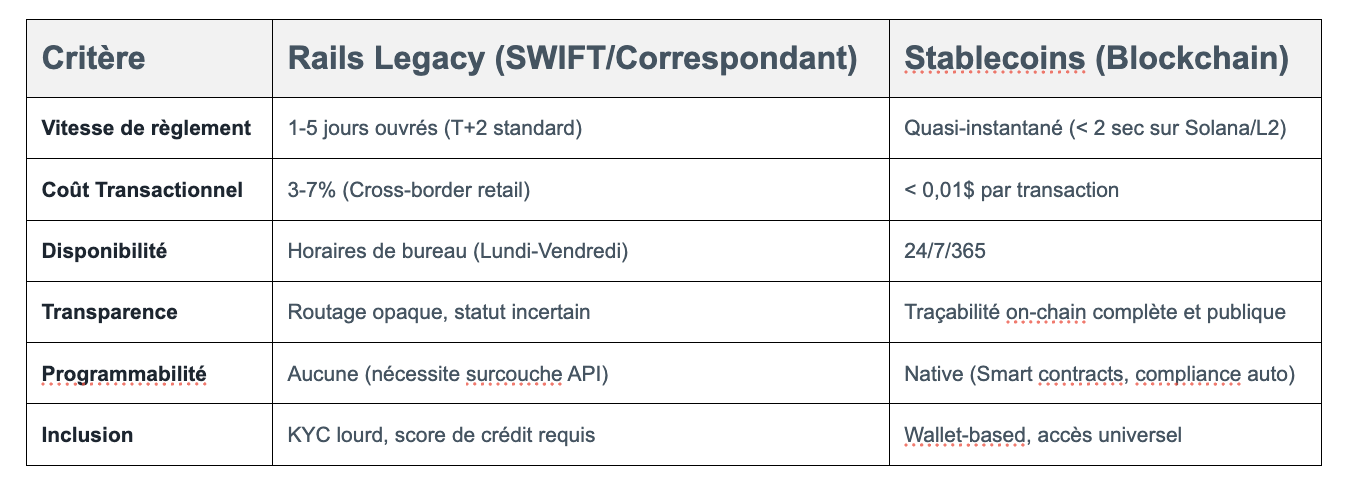
L'infrastructure bancaire actuelle (Correspondant Banking, SWIFT) souffre de frictions incompressibles liées à son architecture en batch-processing :

  • Délais : 1 à 5 jours ouvrés pour un règlement final cross-border.

  • Coûts : Empilement de frais intermédiaires et de change.

  • Disponibilité : Limitée aux horaires d'ouverture bancaires.

  • Exclusion : 1,7 milliard de personnes restent non-bancarisées en raison de coûts d'entrée prohibitifs.

L'Avantage Asymétrique des Stablecoins

La tokenisation ne se contente pas d'améliorer le système existant ; elle le remplace par une architecture supérieure.

3. Les 4 Catalyseurs de l'Inflexion 2025

1. Clarification Réglementaire Globale

Le risque réglementaire, jadis frein principal, devient un catalyseur. En Europe, le règlement MiCA (Markets in Crypto-Assets) impose désormais des audits stricts et des exigences de réserves, assainissant le marché. Aux USA, le GENIUS Act vise à établir une supervision fédérale pour garantir la parité dollar. En Asie (Singapour, Hong Kong, Japon), les licences pour émetteurs de stablecoins intègrent nativement les contrôles AML/KYC on-chain. Pour les VC, cela signifie une chose : le capital institutionnel a désormais le feu vert pour entrer.

2. Maturité Technologique (Infratech)

L'infrastructure a franchi le cap de la scalabilité. Les blockchains de nouvelle génération (Solana, Avalanche) et les Layer 2 sur Ethereum (Arbitrum, Base) offrent des frais négligeables. Parallèlement, la sécurité des wallets institutionnels (MPC, gestion de clés hardware) et les outils d'analytics (Chainalysis, TRM Labs) permettent une compliance en temps réel supérieure aux systèmes bancaires.

3. Adoption Institutionnelle Massive

Les incumbents ne combattent plus la technologie, ils l'adoptent :

  • JPMorgan traite plus d'1 milliard de dollars par jour via JPM Coin.

  • Le Canton Network fédère Goldman Sachs, UBS et Citibank autour d'actifs tokenisés.

  • Les banques centrales multiplient les projets concrets : Project Guardian (Singapour), mBridge (Chine-UAE) et Helvetia (Suisse).

4. L'Émergence des Yield-Bearing Tokens

C'est la disruption ultime du modèle de dépôt bancaire. Des fonds tokenisés comme BlackRock BUIDL ($2,9Md), Franklin BENJI ($0,8Md) ou Ondo USDY permettent d'utiliser des parts de fonds monétaires comme moyen de paiement liquide. L'argent dormant rapporte désormais du rendement en temps réel, sans verrouillage.

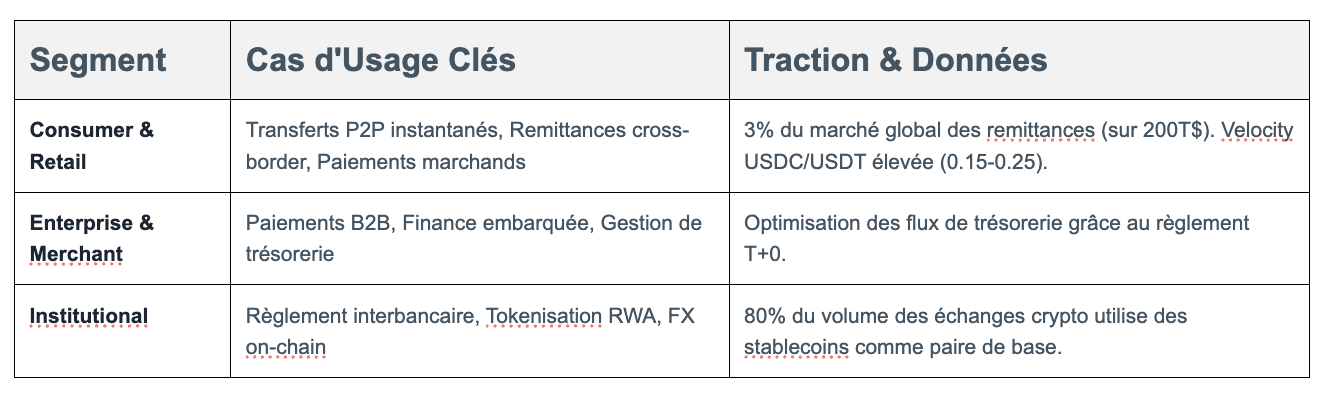
4. Cartographie des Cas d'Usage et Traction

L'utilisation des stablecoins se diversifie bien au-delà du trading crypto.

5. Matrice de Risques et Limites Opérationnelles

Analyse Critique des Risques

Si l'opportunité est massive, ignorer les risques structurels et les limites pratiques serait une erreur fatale pour tout investisseur. L'écosystème stablecoin reste immature sur plusieurs dimensions critiques.

  • Risques Opérationnels : Le risque de de-pegging persiste si la transparence des réserves n'est pas totale. La custody reste le point de défaillance unique (SPOF) critique.

  • Risques Juridiques : En cas de faillite de l'émetteur, les détenteurs sont souvent des créanciers non sécurisés. Le statut juridique du "droit de rachat" reste à tester devant les tribunaux.

  • Risques Systémiques : Une concentration excessive (Tether + Circle = 85% du marché) crée un risque de contagion. De plus, la fuite des dépôts vers les stablecoins menace le modèle de financement traditionnel des banques commerciales.

  • Friction d'adoption B2B : Convaincre un partenaire commercial d'accepter des paiements en stablecoins reste un défi majeur. Les départements financiers traditionnels préfèrent les rails bancaires connus, même imparfaits. La résistance au changement comptable et fiscal ralentit l'adoption.

  • Coûts d'off-ramp prohibitifs : Convertir des stablecoins en monnaie fiduciaire peut coûter entre 0,5% et 2% selon les volumes et les plateformes. De plus, des limites de volume s'appliquent souvent (plafonds journaliers/mensuels), rendant difficile la liquidation de montants importants sans friction.

  • Centralisation des blockchains : Contrairement au narratif de décentralisation, la plupart des blockchains supportant les stablecoins (Solana, BNB Chain, même Ethereum via ses Layer 2) reposent sur un nombre limité de validateurs. Cette centralisation crée des risques de censure et de point de défaillance unique.

  • Rendement et culture du risque : Les plateformes offrant du rendement sur stablecoins (DeFi lending, yield farming) manquent souvent de maturité en gestion de risque. Les effondrements comme celui de Terra/Luna ou de FTX ont montré la fragilité des protocoles sous-collatéralisés. Les curateurs institutionnels commencent tout juste à développer une vraie culture prudentielle.

5.5. Le Bras de Fer Géopolitique : États vs Banques Commerciales

Un enjeu stratégique majeur se joue en arrière-plan : qui contrôlera l'infrastructure monétaire tokenisée ?

Position des États : Stablecoins comme Outil de Financement Souverain

Les gouvernements, notamment aux États-Unis, voient dans les stablecoins une opportunité de refinancer leur dette ad infinitum. En imposant que les stablecoins soient adossés à des obligations d'État (T-bills), ils créent une demande structurelle massive pour leur dette souveraine. Chaque dollar tokenisé devient ainsi un vecteur de financement de la dette américaine, générant des milliards de revenus d'intérêts pour le Trésor américain.

Le GENIUS Act pousse explicitement dans cette direction : exiger que les réserves soient investies en actifs "sûrs et liquides", c'est-à-dire principalement des obligations d'État. Résultat : les émetteurs de stablecoins deviennent de facto des acheteurs captifs de dette publique.

Contre-Offensive des Banques : Tokenized Deposits et Réserves Fractionnaires

Les banques commerciales, menées par JPMorgan (JPM Coin), Citi, et les consortiums comme le Canton Network, défendent un modèle différent : les tokenized deposits (tokens de dépôts bancaires).

Contrairement aux stablecoins régulés qui exigent 100% de réserves, les tokens de dépôts fonctionnent comme des comptes bancaires classiques : ils restent éligibles au modèle de réserves fractionnaires. Les banques peuvent donc continuer à prêter la majorité des fonds déposés, préservant leur modèle économique traditionnel.

Ce bras de fer est passionnant car il redéfinit la structure du système monétaire : d'un côté, des États qui cherchent à capter le flux de financement via des stablecoins "pleins"; de l'autre, des banques qui veulent maintenir leur rôle d'intermédiaire et leur capacité à créer du crédit via les dépôts tokenisés.

⚖️ Implications Stratégiques

Pour les investisseurs, ce conflit est déterminant. Si les stablecoins régulés l'emportent, la valeur se concentrera chez les émetteurs (Circle, Tether) et les gestionnaires de réserves (BlackRock). Si les tokenized deposits dominent, les banques traditionnelles conserveront leur position dominante et limiteront l'émergence de nouveaux acteurs.

La réglementation MiCA en Europe et le GENIUS Act aux USA penchent aujourd'hui en faveur des stablecoins à réserves pleines, mais la pression du lobby bancaire reste intense. Surveillez de près les amendements législatifs et les positions de la BCE et de la Fed.

6. Implications Stratégiques pour Investisseurs et Institutions

Positionnement VC : Où Déployer le Capital ?

L'argent intelligent ne chasse pas seulement les émetteurs, mais l'infrastructure qui les rend utilisables :

  • Infrastructure (Pelles et Pioches) : Custody institutionnelle, portefeuilles MPC, analytics on-chain et compliance. C'est ici que se construisent les douves (moats) technologiques.

  • Payment Rails : Fintechs intégrant nativement les stablecoins pour le B2B (ex: SAP, PayPal).

  • Yield-Bearing Instruments : Les fonds monétaires tokenisés représentent le futur de la gestion de trésorerie corporate.

  • Corridors Cross-Border : Focus géographique sur les corridors Europe ↔ Asie du Sud-Est (Singapour, Vietnam, Indonésie) où la friction bancaire est maximale.

Unit Economics et Capture de Valeur par Acteur

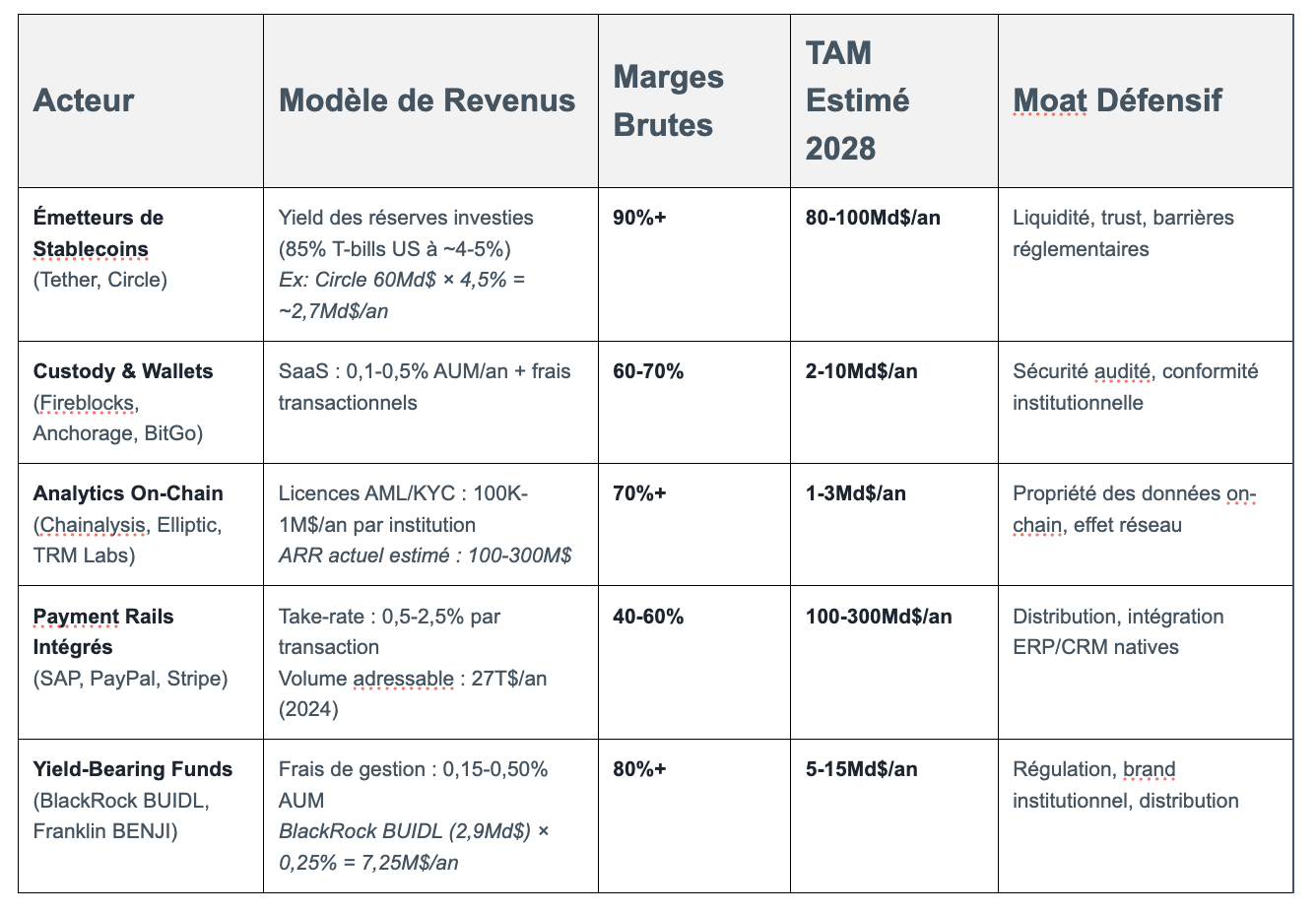
La question fondamentale pour tout investisseur : où se capte réellement la valeur dans l'écosystème stablecoin ? Contrairement aux idées reçues, ce ne sont pas uniquement les émetteurs qui génèrent des revenus massifs. L'infrastructure autour des stablecoins offre des marges SaaS élevées avec moins de risque systémique.

📊 Perspective Critique VC

Upside maximum : Les émetteurs (Circle, Tether) capturent l'essentiel de la valeur via le float des réserves. Mais ce sont des business winner-takes-most avec un risque réglementaire et de concentration élevé.

Meilleur risque/rendement : L'infrastructure (custody, analytics, payment rails) offre des marges SaaS élevées (60-70%) avec moins de risque systémique. C'est ici que se joue le dealflow intelligent pour un fonds early-stage.

Piège à éviter : Ne pas investir dans des stablecoins "me-too" sans liquidité ni différenciation réglementaire. Le marché est un winner-takes-most, et sans 10Md$ de circulation minimum, l'utilité est nulle.

Roadmap pour les Banques

Le temps de l'observation est révolu. Les banques doivent choisir leur modèle de participation :

  1. Tier 1 : Lancer un stablecoin propriétaire (difficile à scaler hors réseau interne).

  2. Tier 2 : Rejoindre un consortium pour mutualiser la liquidité.

  3. Regional Banks : S'appuyer sur des fournisseurs technologiques (Fiserv, FIS) ou partenariats avec émetteurs globaux (Circle) pour ne pas être désintermédiées.

7. Les 6 Signaux d'un Marché Mature

Pour monitorer l'accélération, surveillez ces indicateurs clés :

  1. Attentes consommateurs : Le paiement instantané global devient la norme exigée.

  2. Clarté réglementaire : Passage effectif du GENIUS Act (US) et harmonisation totale MiCA.

  3. M&A et IPOs : L'IPO de Circle, acquisitions majeures (ex: Stripe rachetant Bridge).

  4. Réponse des Incumbents : Lancement de stablecoins conjoints par des consortiums bancaires US/EU.

  5. Infrastructure critique : On/off ramps fluides et intégration native dans les applications bancaires mobiles.

  6. Volumes transactionnels : Doublement de la circulation (vers 500Md$) porté par des usages non-crypto.

Conclusion : L'Infrastructure Invisible de l'Économie de Demain

Mathieu Charret, Mon Livret C : "Ce qu'Internet a fait pour le transfert mondial de l'information, la tokenisation est en train de le faire pour le transfert et la détention de la valeur : devenir l'infrastructure invisible, transparente et instantanée de notre économie."

Nous avons atteint le point d'inflexion. La convergence de la réglementation, de la technologie et de l'adoption institutionnelle confirme que la tokenisation n'est pas une mode, mais la prochaine couche fondamentale du système financier. Avec des volumes de transactions en stablecoins qui surpassent désormais ceux du réseau Visa, la blockchain s'impose comme une infrastructure technologique majeure pour le transfert et la conservation de valeur.

Toutefois, cet article a volontairement mis en lumière les limites structurelles : friction d'adoption B2B, coûts d'off-ramp, centralisation des blockchains, et faiblesse de la culture risque. L'enthousiasme ne doit pas occulter la réalité opérationnelle. Les architectures financières traditionnelles ne s'effondreront pas du jour au lendemain; elles doivent progresser en intégrant progressivement ces nouvelles rails.

Pour l'investisseur européen ou asiatique, trois thèses tactiques se dégagent :

#1 Position Principale : Infrastructure Cross-Border Europe-SEA
Ciblez les startups facilitant les flux B2B entre l'Europe et l'Asie du Sud-Est. La demande corporate est forte, les synergies avec des hubs comme Singapour sont évidentes.

#2 Alternative Solide : Yield-Bearing Tokenized Funds
Investir dans la disruption du cash management. La traction de BlackRock prouve le product-market fit. L'enjeu est l'inclusion financière corporate.

#3 Option Conditionnelle : Champion Européen Régulé MiCA
L'Europe a besoin d'une alternative crédible au dollar tokenisé. Un émetteur d'Euro-stablecoin parfaitement régulé (MiCA) représente une opportunité de souveraineté numérique majeure. Comme le souligne :

Mathieu Charret, Mon Livret C : "l'Europe a cruellement besoin d'alternatives crédibles et régulées. C'est le constat que nous avons fait sur le terrain avec nos centaines de conseillers financiers partenaires : les entreprises internationales veulent bien utiliser les stablecoins et générer du rendement avec, mais uniquement si on leur apporte un cadre de gestion des risques institutionnel, anticipant des normes comme MiCA. C'est ce pont que Mon Livret C construit."

Les institutions financières et investisseurs qui n'intègrent pas dès maintenant une stratégie de tokenisation seront en position défensive d'ici 18 à 24 mois. Le moment de structurer le dealflow, les capacités internes et les partenariats, c'est maintenant.

From Capital to Capability: Why Operational Involvement Is the Fintech Scale Engine

Fintech startups often face a gap between securing capital and scaling effectively. Many founders find that funding alone does not solve challenges in governance, go-to-market strategy, or risk management. Operational involvement plays a critical role in closing this gap by reducing execution risk and accelerating growth. In this post, you’ll learn why hands-on investor engagement across strategy, data, and talent is the key to fintech scaling—and how Mandalore Partners bridges capital and execution to build lasting value. For more perspectives on supporting early-stage fintechs, visit this article.

Operational Involvement in Fintech

Even with capital in hand, fintech startups face hurdles that demand more than just money. Operational involvement is the key to overcoming these challenges and fueling growth.

Strategy and Execution Alignment

Aligning strategy and execution is crucial. You need a clear roadmap that not only outlines objectives but also provides step-by-step guidance to achieve them. Most fintech founders have ambitious plans, but execution often falls short without proper support. For instance, a solid strategy might involve targeting a new customer segment. Yet, without detailed execution plans, this strategy may not translate into action. The secret sauce is in combining strategic vision with operational steps. This dual focus ensures that your team knows exactly what to do next, reducing the gap between planning and doing.

Governance for Startups

Governance is often seen as a burden, but for startups, it's a lifesaver. Effective governance sets the foundation for scalability and sustainability. It provides a framework for decision-making, ensuring transparency and accountability. When governance is well-structured, it can prevent costly mistakes. For example, clear roles and responsibilities can stop conflicts before they arise. Additionally, regular board meetings can keep your team aligned and focused on long-term goals. This structure not only helps you maintain control but also builds trust with investors and stakeholders. Check out this insightful article on why a finance operations team is vital for fintech startups.

Go-to-Market Strategy

Launching a product is just the beginning. Your go-to-market strategy determines whether it will succeed or fail. A well-crafted plan identifies your target audience, messaging, and channels. It's not enough to have a great product; you must know how to present it to the world. For instance, choosing the right distribution partners can significantly boost your reach. Moreover, effective marketing campaigns can establish your brand's presence quickly. Remember, your go-to-market strategy is your product's first impression. Make it count by being clear, direct, and targeted.

Data and Talent in Scaling

Scaling a fintech startup involves juggling both data and talent. These two pillars support growth and help you adapt to market changes.

Data-Driven Growth Tactics

Data is a powerful tool for growth. By analyzing customer behavior, you can make informed decisions that drive your business forward. For example, tracking user engagement can reveal which features are most popular. This insight allows you to focus on what's working and improve what's not. Additionally, data can help you identify trends and predict future demands. When used effectively, data transforms guesswork into strategy. The longer you wait to embrace this, the more opportunities you miss. Explore more on how fintechs are scaling in the BCG report.

Talent Acquisition and Development

A strong team is the backbone of any successful startup. Recruiting the right talent ensures your company has the skills needed to grow. But hiring is just the first step. Developing your team through training and mentorship keeps them engaged and productive. Consider creating clear career paths to retain top performers. When your team feels valued and supported, they're more likely to contribute to your company's success. Investing in talent pays off in innovation and execution.

Strategic Capital and Risk Management

Strategic capital and risk management are essential for fintech startups looking to scale. These elements provide stability and direction.

Risk Management in Fintech

Understanding and managing risks can save your startup from potential pitfalls. This involves identifying threats and creating strategies to mitigate them. A proactive approach to risk management can prevent small issues from becoming major problems. For instance, regularly reviewing compliance and security measures can protect your business from legal troubles. By staying ahead of risks, you maintain control and confidence in your operations. Discover more strategies in this Harmonic Finance insight.

Board Governance and Compliance

Strong board governance ensures that your startup stays on track. The board's role is to guide your company towards its strategic goals while ensuring compliance with regulations. Regular board meetings provide opportunities to review performance and adjust strategies as needed. This oversight keeps your company grounded and focused on achieving long-term success. Compliance is not just about following rules; it's about building trust with investors and stakeholders.

Fintech Fundraising Dynamics

Raising funds is a critical aspect of scaling. Understanding the dynamics of fundraising can give you an edge. It's essential to tailor your pitch to different investors, highlighting your unique value proposition. Additionally, maintaining transparency and delivering on promises builds credibility and investor confidence. Remember, fundraising is not just about securing capital; it's about forming partnerships that support your growth journey. Read more about navigating modern fintech scaling challenges in this Impakter article.

In conclusion, operational involvement is crucial in transforming fintech startups into scalable businesses. By focusing on strategy, governance, data, talent, and risk management, you create a strong foundation for growth. Mandalore Partners excels in bridging capital and execution, acting as a true partner in your entrepreneurial journey.

How Builder–Investor Models Accelerate Startup Development

Most venture capital firms stop at writing a check. But startup success demands more: operational support, strategic guidance, and a partner who stays engaged through tough decisions. Hybrid venture capital models combine capital with active venture building, offering a startup development framework that accelerates growth while managing risk. This builder–investor approach reshapes how founders in fintech, insurtech, and digital services scale their businesses—and Mandalore Partners is at the forefront of this shift. Read more.

Understanding Hybrid Venture Capital

Hybrid venture capital models are changing the game for startups. They offer more than just funding. Let's explore how these models work.

The Builder–Investor Model

In the builder–investor model, you find a unique blend of funding and hands-on support. Imagine not just getting cash, but also a partner who’s in the trenches with you. This model means investors are actively involved in your journey. They help with strategy, product development, and scaling. Instead of just watching from the sidelines, they dive in to help you overcome challenges.

This approach is particularly useful in fast-moving sectors like fintech and insurtech. Here, having a partner who understands your industry is crucial. By adopting a builder–investor model, startups can tap into both financial resources and industry expertise. The outcome? A well-rounded support system that propels you forward.

Strategic Capital and Operational Support

Strategic capital is more than just money. It's about using funds wisely to grow your startup. With operational support, you gain access to mentorship and resources that help refine business processes. Think of it as having a team of experts to guide you.

This support helps you make informed decisions, from choosing the right tech stack to navigating regulatory challenges. Investors in this model play a dual role: financiers and advisors. They offer insights that drive your strategy and operations. This dual role creates a powerful synergy between capital and execution, enhancing your chances of success.

Advantages of Hybrid VC Models

By now, you see how hybrid VC models provide benefits beyond traditional funding. Let’s delve into how these advantages manifest for startups.

Accelerating Startup Development

Hybrid VC models accelerate startup development by providing a mix of resources. This mix helps founders focus on growth. For instance, access to industry experts can speed up the product-market fit process. Instead of guessing, you benefit from proven strategies.

Moreover, having financial backing and expert guidance means you can tackle challenges head-on. Most startups struggle with scaling, but hybrid models offer a solution. They provide the frameworks and support needed to grow quickly. With this model, you reduce trial and error, making every effort count.

Founder-Centric Investing and Co-Creation

Founder-centric investing puts you at the center. Investors align with your vision and goals. This alignment fosters a strong partnership, where both parties work towards the same outcome—success. Co-creation is part of the deal. It means you’re not alone in idea generation and execution.

In this setup, investors collaborate with you to refine ideas and identify new opportunities. This collaboration leads to innovative solutions that might not have surfaced otherwise. The longer you wait to embrace this model, the more you miss out on these collaborative benefits.

Mandalore Partners' Differentiated Approach

Mandalore Partners stands out in the realm of hybrid venture capital. Their approach is tailored to meet the specific needs of fintech and insurtech sectors.

Fintech and Insurtech Growth

Mandalore Partners focuses on fintech and insurtech growth by offering sector-specific expertise. This focus ensures they understand the unique challenges and opportunities in these fields. Their involvement goes beyond investment; they drive innovation and growth.

With Mandalore, you gain a partner who’s as committed to your success as you are. They bring insights from their experiences with similar ventures. This support helps you navigate complex regulations and market dynamics with ease.

Impact-Driven Ventures and Portfolio Acceleration

Impact-driven ventures benefit from Mandalore’s approach. They prioritize sustainable growth and meaningful impact. This focus is evident in how they accelerate their portfolio companies. By aligning with your mission, they ensure long-term success.

Mandalore Partners uses their expertise to push your venture forward. They provide resources and guidance that help you scale effectively. This alignment between values and growth strategies creates a fertile ground for success.

In conclusion, hybrid venture capital offers a promising path for startups. By combining capital with active support, you’re not just surviving; you’re thriving. As you consider your next move, remember the benefits of having a partner like Mandalore Partners by your side.

Governance That Scales: Essential Practices for Fintech and Insurtech Leaders

Scaling fintech and insurtech startups demands more than growth—it requires governance that keeps pace without slowing momentum. Many founders struggle to build frameworks that satisfy regulators and investors while staying agile. In this post, you’ll find essential fintech governance practices tailored to your stage, designed to strengthen compliance, risk management, and board effectiveness as you scale. For more insights, visit this guide on fintech compliance for scaling companies.

Key Governance Practices

Every startup needs a strong foundation. Building the right governance framework is crucial. Let's explore some key practices that will keep your fintech or insurtech startup on track.

Board Composition Essentials

Your board is your strategic brain. Ensuring that it has the right mix of skills and experience is essential. Having independent directors can provide unbiased perspectives and increase credibility with investors. They can also help in areas like risk management and strategic planning. It's important to balance industry expertise with diverse viewpoints to foster robust decision-making.

For example, consider a fintech startup that appointed two independent directors. These directors brought insights from other sectors, which helped the company navigate regulatory changes. Their input was invaluable in expanding into new markets. When building your board, seek individuals who can challenge assumptions and offer fresh insights. This approach can be a game-changer in maintaining strategic agility.

Risk Management Frameworks

Managing risk is about anticipation, not reaction. A solid risk management framework identifies potential threats early. This includes financial risks, regulatory changes, and cybersecurity threats. By setting up a risk committee, you can regularly review and update your risk assessments. This proactive stance keeps your company prepared for potential challenges.

Imagine a fintech platform that faced a data breach. Thanks to a robust risk management plan, they quickly mitigated the fallout. This not only protected their reputation but also strengthened trust with their users. Regularly updating your risk strategies ensures you're always a step ahead. Your framework should evolve as your company grows, ensuring resilience in the face of new challenges.

Compliance Program Fundamentals

A well-structured compliance program is non-negotiable. It safeguards your startup against legal pitfalls. Start with the basics like AML/KYC and transaction monitoring. These elements are crucial for fintech companies dealing with financial transactions. Additionally, building a culture of compliance within your team is vital.

For instance, a startup invested in compliance training for all employees. This initiative reduced errors and enhanced overall efficiency. To learn more about best practices, check out this article on building a culture of compliance. When your team understands the importance of compliance, it becomes part of your company's DNA. This not only minimizes risks but also enhances your reputation in the industry.

Governance for Scaling

As your startup grows, so do its governance needs. Scaling requires a strategic approach to manage new challenges and opportunities effectively.

Data and Model Governance

In the digital age, data is your most valuable asset. Ensuring data governance is crucial for maintaining quality and security. This involves setting up clear policies for data usage, storage, and sharing. Additionally, model risk management is essential for fintechs relying on algorithms and AI. Regularly reviewing models for accuracy and bias is a must.

Consider a startup that developed an AI-driven lending platform. By implementing strict model governance, they ensured fairness and accuracy in lending decisions. This not only improved customer trust but also increased regulatory compliance. When your data and models are well-governed, you can confidently leverage them for growth and innovation.

Cybersecurity and Operational Resilience

In today's world, cybersecurity is a top priority. Protecting your systems from breaches is crucial. Establishing strong defenses like ISO 27001 standards can safeguard your data. Additionally, building operational resilience ensures your startup can withstand disruptions. This includes having backup systems and recovery plans in place.

For example, a fintech firm faced a major cyber attack but quickly recovered due to a well-prepared resilience plan. This not only minimized downtime but also maintained customer trust. The cost of not preparing can be devastating, so invest in cybersecurity measures early. Your reputation and success depend on it.

Third-Party Risk Management

Working with third parties can elevate your business. However, it also introduces risks. Effective third-party risk management involves assessing and monitoring partner relationships. This ensures they meet your security and compliance standards.



A notable case involves a startup that experienced a data leak due to a vendor's oversight. By enhancing their third-party risk management, they avoided future incidents and protected their brand. Regular audits and clear contracts with partners are essential. This not only protects your company but also strengthens your overall governance framework.

Regulatory Readiness and Reporting

Being prepared for regulatory expectations is key. It ensures smooth operations and builds trust with investors and regulators.

Investor and Regulator Trust

Trust is the currency of the business world. Building trust with investors and regulators requires transparency and accountability. Regular reporting and open communication are fundamental. This involves sharing your internal controls and compliance measures. It reassures stakeholders that your startup operates ethically and within the law.

For example, a startup that consistently updated its investors on compliance initiatives enjoyed greater support. This transparency encouraged additional investments and fostered long-term relationships. The more you communicate, the more you build trust, which is essential for growth and sustainability.

Impact and ESG Governance

Impact and ESG governance are increasingly important. They reflect your commitment to social and environmental responsibilities. Implementing ESG practices can attract conscious investors and improve company reputation. This includes initiatives that focus on reducing carbon footprint and promoting ethical sourcing.

An insurtech startup that prioritized ESG saw a rise in customer loyalty. Their efforts were recognized by industry leaders, elevating their brand. To learn more, explore the importance of board governance in fintech startups. Aligning your business with ESG principles can drive both impact and profitability.

OKRs and KPIs for Growth

Setting clear OKRs and KPIs is essential for tracking progress. They provide a roadmap for growth and help align your team with company goals. Regularly reviewing these metrics ensures your startup remains on the path to success.

A fintech company that implemented regular OKR reviews saw a 30% increase in team productivity. By setting tangible goals, they motivated employees and improved overall performance. Monitoring OKRs and KPIs keeps your startup focused and accountable. It ensures everyone is working towards the same vision.

In conclusion, effective governance is the backbone of any successful fintech or insurtech startup. By implementing these practices, you can scale confidently while maintaining compliance and building trust with stakeholders. Stay proactive, and your startup will be well-positioned for sustainable growth.

https://www.mandalorepartners.com/

Building Resilient Startups: Operational Discipline and Governance in Practice

Many startups struggle not because ideas fail, but because execution falls short. Without a clear governance framework and operational discipline, risks multiply and growth slows. You can change this by establishing a solid operating cadence and aligning your board and investors around measurable goals. This post explains how startup governance builds resilience and accelerates sustainable growth, with practical steps you can apply now. For further insights on building operational resilience, refer to this article.

Operational Discipline for Startup Resilience

To build a resilient startup, operational discipline is key. It ensures that your business can weather challenges and seize opportunities with confidence.

Building a Structured Operating Cadence

An operating cadence helps your team stay focused and organized. Start by setting regular check-in meetings. These meetings should involve all key players and cover project progress, obstacles, and next steps. Frequent updates keep everyone aligned and motivated.

Establish clear roles and responsibilities. When everyone knows their tasks, you reduce confusion and increase productivity. It's crucial to document processes. Documenting helps new team members get up to speed quickly and ensures consistency in your operations.

Finally, use tools to track progress. Project management software can help you visualize timelines and allocate resources effectively. A structured cadence is not just routine; it's a lifeline for keeping your startup running smoothly.

Maintaining Execution Excellence

Execution excellence is about delivering on your promises. Start with setting clear, measurable goals. Use OKRs—Objectives and Key Results—to define targets and track success. This approach aligns efforts across your team and highlights achievements.

Encourage a culture of feedback. Regular feedback helps identify issues early and fosters improvements. Listen to your team's insights; they often hold the key to refining processes. Moreover, invest in training your team. Skilled employees execute plans more effectively and confidently.

Lastly, celebrate small wins. Recognizing achievements boosts morale and motivates your team to maintain high standards. By focusing on execution excellence, you lay the groundwork for a resilient startup.

Effective Startup Governance Practices

With a strong operational foundation, the next step is effective governance. It guides your startup by providing structure and oversight.

Establishing a Governance Framework

A governance framework sets the rules for decision-making. Begin by defining the roles of your board and management. Clearly distinguish between strategic oversight and operational management. This separation ensures efficient decision-making and accountability.

Create a code of conduct for your board. It should outline ethical standards and responsibilities. Transparency is key. Open communication builds trust and strengthens governance. Regular board meetings should include performance reviews and strategic discussions.

Incorporate risk management into your framework. Identify potential risks and develop strategies to mitigate them. For more about integrating risk management, check out this resource.

Enhancing Board Effectiveness

An effective board is a valuable asset. Start by selecting members with diverse skills and experience. A varied board brings different perspectives, which is crucial for balanced decision-making.

Conduct regular evaluations of your board's performance. Use these evaluations to identify areas for improvement and training needs. Encourage open and honest discussions during meetings. A culture of openness leads to better decision-making.

Ensure that your board stays informed. Provide them with relevant data and insights to make well-informed decisions. An informed board is better equipped to guide your startup towards success.

Aligning for Sustainable Growth

Sustainable growth requires alignment among founders, investors, and the board. This alignment drives long-term success.

Founder–Investor Alignment Strategies

Aligning founders and investors is crucial. Start by setting shared goals and expectations. Both parties should agree on the startup's mission and vision. This shared understanding reduces conflicts and keeps everyone working towards the same objectives.

Maintain open communication. Regular updates on progress and challenges foster trust. Be transparent about financial performance and strategic shifts. Transparency builds confidence among investors.

Develop a flexible approach to investment terms. Tailor terms to suit the specific needs of your startup. Flexibility can lead to more favorable outcomes for both founders and investors. For more on this topic, explore this study.

Reporting Cadence and KPI Management

A solid reporting cadence helps track progress and make informed decisions. Start by identifying key performance indicators (KPIs) relevant to your startup. KPIs provide a clear picture of how well you're meeting goals.

Schedule regular reporting intervals. Monthly or quarterly reports keep your team and investors informed. Use these reports to highlight successes and address challenges. Regular reporting creates accountability and shows your commitment to transparency.

Adapt your KPIs as your startup grows. As goals change, your metrics should reflect new priorities. By managing your reporting cadence and KPIs effectively, you support sustainable growth and build trust with stakeholders. For insights on risk management strategies, see this guide.

By implementing these strategies, you're not just aiming for growth; you're building a resilient startup equipped to thrive in any environment.

How Venture Studios Leverage the Intangible Assets of Their Start-ups

Introduction

In the digital economy, competitive advantage is increasingly defined by intangible assets rather than physical ones. Data, brand, intellectual property, organizational knowledge, and networks now drive the majority of value creation in high-growth companies. Venture studios—also known as start-up studios or company builders—are uniquely positioned to identify, develop, and scale these intangible assets across their portfolios.

Unlike traditional investors, venture studios are deeply involved in venture creation from inception. This proximity allows them not only to fund start-ups, but to actively shape and leverage intangible assets in a systematic and repeatable way. As a result, venture studios often generate stronger foundations for long-term value creation and improved risk-adjusted returns.

Intangible Assets as the Core of Venture Studio Value Creation

From day one, venture studios view intangible assets as strategic building blocks rather than by-products of growth. While traditional start-ups may develop data capabilities, brand identity, or intellectual property organically over time, venture studios intentionally design these assets into the venture creation process.

This structured approach enables studios to accelerate learning, reduce duplication, and transfer value across multiple start-ups—turning intangible assets into scalable, portfolio-level advantages.

Leveraging Data Across the Studio Portfolio


Data is one of the most powerful intangible assets venture studios manage. Studios often centralize data infrastructure, analytics tools, and governance frameworks that support multiple start-ups simultaneously. This allows early ventures to benefit from enterprise-level data capabilities without bearing the full cost.

By aggregating insights across ventures, such as customer behavior, pricing experiments, and go-to-market performance, studios create feedback loops that inform future venture design. Over time, this shared intelligence improves idea selection, product-market fit, and capital efficiency.

Moreover, studios embed responsible data practices early, ensuring compliance, security, and ethical use. This proactive governance increases the long-term value of data assets and strengthens investor confidence.

Building Brands with Institutional Discipline

Brand is another intangible asset that venture studios manage with deliberate intent. Rather than treating branding as a late-stage marketing exercise, studios establish brand positioning, messaging, and identity frameworks at the earliest stages of venture development.

Many venture studios maintain in-house brand and design teams that work across the portfolio. This ensures professional standards, consistency, and speed while allowing each start-up to develop a distinct market identity. Strong early branding reduces customer acquisition costs, builds trust, and supports premium positioning.

From an investor perspective, studio-backed start-ups often present stronger brand coherence and credibility, even at early stages—an important signal in crowded digital markets.

Structuring and Protecting Intellectual Property

Intellectual property is central to the venture studio model, particularly in technology, data-driven, and platform-based businesses. Studios typically manage IP strategy centrally, ensuring that patents, trademarks, copyrights, and trade secrets are identified, protected, and documented from inception.

This centralized IP management reduces legal risk, avoids ownership disputes, and ensures clean capitalization structures. It also enhances the attractiveness of studio-backed start-ups to later-stage investors and acquirers, for whom IP clarity is a critical due diligence factor.

By institutionalizing IP creation and protection, venture studios transform innovation into a defensible and monetizable asset.

Transferring Organizational Knowledge and Processes

Beyond formal assets, venture studios generate significant value through the accumulation and transfer of organizational knowledge. Lessons learned from previous ventures, successful or not, are codified into playbooks, templates, and operating procedures.

These knowledge assets reduce learning curves for new start-ups, enabling faster execution and fewer costly mistakes. This institutional memory is difficult for standalone start-ups to replicate and becomes a durable competitive advantage for the studio over time.

For investors, this repeatability is a key differentiator between venture studios and traditional early-stage investment vehicles.

Networks and Relationships as Strategic Assets

Networks represent another powerful intangible asset leveraged by venture studios. Studios cultivate relationships with investors, corporate partners, regulators, talent pools, and ecosystem stakeholders. These networks are shared across the portfolio, giving start-ups accelerated access to capital, customers, and strategic partnerships.

By embedding ventures within an established network, studios reduce time-to-market and increase credibility, particularly in regulated or enterprise-focused sectors. Network leverage also improves fundraising efficiency, as studio-backed ventures often benefit from pre-existing investor trust.

Portfolio-Level Synergies and Compounding Advantage

One of the most distinctive features of venture studios is their ability to create portfolio-level synergies from intangible assets. Data insights from one venture inform another. Brand-building capabilities improve across the portfolio. IP strategies evolve and strengthen with each new company.

This compounding effect allows venture studios to improve outcomes over time, even as individual ventures succeed or fail. Intangible assets, once built, continue to generate value far beyond a single start-up.

Risk Management Through Intangible Asset Control

Control over intangible assets also enhances risk management. Studios can intervene early when data signals weak traction, reposition brands in response to market feedback, or protect IP before vulnerabilities emerge. This proactive involvement reduces downside risk and capital loss.

Institutional investors increasingly value this level of control, particularly in early-stage environments characterized by uncertainty and rapid change.

Final Thought

Venture studios are not merely builders of companies, they are architects of intangible value. By systematically developing and leveraging data, brand, intellectual property, knowledge, and networks, venture studios create start-ups with stronger foundations and clearer paths to scale.

In a digital economy where intangible assets define success, venture studios offer a uniquely effective model for transforming ideas into resilient, high-value enterprises. For investors, founders, and ecosystem partners, the strategic management of intangible assets is one of the most compelling advantages of the venture studio model.

Beyond IRR: A Practical Framework to Measure Impact and Financial Performance in Venture Portfolios

Most venture portfolios focus narrowly on IRR, leaving impact measurement as an afterthought. If you want disciplined insights on financial and impact returns that actually guide decisions, this gap becomes a real problem. This post outlines a practical framework to measure both sides of the double bottom line, showing how Mandalore Partners applies governance, metrics, and reporting to make impact as clear and actionable as financial performance.

Defining Impact and Financial Metrics

Understanding the different metrics driving impact and financial returns is crucial. Let's start by exploring the concept of the double bottom line.

Understanding Double Bottom Line

Balancing profit with purpose isn't just trendy—it's essential. The double bottom line approach considers both financial profit and social impact. In practice, this means evaluating success not only by the traditional financial returns but also by the positive impact created.

Take, for instance, an insurtech startup that offers microinsurance to underserved communities. Here, financial returns are measured alongside the number of people who gain insurance coverage. This dual focus helps ensure that ventures do not lose sight of their broader goals. If you're curious about how impact investors track this dual focus, check out this insightful article.

Theory of Change and SDG Alignment

Setting a theory of change helps articulate how your venture will achieve its impact goals. This framework requires you to map out the steps needed to reach your objectives. Aligning these steps with the United Nations Sustainable Development Goals (SDGs) gives a global context to your impact.

For example, if your fintech solution aims to reduce poverty, aligning with SDG 1 can provide a structured pathway. This alignment not only clarifies your mission but also communicates your impact effectively to stakeholders. Interested in how this alignment works in practice? Explore more in this detailed analysis.

ESG vs Impact Measurement

While ESG (Environmental, Social, and Governance) factors focus on how operations affect stakeholders, impact measurement zooms in on the change created. It's a subtle yet significant distinction. ESG might evaluate a company's carbon footprint, while impact measurement would assess the actual reduction in emissions.

This difference can seem minor, but it shifts focus from mere compliance to active transformation. To delve deeper into the importance of distinguishing these measures, visit this informative blog.

Framework for Impact and Financial Performance

Crafting a robust framework for measuring both impact and financial performance requires careful planning and execution.

Designing Impact KPIs with IRIS+

Start with clear metrics. IRIS+, a system developed by the Global Impact Investing Network (GIIN), offers standardized metrics to measure impact. These impact KPIs help in tracking how effectively you are meeting your social goals.

Consider a fintech company focusing on financial inclusion. Its KPI might measure the number of previously unbanked individuals now using banking services. This specificity provides actionable insights. To learn more about designing these KPIs, explore this resource.

Data Architecture for Impact Reporting

An effective data setup is pivotal. A well-designed data architecture ensures that impact data is collected consistently and reported accurately. This setup should integrate with existing financial reporting systems to provide a comprehensive view.

Imagine having a dashboard that shows both profitability and the social impact of your venture. This integration allows seamless tracking and decision-making. For more on how this architecture can transform your reporting, visit this guide.

Impact Governance and Board Reporting

Impact governance ensures that your board remains focused on both financial and social returns. Regular board reports should include impact metrics alongside financial ones. This dual reporting keeps both sides of the double bottom line in view, ensuring balanced decision-making.

For instance, a board meeting might review both quarterly profits and the social outcomes achieved during that period. This holistic approach guides strategic direction. For further details on implementing this governance, read this insightful article.

Implementing Impact in Venture Portfolios

With a solid framework in place, the next step is practical implementation in venture portfolios.

Portfolio Dashboards and Impact-Weighted Accounts

Portfolio dashboards provide real-time insights into both financial and impact metrics. These dashboards should integrate data from across your portfolio, giving a unified view of performance.

Impact-weighted accounts go a step further by monetizing impact. For example, a fintech app improving financial literacy might quantify its contribution to increased savings rates. This financialization of impact provides a clearer picture of overall value. Interested in creating such dashboards? Check this comprehensive resource.

Insurtech and Fintech Impact Metrics

In the realms of insurtech and fintech, impact metrics might include the number of new users accessing financial services or the reduction in claim processing time. These metrics should align with your broader impact goals and provide tangible evidence of progress.

For instance, measuring how many low-income families gain access to affordable insurance through your platform provides both a social and financial metric. This dual measurement approach enhances transparency and accountability.

The Role of Impact Multiple of Money and SROI

The Impact Multiple of Money (IMM) and Social Return on Investment (SROI) are powerful tools. IMM calculates the social value created per dollar invested, while SROI compares the value of benefits to the cost of achieving them.

These metrics offer a nuanced view of impact. For example, an SROI ratio of 3:1 indicates that for every dollar spent, three dollars of social value is created. Such insights can guide strategic decisions and attract impact-focused investors. For an in-depth exploration of these metrics, dive into this article.

By incorporating these strategies, venture portfolios can align financial goals with meaningful impact, creating lasting value for both investors and society.

Flexible Venture Capital: Adapting Capital and Execution to Diverse Startup Needs

Most venture capital follows a one-size-fits-all approach that often misses the mark for startups facing unique challenges. Your venture deserves more than just funding—it needs adaptive funding structures and operational support tailored to your stage and sector. Flexible venture capital, combined with hands-on value creation, can reshape how strategic capital drives growth from early-stage to scaling. This post explains how Mandalore Partners applies a hybrid VC and venture studio model to meet diverse founder needs with disciplined execution and tailored governance.

Understanding Flexible Venture Capital

Venture capital that adapts to your needs can change your growth path. Let's explore why this matters to startups like yours and how it impacts success.

Key Advantages for Startups

Flexible venture capital offers tailored support that aligns with your unique challenges. Imagine having an investor that not only provides money but also understands your specific industry needs. This approach increases your chances of success by aligning goals and resources. A report by NYCEDC highlights the importance of diversity in venture capital, which can lead to more tailored and effective solutions for startups.

Flexible models also allow for adjustments as your startup grows. Instead of being locked into rigid agreements, you can pivot and adapt, ensuring that your business remains on track. This adaptability is key for navigating the fast-paced landscape of innovation.

Enhancing Outcomes Through Adaptability

When venture capital adapts to your business, outcomes improve. You gain not just financial backing but also strategic guidance that evolves with your needs. For instance, a fintech startup received flexible funding that allowed it to trial new market strategies without financial strain. This adaptability led to a 30% increase in market reach within six months.

The longer you wait to embrace flexible capital, the more opportunities you might miss. An adaptive approach ensures you stay competitive and relevant. Most people think sticking to traditional funding is safe, but in the ever-changing market, flexibility can be your biggest asset.

Tailored Investment Models

Tailored investment models are becoming the norm as startups seek more than just financial support. These models provide specialized strategies that align with your stage, sector, and goals.

Hybrid VC and Venture Studio Approach

Combining venture capital with a venture studio model offers a unique advantage. This hybrid approach provides financial support alongside operational expertise. For example, many startups benefit from having access to seasoned mentors who guide them through critical phases, increasing their chances of success.

A venture studio doesn't just invest; it actively participates in building your business model. This hands-on involvement ensures that your startup doesn't just survive but thrives. By integrating financial and operational support, you gain a partner that is invested in your long-term success.

Founder-Centric Investment Strategies

Founder-centric strategies focus on your vision. Rather than imposing external goals, these strategies align with your startup's unique mission. This approach fosters a strong partnership where your needs and aspirations are prioritized.

Imagine a scenario where your investor is as passionate about your mission as you are. This alignment creates a more harmonious relationship, allowing for smoother decision-making and execution. By prioritizing your perspective, founder-centric strategies empower you to lead with confidence.

Sector-Specific Support

Different sectors face different challenges. Tailored support ensures that your venture receives the specific resources and guidance it needs to succeed.

Fintech and Insurtech Venture Building

Fintech and insurtech startups often require specialized expertise. Mandalore Partners provides sector-specific support that addresses these needs. By offering strategic insights and industry connections, they help you navigate complex regulatory environments and competitive landscapes.

For example, a fintech company working with Mandalore Partners gained access to crucial industry contacts, accelerating its market entry by 50%. This kind of support is invaluable for startups looking to establish themselves quickly and effectively.

Impact-Driven Ventures and Co-Investment Opportunities

Impact-driven ventures focus on creating positive social and environmental change. These startups benefit from co-investment opportunities that align financial returns with mission-driven goals. By partnering with investors who share your values, you can amplify your impact.

Mandalore Partners excels in facilitating these partnerships, ensuring that your venture attracts the right kind of support. This alignment not only boosts your financial standing but also strengthens your position as a leader in impact-driven innovation.

Founder-Centric Investment Models: A Blueprint for Long-Term Venture Success

Founder-centric investing challenges the usual venture capital script, putting founders’ goals at the heart of every decision. You know that quick exits and misaligned incentives can stall real growth. This model reshapes how strategic capital, scalable governance, and operational support come together to build ventures meant to last. Let’s examine how this approach drives long-term venture success and what it means for founders, investors, and SMEs alike.

Principles of Founder-Centric Investing

In today's competitive landscape, focusing on founder-centric models can redefine success. This approach centers on what truly matters—empowering founders to create lasting ventures.

Core Tenets and Benefits

Founder-centric investing is about prioritizing the founder's vision. By listening to your needs, investors can offer strategic capital and operational support that aligns with your goals. When founders have the right resources, they can focus on what they do best—innovating and growing their business.

The benefits are clear: founders gain control and direction, allowing for sustainable growth. This model promotes a partnership mindset, creating an environment where both investors and founders thrive. By focusing on your objectives, the investor-founder relationship transforms into a collaborative journey toward success.

Contrasting Traditional VC Approaches

Traditional venture capital often prioritizes quick returns over long-term growth. This can lead to pressure for rapid exits, leaving founders feeling overwhelmed. In contrast, founder-centric models prioritize aligned incentives. They focus on the vision you have for your company, not just financial returns.

This shift in focus means the emphasis is on building a robust business foundation. Instead of being driven by external pressures, your journey is guided by your goals. Founder-centric investors work alongside you, providing support that aligns with your vision, ensuring a smoother path to sustainable success.

Founder-Friendly Terms Explained

Understanding the terms of your investment is crucial. Founder-friendly terms are designed to empower you. They provide clear expectations and align with your long-term goals. For instance, these terms may include flexible exit strategies or profit-sharing models that reflect your hard work.

This clarity builds trust and creates a foundation for lasting partnerships. When both parties are aligned, it leads to a more harmonious growth process. You gain confidence, knowing that your interests are prioritized. This creates a strong basis for achieving long-term venture success.

Mandalore's Investment Blueprint

Mandalore Partners embraces a founder-centric approach, ensuring that your venture is built on solid ground. They understand the importance of aligning incentives with strategic goals, fostering a supportive environment for growth.

Strategic Capital and Aligned Incentives

Strategic capital is more than just funding. It's about providing the right resources at the right time. Mandalore Partners focuses on venture building and aligned incentives, ensuring that you have the support needed to execute your vision effectively.

This approach allows you to grow steadily, with the flexibility to adapt to changing markets. By aligning their incentives with your goals, Mandalore Partners ensures that both parties benefit from long-term success. It's about creating a relationship built on mutual trust and shared objectives.

Scalable Governance and Operational Support

Effective governance is key to sustainable growth. Mandalore Partners offers scalable governance frameworks tailored to your unique needs. This includes comprehensive operational support that helps streamline processes, making it easier for you to focus on innovation.

This support structure is designed to grow with your venture, providing stability and guidance as you navigate challenges. It's about giving you the tools to succeed without micromanaging, allowing you to harness your creative potential and drive your business forward.

Active Value Creation in Fintech and Insurtech

Mandalore Partners specializes in active value creation, particularly in fintech and insurtech sectors. By leveraging their expertise, they help you unlock new opportunities and accelerate growth. This hands-on approach ensures that you're not just surviving, but thriving in competitive markets.

Their involvement goes beyond financial support. They offer strategic insights and industry connections that enhance your venture's potential. This active participation is crucial for making informed decisions and achieving long-term success in rapidly evolving industries.

Building Sustainable Ventures

Sustainability is at the heart of Mandalore's philosophy. Their commitment to fostering long-term growth sets the stage for ventures that are resilient and adaptable.

Co-Investment Opportunities and Portfolio Acceleration

Mandalore Partners offers unique co-investment opportunities that allow you to accelerate your venture's growth. By collaborating with other investors, you gain access to a wider network and additional resources. This collaborative approach enhances your portfolio and drives faster results.

The focus on portfolio acceleration means more than just financial gains. It's about strategic partnerships that provide you with the leverage needed to expand your reach and impact. This synergy creates a powerful ecosystem where your venture can flourish.

The Role of Hands-On Investors

Hands-on investors play a vital role in your venture's success. Mandalore Partners takes an active interest in your growth, offering guidance and support every step of the way. This involvement ensures you have the expertise needed to overcome challenges and seize opportunities.

Their approach is about empowering you, not controlling your decisions. By offering insights and resources, they enable you to make informed choices that align with your vision. This partnership builds a strong foundation for achieving your goals.

Physical and Infrastructural Assets: The Foundations of Impact Financing

Introduction

Impact financing seeks to generate measurable social and environmental benefits alongside financial returns. While much attention in recent years has focused on innovation, technology, and intangible assets, the role of physical and infrastructural assets remains fundamental to achieving scalable and lasting impact. Roads, energy systems, water infrastructure, housing, healthcare facilities, and digital connectivity form the backbone of inclusive economic development.

For impact investors, development finance institutions (DFIs), and blended finance vehicles, physical and infrastructural assets provide the tangible foundations upon which social progress and economic resilience are built. These assets not only enable essential services but also unlock productivity, reduce inequality, and catalyze private sector participation.

Defining Physical and Infrastructural Assets in Impact Finance

Physical and infrastructural assets include long-lived, capital-intensive investments that support economic activity and public welfare. In the context of impact financing, these assets typically span:

  • Transportation networks (roads, ports, railways)

  • Energy infrastructure (renewable power, grids, storage)

  • Water and sanitation systems

  • Healthcare and education facilities

  • Affordable housing

  • Digital and telecommunications infrastructure

These assets are characterized by high upfront capital requirements, long operating lifecycles, and broad societal spillover effects. Their impact extends beyond direct users to entire communities and regions.

Why Infrastructure Matters for Impact

Infrastructure is a multiplier of development outcomes. Access to reliable electricity enables businesses to operate efficiently, improves healthcare delivery, and supports education. Clean water and sanitation reduce disease and healthcare costs. Transportation networks connect rural communities to markets, jobs, and services.

From an impact perspective, infrastructure investments address systemic constraints rather than isolated problems. They create enabling environments that allow other forms of capital, entrepreneurial, human, and financial, to flourish. This systemic impact makes infrastructure a cornerstone of sustainable development strategies.

Infrastructure as an Investable Asset Class

Historically, infrastructure was financed primarily by governments and multilateral institutions. However, fiscal constraints and growing development needs have expanded the role of private and impact-oriented capital. Today, infrastructure is increasingly recognized as a distinct and investable asset class.

For impact investors, physical and infrastructural assets offer several attractive characteristics:

  • Stable, long-term cash flows linked to essential services

  • Lower volatility compared to traditional equities

  • Inflation-linked revenues in regulated or contracted structures

  • Clear impact measurability tied to service delivery

These features align well with the long-term horizons of pension funds, insurers, and DFIs seeking both financial sustainability and social outcomes.

Blended Finance and Risk Mitigation

One of the key challenges in impact infrastructure financing is risk, particularly in emerging and frontier markets. Political, regulatory, currency, and construction risks can deter purely commercial investors.

Blended finance structures play a critical role in mobilizing capital by combining concessional funding, guarantees, or first-loss capital with private investment. Public and philanthropic capital absorb early-stage or non-commercial risks, enabling private investors to participate at scale.

This risk-sharing approach has proven effective in sectors such as renewable energy, affordable housing, and water infrastructure, where social returns are high but commercial risk profiles may initially be unattractive.

Physical Assets and Climate Impact

Climate change has elevated the importance of resilient and sustainable infrastructure. Impact financing increasingly targets assets that support climate mitigation and adaptation, including renewable energy, climate-resilient transport, and sustainable urban development.

Investments in physical infrastructure that reduce emissions or enhance resilience deliver dual benefits: environmental impact and long-term economic stability. For impact investors, climate-aligned infrastructure represents both a moral imperative and a strategic opportunity.

Measuring Impact in Infrastructure Investments

Unlike some social interventions, physical and infrastructural assets often lend themselves to clear and quantifiable impact metrics. These may include:

  • Number of households with access to electricity or clean water

  • Reduction in travel time or logistics costs

  • Jobs created during construction and operation

  • Emissions reduced through renewable energy projects

  • Improved health or education outcomes linked to facility access

Robust measurement frameworks are essential to ensure accountability and transparency, particularly for institutional and development-oriented investors.

Catalyzing Private Sector and Ecosystem Growth

Infrastructure investments have powerful catalytic effects. Reliable energy and connectivity attract private enterprises, enable digital services, and support local entrepreneurship. Improved infrastructure also enhances government capacity by expanding the tax base and reducing service delivery costs.

In this way, physical and infrastructural assets do more than deliver direct services, they create ecosystems where inclusive growth can take root.

Challenges and the Need for Long-Term Capital

Despite their importance, impact infrastructure projects face challenges, including long development timelines, complex stakeholder coordination, and regulatory uncertainty. Success requires patient capital, strong governance, and alignment between public and private actors.

Institutional investors with long-term liabilities are particularly well suited to address these challenges, provided that appropriate risk mitigation and policy frameworks are in place.

Final Thought

Physical and infrastructural assets are the foundations upon which impact financing delivers lasting change. They enable essential services, unlock economic potential, and create the conditions for inclusive and sustainable growth.

As the demand for impact investment continues to grow, infrastructure will remain central to achieving scale, durability, and measurable outcomes. For investors committed to combining financial performance with meaningful impact, physical and infrastructural assets represent not just opportunities, but essential building blocks of a more resilient and equitable future.

Intangible assets: data, brand, intellectual property the hidden treasures of the digital world

In the digital economy, value is increasingly created not by what organizations own physically, but by what they control intellectually. Data, brand, and intellectual property (IP) have become some of the most powerful, and often underestimated, assets shaping competitive advantage, valuation, and long-term growth. These intangible assets, though invisible on factory floors and balance sheets, are now central to how modern enterprises compete and scale.

As digital transformation accelerates across industries, understanding the strategic role of intangible assets is no longer optional. For investors, founders, and policymakers alike, these assets represent the hidden treasures of the digital world, capable of generating outsized returns when managed effectively, and significant risk when neglected.

Data: The Foundation of Digital Value Creation

Data is often described as the “new oil,” but unlike finite natural resources, data increases in value as it is collected, refined, and applied. In the digital world, data underpins decision-making, personalization, automation, and innovation. Organizations that can capture high-quality data and translate it into actionable insights gain a decisive edge over competitors.

Data enables companies to understand customer behavior, optimize operations, anticipate market trends, and develop new products and services. In sectors such as finance, healthcare, agriculture, logistics, and e-commerce, data-driven models are redefining efficiency and scalability.

However, the value of data is inseparable from trust and governance. Privacy regulations, cybersecurity threats, and ethical considerations now play a central role in determining whether data is an asset or a liability. Companies that invest in secure infrastructure, compliance, and responsible data use are better positioned to unlock long-term value from this critical intangible asset.

Brand: Trust as an Economic Asset

In a world of abundant choice and digital noise, brand has emerged as one of the most powerful economic assets an organization can possess. A brand represents reputation, trust, credibility, and emotional connection, all of which influence customer decisions far beyond price or functionality.

Strong brands reduce friction in markets. They lower customer acquisition costs, increase retention, and enable premium pricing. In digital environments where physical interaction is limited or nonexistent, brand trust often becomes the primary signal of quality and reliability.

From an investment perspective, brand equity contributes significantly to enterprise value, even though it may not be fully reflected in financial statements. Companies with strong brands are more resilient during market downturns and better positioned to expand into new products or geographies. In this sense, brand is not merely a marketing tool, it is a strategic asset that compounds over time.

Intellectual Property: Securing Innovation and Competitive Advantage

Intellectual property forms the legal and strategic backbone of innovation-driven businesses. It includes patents, trademarks, copyrights, trade secrets, and proprietary technologies or processes. In the digital world, where ideas can be replicated quickly, IP protection is essential for preserving value.

Patents protect technological innovation, allowing firms to commercialize breakthroughs without immediate imitation. Trademarks safeguard brand identity, while copyrights protect creative and digital content. Trade secrets, such as algorithms, data models, or operational processes, often represent some of the most valuable and closely guarded assets within organizations.

For start-ups and scaling companies, a robust IP strategy enhances valuation, attracts investment, and strengthens negotiating power. For institutional investors, IP serves as a signal of defensibility and long-term return potential. In knowledge-based economies, IP is no longer a legal afterthought, it is a core business asset.

Why Intangible Assets Matter More Than Ever

Unlike physical assets, intangible assets often scale without proportional cost. A software platform can serve millions of users, a dataset can power multiple products, and a strong brand can extend across markets with minimal incremental investment. This scalability explains why digital companies often achieve rapid growth and high valuations.

Moreover, intangible assets tend to appreciate with use. Data becomes richer over time, brands strengthen through consistent engagement, and IP portfolios expand through continuous innovation. When strategically managed, these assets create compounding advantages that are difficult for competitors to replicate.

At the same time, intangible assets require intentional investment. Data infrastructure, brand-building, and IP protection demand long-term thinking, skilled leadership, and strong governance. Organizations that underinvest in these areas risk erosion of value and loss of competitive position.

Valuation and Measurement Challenges

One of the defining challenges of intangible assets is measurement. Traditional accounting frameworks were designed for tangible assets and often fail to capture the true value of data, brand, and IP. As a result, there is frequently a large gap between a company’s book value and its market valuation.

To bridge this gap, investors increasingly rely on alternative indicators such as customer lifetime value, data quality, brand strength, and IP portfolios. This shift reflects a broader transformation in how economic value is understood in the digital age.

Intangible Assets in Emerging and Digital Economies

For emerging markets and digitally native economies, intangible assets offer a powerful pathway to growth. Unlike capital-intensive industrial models, digital businesses can compete globally by leveraging data, innovation, and brand without heavy physical infrastructure.

Governments and institutions play a critical role in enabling this shift by investing in digital infrastructure, strengthening IP protection, and fostering innovation ecosystems. In doing so, they unlock new sources of economic value and global competitiveness.

Risks and Responsibilities

While intangible assets are powerful, they are also fragile. Data breaches, reputational damage, and IP disputes can rapidly destroy value and trust. Managing these assets requires strong governance, ethical leadership, and continuous risk management.

As stakeholders place greater emphasis on transparency and accountability, responsible stewardship of intangible assets has become a defining feature of credible and sustainable organizations.

Final Thought

In the digital world, the most valuable assets are often the least visible. Data, brand, and intellectual property now sit at the heart of competitive advantage, innovation, and long-term value creation. These intangible assets are the hidden treasures shaping modern economies and investment strategies.

Organizations and investors that recognize their importance, and invest in managing them strategically, will be best positioned to thrive in an increasingly digital, knowledge-driven future.

Financial Assets: Shares, Bonds, and New Investment Vehicles Shaping Modern Portfolios

Financial assets form the backbone of modern investment portfolios, enabling individuals and institutions to allocate capital, manage risk, and generate returns over time. Traditionally, shares and bonds have dominated financial markets, serving as the primary instruments through which investors participate in economic growth and capital preservation. However, evolving market conditions, technological innovation, and changing investor preferences have given rise to new investment vehicles that are reshaping how capital is deployed.

This article explores the core characteristics of shares and bonds, examines their roles within diversified portfolios, and analyzes emerging investment vehicles that are increasingly influencing modern financial markets.

Shares: Ownership and Growth-Oriented Assets

Shares, commonly referred to as equities, represent ownership in a company. When investors purchase shares, they acquire a claim on the company’s assets and earnings, as well as voting rights in corporate governance, depending on the class of shares held.

The primary appeal of shares lies in their growth potential. As companies expand, improve profitability, and increase market value, shareholders benefit through capital appreciation. In addition, many companies distribute a portion of profits as dividends, providing an income stream alongside growth.

However, shares are also associated with higher risk. Equity prices can fluctuate significantly due to company performance, market sentiment, economic cycles, and geopolitical events. For this reason, shares are typically favored by investors with longer time horizons who can tolerate short-term volatility in exchange for higher expected returns.

From an institutional perspective, equities play a critical role in long-term wealth creation, particularly for pension funds and endowments seeking to match long-dated liabilities.

Bonds: Income and Capital Preservation

Bonds are debt instruments through which investors lend money to governments, corporations, or other entities in exchange for regular interest payments and the return of principal at maturity. Unlike shareholders, bondholders do not own the issuing entity but are creditors with contractual claims.

Bonds are generally considered lower-risk assets compared to shares, particularly when issued by stable governments or highly rated corporations. They provide predictable income streams and are commonly used to stabilize portfolios during periods of market volatility.

Key bond characteristics include:

  • Coupon rate: the interest paid to bondholders

  • Maturity date: when principal is repaid

  • Credit quality: the issuer’s ability to meet obligations

While bonds offer lower return potential than equities over the long term, they play a vital role in risk management and income generation. Institutional investors often use bonds to balance equity exposure and ensure liquidity.

The Complementary Role of Shares and Bonds

Shares and bonds have traditionally formed the foundation of diversified investment portfolios. Equities drive growth, while bonds provide stability and income. Their performance often differs across economic cycles, allowing investors to reduce overall portfolio volatility through strategic allocation.

However, low interest rates in recent years and increased market correlations have challenged the effectiveness of the traditional equity–bond mix. As a result, investors are increasingly exploring new asset classes and investment vehicles to enhance diversification and returns.

New Investment Vehicles: Expanding the Financial Asset Landscape

The evolution of financial markets has introduced a range of new investment vehicles that complement or extend beyond traditional shares and bonds. These instruments are designed to address changing investor needs, including access, diversification, impact, and innovation.

Exchange-Traded Funds (ETFs)

ETFs have transformed investing by offering low-cost, diversified exposure to equities, bonds, commodities, and thematic strategies. Traded on exchanges like shares, ETFs provide liquidity, transparency, and flexibility. They are widely used by both retail and institutional investors to efficiently implement asset allocation strategies.

Private Market Investments

Private equity, venture capital, and private credit have grown significantly as investors seek higher returns and diversification away from public markets. These investments offer exposure to unlisted companies and alternative lending structures but typically involve longer investment horizons and reduced liquidity.

Institutional investors are particularly attracted to private markets due to their potential for enhanced returns and reduced correlation with public assets.

Venture Studios and Company Builders

Newer investment models, such as venture studios, represent a structural innovation in how early-stage investments are made. Rather than investing in externally sourced start-ups, venture studios create companies internally, combining capital with execution capabilities. This model offers higher ownership, capital efficiency, and reduced execution risk compared to traditional venture investing.

While still emerging, venture studios are increasingly viewed as institutional-grade vehicles for accessing innovation-driven growth.

Impact and ESG Investment Vehicles

Environmental, Social, and Governance (ESG) considerations have given rise to impact-focused funds, green bonds, and sustainability-linked instruments. These vehicles allow investors to align financial objectives with social and environmental outcomes, reflecting a broader shift toward responsible investing.

Governments and institutions are increasingly issuing bonds tied to climate targets, social development, or infrastructure projects, expanding the universe of investable assets.

Digital and Tokenized Assets

Technological advancements have also introduced digital assets and tokenized securities. While still evolving and subject to regulatory scrutiny, tokenization has the potential to improve market efficiency, increase access, and reduce transaction costs by representing ownership digitally.

Institutional adoption remains cautious, but interest continues to grow as regulatory frameworks mature.

Portfolio Implications for Modern Investors

The expanding range of financial assets requires investors to adopt a more dynamic approach to portfolio construction. Rather than relying solely on shares and bonds, modern portfolios increasingly incorporate alternative and innovative investment vehicles to enhance diversification, manage risk, and capture new sources of return.

Institutional investors, in particular, are balancing traditional assets with private markets, thematic strategies, and emerging vehicles to meet long-term objectives in a complex economic environment.

Final Thought

Shares and bonds remain foundational financial assets, offering growth and stability respectively. However, the investment landscape is evolving. New investment vehicles, ranging from ETFs and private markets to venture studios and impact-focused instruments, are reshaping how capital is allocated and managed.

For today’s investors, understanding the characteristics and roles of both traditional and emerging financial assets is essential. A well-constructed portfolio now demands not only balance between risk and return, but also adaptability to innovation and changing market dynamics. As financial markets continue to evolve, diversified and informed asset allocation will remain central to sustainable investment success.

Why Institutional Investors Are Increasingly Interested in the Venture Studio Model

Institutional investors are operating in a markedly different investment environment than a decade ago. Heightened market volatility, longer exit cycles, rising early-stage failure rates, and increasing scrutiny around capital efficiency have challenged traditional venture capital models. As a result, institutional investors, including pension funds, sovereign wealth funds, development finance institutions (DFIs), and endowments, are reassessing how they access innovation-driven growth.

Against this backdrop, the venture studio model has gained meaningful traction. Venture studios, also referred to as start-up studios or company builders, offer a structured, execution-led approach to venture creation that directly addresses many of the risks and inefficiencies that institutional investors associate with early-stage investing.

Greater Control Over Capital Deployment

One of the most compelling reasons institutional investors are drawn to venture studios is the greater control and visibility over capital deployment. In traditional venture capital funds, capital is committed upfront, and limited partners have limited insight into deal sourcing, timing, and capital allocation decisions at the company level.

Venture studios operate differently. Capital is deployed incrementally across internally generated ventures, with funding tightly linked to validation milestones such as customer discovery, MVP completion, or early revenue traction. This staged deployment allows institutional investors to gain confidence that capital is only committed as risk is progressively reduced. For investors with fiduciary responsibilities, this discipline is particularly attractive.

Superior Capital Efficiency at the Earliest Stages

Early-stage investing is most vulnerable to capital inefficiency. Many start-ups fail before achieving product-market fit, often after consuming significant capital. Venture studios mitigate this risk through shared infrastructure and centralized teams, including product development, engineering, legal, finance, and go-to-market functions.

By spreading these fixed costs across multiple ventures, studios significantly lower the capital required per start-up during the riskiest phases. For institutional investors, this efficiency improves capital preservation and enhances the probability that invested capital is deployed into ventures with real commercial potential.

Higher Ownership and Stronger Economic Alignment

Institutional investors increasingly emphasize ownership economics as a driver of long-term returns. Venture studios typically hold substantial equity stakes, often between 30% and 70%, in the ventures they create. This reflects both their early capital contribution and their role as active builders.

Higher ownership provides stronger downside protection and increases the likelihood that successful exits materially impact fund performance. Compared to traditional VC models, where competition and valuation inflation can erode ownership early, venture studios offer more predictable and defensible economics.

Built-In Portfolio Diversification

Diversification is a core principle of institutional investing. Venture studios inherently align with this principle by building portfolios of ventures within a single fund structure. Rather than making a small number of concentrated bets, studios launch multiple ventures, expecting that some will fail early at low cost while a subset generates meaningful returns.

This portfolio-based approach reduces reliance on any single company and improves overall risk-adjusted performance. For institutional investors, this structure offers exposure to innovation without excessive concentration risk.

Reduced Execution Risk Through Embedded Capabilities

Execution risk remains one of the most significant challenges in early-stage investing. Many start-ups struggle not because of weak ideas, but due to inexperienced teams, operational inefficiencies, or poor go-to-market execution.

Venture studios directly address this issue by embedding experienced operators, standardized processes, and proven playbooks into the venture creation process. Start-ups benefit from hands-on support in product development, hiring, partnerships, and scaling. This operational backbone significantly increases the likelihood that ventures reach meaningful milestones before seeking external capital.

For institutional investors, reduced execution risk translates into greater confidence in early-stage exposure.

Stronger Governance and Transparency

Governance and reporting are critical considerations for institutional capital, particularly for regulated entities and DFIs. Venture studios typically offer clearer governance structures than traditional early-stage funds. Ventures are built within a centralized platform, allowing for standardized reporting, consistent KPIs, and active oversight.

This transparency supports internal reporting requirements and aligns well with institutional expectations around accountability, risk management, and performance tracking.

Alignment with Long-Term and Thematic Capital

Many institutional investors are increasingly focused on long-term, thematic investment strategies, including climate resilience, financial inclusion, healthcare, education, and agri-business. Venture studios are uniquely positioned to support these mandates, as ventures can be intentionally designed around specific themes from inception.

Because studios control venture formation, they can embed impact metrics, sustainability principles, and governance standards directly into business models. This makes venture studios particularly attractive to investors seeking both financial returns and measurable impact.

Faster Learning Cycles and Adaptive Strategy

Venture studios benefit from shorter feedback loops than traditional venture funds. Ideas are tested quickly, underperforming ventures are discontinued early, and insights are systematically applied to future ventures. Over time, this iterative learning process improves venture quality and capital efficiency.

Institutional investors value this adaptability, as it enhances platform resilience and reduces long-term risk across fund cycles.

Final Thought

Institutional investors are not stepping away from venture investing, but they are demanding greater discipline, transparency, and capital efficiency. The venture studio model responds directly to these needs by combining systematic venture creation with embedded execution, higher ownership, and portfolio-level risk management.

As the venture landscape matures and capital becomes more selective, venture studios are increasingly viewed as institutional-ready platforms for accessing innovation. For investors seeking exposure to early-stage growth with stronger governance and improved risk-adjusted returns, the venture studio model represents a compelling evolution in venture investing.

Case study: how a venture studio structures capital around its start-ups

As early-stage venture risk continues to rise and capital efficiency becomes a defining success factor, venture studios are gaining attention from institutional investors and strategic partners. Unlike traditional venture capital firms that primarily deploy capital into founder-led companies, venture studios take a more integrated approach, combining capital, talent, and execution under one operating platform. At the center of this model lies a disciplined and intentional approach to capital structuring, designed to reduce risk, accelerate validation, and optimize portfolio-level returns.

This case study examines how a venture studio structures capital across the lifecycle of its start-ups, highlighting why this model is increasingly attractive to investors seeking predictable deployment, stronger downside protection, and repeatable venture creation.

Venture Studios as Capital Allocation Engines

A venture studio operates as a venture creation engine, not a passive investor. Capital is raised at the studio level, often through a dedicated fund backed by institutional investors, family offices, or corporate partners. This fund is designed to finance the creation of multiple start-ups over a fixed investment period.

Unlike traditional VC funds, where capital is deployed into externally sourced deals, venture studio capital is allocated internally with greater control over timing, cost, and execution. This allows the studio to manage capital deployment with precision, ensuring that resources are committed only when ideas demonstrate clear commercial potential.

From an investor’s perspective, this model introduces earlier visibility into venture formation and greater influence over how capital is deployed.

Studio-Level Capital: Shared Infrastructure and Cost Efficiency

At the foundation of the model is shared studio capital, which finances core operations across the portfolio. This includes:

  • Centralized product, engineering, and design teams

  • Legal, finance, and compliance functions

  • Market research, customer validation, and go-to-market support

  • Internal tooling and operational systems

By spreading these fixed costs across multiple ventures, the studio dramatically reduces the capital required per start-up during the most failure-prone stages. This capital efficiency improves survival rates while preserving investor capital for ventures that demonstrate traction.

For investors, this structure lowers early-stage burn rates and enhances capital discipline—two factors strongly correlated with long-term returns.

Pre-Seed Capital Deployment: Controlled Risk Exposure

Once an idea passes initial validation, the venture studio allocates pre-seed capital to build and test a minimum viable product (MVP). Rather than injecting large sums of cash, capital is deployed incrementally and is often supplemented by in-kind services such as engineering hours or operational support.

In exchange, the venture studio takes a substantial founding equity position, typically between 30% and 70%, reflecting its role as both capital provider and co-founder. This high initial ownership ensures that early risk is appropriately compensated while preserving meaningful upside at exit.

This stage-by-stage deployment limits capital exposure to unproven ideas and allows underperforming ventures to be paused or discontinued before significant capital is consumed.

Founder Equity and Incentive Alignment

Venture studios place strong emphasis on aligning incentives between founders, the studio, and investors. Founders, whether recruited externally or developed internally,  receive equity packages that are competitive but performance-driven.

Common features include:

  • Equity vesting over time

  • Milestone-based equity unlocks

  • Clearly defined option pools for key hires

This approach ensures founders are deeply invested in long-term value creation while maintaining investor confidence that equity dilution is justified by performance. Importantly, founder compensation is weighted toward ownership rather than cash, reinforcing a culture of accountability and capital stewardship.

Seed and Growth Capital: A Hybrid Funding Strategy

As start-ups demonstrate product-market fit and early revenue traction, venture studios typically pursue a hybrid capital strategy. The studio may:

  • Lead or anchor the seed round

  • Co-invest alongside angels or institutional VCs

  • Introduce strategic investors aligned with the company’s market

The studio often retains follow-on reserves, enabling it to double down on top-performing ventures while limiting further investment in underperformers. This selective allocation enhances portfolio returns and reduces dilution at critical growth stages.

For external investors, studio-backed start-ups present lower execution risk, as many operational uncertainties have already been addressed before external capital is introduced.

Portfolio Construction and Risk Management

From an investor standpoint, one of the most compelling features of the venture studio model is portfolio-level risk diversification. Capital is intentionally distributed across multiple ventures with the expectation that:

  • Several will fail early with minimal capital loss

  • A portion will achieve moderate success

  • A small number will deliver outsized returns

Because early costs are controlled and ownership stakes are higher, even a single successful exit can generate meaningful fund-level returns. This contrasts with traditional VC models that rely heavily on external deal flow and large early checks.

Exit Pathways and Capital Recycling

Venture studios design capital structures with exit optionality in mind. Common exit routes include:

  • Strategic acquisitions

  • Majority buyouts

  • Venture-backed scale-ups leading to later-stage exits

In some cases, realized gains are partially recycled into the studio’s venture creation engine, extending the fund’s productive life and compounding investor value. This reinforces the studio’s role not only as a builder of companies, but as a long-term capital allocator.

Final Thought: Why Venture Studios Are Investor-Ready Platforms

For investors seeking exposure to innovation with greater control, discipline, and repeatability, venture studios represent a compelling evolution of early-stage investing. Their approach to capital structuring, rooted in staged deployment, shared infrastructure, and aligned incentives, addresses many of the inefficiencies that plague traditional start-up financing.

Rather than betting on isolated founders and uncertain execution, investors gain access to a system designed to build, test, and scale ventures methodically. In an era where capital efficiency and risk-adjusted returns matter more than ever, venture studios are not just building start-ups, they are building institutional-grade venture portfolios.

Venture Studios as a new asset class: towards an asset-backed model?

Venture studios have evolved from niche startup creation engines into institutional-grade platforms for company formation. By systematically ideating, validating, and scaling startups using centralized talent, capital, and infrastructure,venture studios have consistently outperformed traditional startup models in early-stage survival and capital efficiency. As the model matures, a critical question emerges for investors: can venture studios be structured and recognized as a distinct, asset-backed asset class?

This article examines the investment case for venture studios, the structural limitations of current equity-only models, and the opportunity to unlock scalable capital through asset-backed frameworks.

The Institutional Case for Venture Studios

Unlike venture capital funds that rely on external deal flow, venture studios generate proprietary opportunities internally. This vertical integration, idea generation, venture formation, and early execution, reduces early-stage risk and increases predictability. Data from multiple studio operators indicates higher venture success rates, faster time-to-market, and lower capital burn compared to traditional venture-backed startups.

For investors, venture studios offer early exposure at founder-level economics, diversified portfolios, and operational control. However, despite these advantages, venture studios remain difficult to classify within existing asset allocation frameworks. They are often treated as operating companies, venture funds, or accelerators, none of which fully capture their economic reality.

This ambiguity limits institutional participation and constrains access to non-dilutive or structured capital.

Constraints of the Equity-Centric Model

Most venture studios operate under a long-duration, equity-dependent return model, retaining significant ownership stakes in portfolio companies while monetization depends on future exits. While this preserves upside, it introduces three material constraints for investors.

First, liquidity risk remains high. Exit timelines of 7–10 years restrict participation to venture-style capital and limit portfolio rebalancing. Second, valuation methodologies are inherently subjective, driven by projected growth rather than cash-generating assets. Third, studio-level capabilities, often the primary drivers of value creation, are expensed rather than capitalized, resulting in structural undervaluation.

From an institutional investor perspective, this model fails to meet requirements for predictable cash flows, asset backing, and downside protection.

Venture Studios as Asset Platforms

A more accurate investment thesis recognizes venture studios not merely as equity aggregators but as asset creation platforms. Mature studios consistently generate reusable, monetizable assets across their portfolios, including:

  • Proprietary technology platforms and software stacks

  • Intellectual property portfolios

  • Standardized venture-building processes and operating systems

  • Curated talent pools and founder pipelines

  • Market intelligence, data assets, and sector-specific playbooks

  • Shared services with external commercial value

These assets generate economic value independent of portfolio exits. However, they are rarely structured for direct monetization or financing, representing a latent balance-sheet opportunity.

Transitioning to an Asset-Backed Model

An asset-backed venture studio model introduces a dual-layer investment structure:

1. The Asset Layer

This layer includes studio-owned IP, platforms, SaaS tools, venture services, and training academies. These assets can generate recurring revenues through licensing, subscriptions, usage fees, or strategic partnerships. Critically, they can be independently valued and financed using revenue-based instruments, structured credit, or blended finance.

2. The Equity Layer

The studio retains equity stakes in portfolio companies, preserving long-term upside. However, equity becomes one component of a broader return profile rather than the sole value driver.

This hybrid structure creates multiple return pathways: near-term cash flows, asset appreciation, and long-term equity optionality.

Investor Implications

For investors, asset-backed venture studios offer several strategic advantages:

  • Improved risk-adjusted returns through diversified income streams

  • Reduced reliance on exits for capital recovery

  • Earlier cash yield, improving portfolio liquidity

  • Collateralized downside protection via tangible and semi-tangible assets

This structure is particularly attractive to institutional LPs, family offices, and development finance institutions seeking exposure to innovation without pure venture risk. In emerging markets, asset-backed studios provide a pathway to mobilize local capital while aligning innovation with economic development priorities such as job creation, SME growth, and digital infrastructure.

Capital Market and Regulatory Considerations 

Recognizing venture studios as an asset class would require evolution in accounting, governance, and regulatory frameworks. Standardized asset valuation methodologies, IP recognition, and clear separation between studio assets and portfolio companies are essential.

However, precedent exists. Infrastructure funds, private credit vehicles, and IP-backed financing demonstrate that markets can adapt when assets are clearly defined and cash flows are measurable.

Risks and Execution Challenges

The transition to an asset-backed model is not without risk. Over-financialization may constrain experimentation, and poor governance can create conflicts between founders, studios, and investors. Asset valuation, particularly for intangibles, requires discipline and transparency.

Successful implementation will depend on strong operating metrics, clear legal structures, and alignment of incentives across stakeholders.

Final Thoughts

Venture studios are entering a phase of institutional maturity that warrants serious consideration from sophisticated investors. As the model evolves beyond equity-only returns, an asset-backed approach offers a compelling pathway to improved risk-adjusted performance, enhanced liquidity, and greater capital efficiency.

By recognizing venture studios as asset platforms, rather than purely speculative vehicles, investors can gain exposure to innovation with infrastructure-like characteristics: recurring revenues, defensible assets, and long-term upside optionality. For capital markets seeking resilient, scalable ways to finance entrepreneurship, asset-backed venture studios may represent the next durable frontier in alternative investments.

Aligning Investor and Founder Interests for Sustainable Venture Growth

Founder-investor alignment often feels like an elusive target, yet it shapes the foundation of sustainable venture growth. When vision, economics, governance, and operating rhythms aren’t in sync, tensions arise that stall progress and dilute value. This post breaks down why alignment matters across these dimensions and offers a practical framework you can apply today. You’ll also see how Mandalore Partners puts structure and clarity into action to support ventures built to last.

Importance of Vision Alignment

Finding common ground in vision sets the stage for successful partnerships. This step is crucial in ensuring that everyone moves toward shared aspirations.

Shared Long-Term Goals

You might wonder why long-term goals matter so much. They provide a roadmap, guiding decisions and fostering confidence amongst team members. Without this shared vision, efforts can scatter, weakening the venture's potential. Imagine a team where each member pulls in a different direction. Progress stalls, and energy dissipates. Clear goals ensure that everyone paddles in the same direction, making the journey smoother and more predictable.

Strategic Capital and Co-Investment

In the world of startups, strategic capital means more than just funding. It’s about wisely channeling resources to spur growth. When investors and founders co-invest, they share risks and rewards, creating a deeper commitment to success. This not only strengthens financial stability but also aligns interests. Co-investment acts as a bond, linking stakeholders in their quest for success. The benefits of strategic capital are profound, enabling ventures to scale efficiently and capture opportunities as they arise.

Impact and ESG Metrics

Today, businesses can’t ignore their impact on society and the environment. Emphasizing ESG (Environmental, Social, and Governance) metrics is not just responsible—it’s smart. By prioritizing these metrics, you not only do good but also attract like-minded investors and customers. This focus can lead to robust brand loyalty and even open doors to new markets. Thus, integrating ESG into your strategy is both a moral and economic imperative, setting you apart in a competitive landscape. Learn more about how ESG metrics can impact your venture here.

Governance and Economic Structures

Strong governance and sound economic structures underpin any thriving business. They create a framework that supports growth and minimizes risks.

Governance Frameworks and Board Governance

Effective governance frameworks provide stability and direction. They ensure that decisions are made transparently and that all voices are heard. Good board governance is essential here. It means having the right people in the room, making informed decisions. This establishes trust, which is vital for long-term success. By prioritizing governance, you lay the groundwork for sustainable growth and investor confidence.

Cap Table Design and Option Pool Strategy

A well-structured cap table is vital for managing ownership and responsibilities. It ensures clarity in equity distribution, which can prevent conflicts down the road. Similarly, an option pool strategy helps in attracting and retaining top talent. By creating clear incentives, you encourage employees to invest in the company’s success. Together, these tools foster a culture of ownership and accountability, driving growth and innovation.

Milestone-Based Funding for Growth

Milestone-based funding aligns financial support with performance, ensuring resources are used wisely. It encourages teams to meet targets and rewards them for hitting key achievements. This approach reduces risk for investors while motivating founders to stay focused. By tying funds to milestones, you create a clear path to success, fostering a sense of urgency and accountability. Discover more about funding strategies here.

Operating Cadence and Incentives

A well-tuned operating cadence and aligned incentives can drive sustainable growth. They keep momentum steady and motivate teams toward shared goals.

Aligned Incentives and Venture Building

Aligning incentives ensures everyone works toward the same objectives. When founders and team members see rewards tied to their efforts, engagement rises. This alignment fosters a culture of commitment and innovation. By clearly linking incentives to business goals, you create a powerful engine for growth. It’s about ensuring that everyone’s efforts contribute to the venture’s success.

Operating Cadence for Sustainable Growth

The rhythm at which a company operates can make or break its success. A consistent operating cadence helps maintain focus and momentum. It sets expectations for performance and progress, ensuring that teams remain productive. By establishing this rhythm, you create a predictable environment where growth becomes a natural outcome. A steady cadence helps navigate challenges smoothly, transforming obstacles into opportunities.

The Power of Flexible Investment Structures in Startup Support

Rigid investment terms often hold startups back just when they need flexibility most. You know how quickly your business model can shift, but traditional venture capital rarely adapts in step. Flexible investment structures change that dynamic, allowing support models to evolve alongside your startup’s growth. In this post, you’ll see how Mandalore Partners customizes these structures to meet your unique challenges and goals.

Flexible Investment Structures Explained

Flexible investment structures are changing how startups grow and adapt. This section explores why these models matter and how they can benefit your business.

Understanding Startup Support Models

Startups need more than just money. They require support that grows with them. Traditional venture capital often falls short because it lacks flexibility. This is where new support models come in. They provide the adaptability that startups need to thrive in changing markets. These models are not about fitting all businesses into one box. Instead, they offer tailored solutions that consider the unique needs of each startup.

Consider a startup in the tech sector. It might start small with a niche product but aims to expand rapidly. A flexible model will adjust to its growth phase, offering the right support at each stage. This approach ensures that the startup has the resources it needs when it needs them most. The result is a business that can pivot and scale without being held back by rigid terms.

The future of startup support lies in flexibility. By understanding and adopting these models, your business is better positioned for long-term success. This is not just about surviving—it's about thriving in a competitive landscape.

Key Benefits for Startup Growth

The benefits of flexible investment structures are clear. They provide the agility needed for growth. But how exactly do they support startups? Let's break it down.

First, these structures offer financial flexibility. Startups often face unpredictable expenses. With a dynamic funding model, they can access capital as needed without lengthy approval processes. This means you're not just surviving financial challenges; you're actively overcoming them.

Second, consider the support beyond capital. Startups need strategic guidance and operational expertise to navigate complex markets. This is where flexible models shine. They provide mentorship and resources tailored to your growth stage. Imagine having access to industry experts who can guide your next big move.

Finally, flexible investment structures foster innovation. They encourage startups to take calculated risks without fearing financial constraints. This mindset is crucial for developing groundbreaking solutions. As your startup grows, these structures evolve to meet new challenges, ensuring continuous support.

In a world where change is constant, flexible investment structures are a startup's best ally. They ensure that growth is not just a possibility but a certainty.

Mandalore Partners' Approach

Mandalore Partners takes a unique approach to investment. Their methods align perfectly with the needs of modern startups, offering tailored solutions that drive success.

Tailored Strategic Investment Plans

Mandalore Partners believes in personalized investment plans. They understand that each startup has distinct needs. Their approach begins with a deep dive into your business model. This ensures that the investment plan is not just supportive but transformative.

Imagine a startup focused on renewable energy. Mandalore Partners would tailor their strategy to match industry specifics. This might include connections to green energy experts or access to specialized technology. By focusing on what makes your startup unique, they ensure that their support is impactful and relevant.

These plans are not static. As your business grows, the strategy evolves. This means you're always aligned with the latest market trends and opportunities. In this way, Mandalore Partners acts not just as an investor but as a true partner in your journey.

Operational Expertise in Practice

Beyond finances, operational expertise is crucial. Mandalore Partners provides hands-on support in this area. They help startups streamline processes, optimize performance, and scale efficiently.

Consider a startup struggling with supply chain issues. Mandalore's team would work closely to identify bottlenecks and implement solutions. This could involve leveraging technology for better inventory management or improving logistics.

Their operational support goes further by preparing startups for expansion. Whether it's entering new markets or launching new products, their expertise ensures that every step is well-executed. This proactive approach minimizes risk and maximizes growth potential.

By integrating strategic and operational support, Mandalore Partners ensures that startups are equipped for long-term success. They provide the tools and insights necessary to navigate challenges and seize opportunities.

Partnering for Success

Building a sustainable business requires more than just capital. It requires a strategic partner who understands your vision and supports your growth.

Building Sustainable Businesses

Mandalore Partners focuses on building businesses that last. They prioritize sustainability in their investment strategy. This means looking beyond immediate profits to ensure long-term viability.

They work closely with startups to identify key sustainability drivers. For example, a startup in the food industry might focus on eco-friendly packaging. Mandalore would support this initiative by connecting the startup with ethical suppliers and advising on sustainable practices.

Their commitment to sustainability also involves measuring impact. They help startups track both financial and non-financial metrics. This comprehensive approach ensures that success is not just about numbers but about making a positive difference.

Active Value Creation in Venture Capital: How Hands-On Partners Drive Growth Beyond Funding

Most venture capital stops at a check. But your startup’s real challenge lies in turning that capital into lasting growth. Active value creation means hands-on investors who partner with you beyond funding—shaping strategy, governance, and execution. In this post, you’ll see how Mandalore Partners’ hybrid investment model supports founders at every step, blending venture capital with venture building to deliver measurable impact.

Active Value Creation in Venture Capital

Active value creation is reshaping how venture capital works. It's not just about funding anymore. Let's dive into what this means for you.

Defining Active Value Creation

Active value creation is about going beyond just money. It's about investors who roll up their sleeves to help you succeed. Imagine a partner who guides your strategy and execution. That's the core of active value creation. This approach ensures that you are not alone in tackling your challenges.

These hands-on investors serve as your team's extended arm. They offer insights and expertise to refine your business model. They help shape your vision into actionable strategies. This support can make the difference between just surviving and truly thriving.

Impact on Startup Outcomes

The impact on startups with active value creation is significant. Consider a startup that partners with such investors. Within a year, it sees a 50% growth in revenue. This isn't just luck—it's the result of targeted support and strategic guidance.

When investors are actively involved, startups can navigate market challenges more effectively. They benefit from better governance and strategic planning. This direct involvement helps startups achieve milestones faster and with more certainty. The results are clear: improved growth and a stronger market presence.

Mandalore Partners’ Hybrid Investment Model

Mandalore Partners redefines the investment landscape with its hybrid model. But what makes this approach so unique? Let's explore.

Strategic Capital and Governance

Mandalore Partners offers more than just financial support. They provide strategic capital, ensuring you have the resources to scale. But that's just the beginning. Their involvement in governance means you gain a partner for critical decision-making processes.

Think of Mandalore as a co-pilot on your journey. They bring experience and knowledge to the table, helping you steer clear of pitfalls. This partnership fosters transparency and trust, essential for sustainable growth. It’s this strategic involvement that sets them apart from traditional investors.

Venture Studio vs VC

The venture studio model offers a unique blend of support. It's not just about funding—it's about building. Mandalore Partners combines venture capital with a studio approach. This allows for a more integrated development process.

In traditional VC, the focus is often on capital. But a venture studio goes further, involving itself in the execution phase. This means startups benefit from shared resources and expertise. The result? A more robust support system that accelerates development. Explore the differences between venture studio and VC.

Supporting Founders from Strategy to Execution

Startup Acceleration Support

Startups need more than just a financial boost. They need acceleration support to gain momentum. Mandalore Partners provides this through tailored strategies and resources. This includes mentorship from seasoned experts who understand your industry.

With Mandalore, you're not just another portfolio company. You're a partner in innovation. They help you refine your strategy and prepare for market challenges. This hands-on approach ensures you’re not just keeping up but leading the pack.

Long-Term Value Creation

Long-term success requires a clear vision and a strategic partner. Mandalore Partners helps you build this foundation. Their focus on long-term value creation aligns with your growth goals. It's about creating a sustainable business that thrives in the long run.

This approach means you're building more than just a company—you’re building a legacy. By focusing on long-term strategies, Mandalore ensures you're well-prepared for future market shifts. The longer you wait to embrace this model, the more you might miss out on growth opportunities.

In conclusion, active value creation is vital in today’s venture capital landscape. By choosing partners like Mandalore Partners, you gain more than just investors. You gain allies committed to your long-term success.

How Hybrid Investment Models Foster Scalable Success in Ventures

Most investments offer capital but leave you to figure out the rest. Hybrid investment models change that by combining strategic capital with operational expertise to support your venture’s growth at every stage. This approach creates a clear path to scalable success, giving your business tools beyond funding. Let’s examine how these models provide an edge in building ventures that grow sustainably and effectively. For more insights, check out this article.

Understanding Hybrid Investment Models

Hybrid investment models are reshaping how ventures grow. They blend financial support with strategic guidance, offering more than just capital. This approach provides a comprehensive support system for startups.

Defining Hybrid Investment Models

Hybrid investment models merge the best of venture capital with operational expertise. Imagine having both the funding you need and the strategic insights to use it wisely. These models are not just about money; they focus on nurturing ventures through every stage of growth.

Consider a startup that receives funding but also gains access to a team of experts. This team helps refine the business model, optimize operations, and even identify new market opportunities. This creates a robust platform for sustainable growth.

In contrast to traditional investment models, hybrids emphasize active partnership. This means continuous involvement, ensuring that ventures are not only well-funded but also strategically guided. With this dual support, startups can navigate challenges more effectively.

Benefits to Venture Growth

The benefits of hybrid models extend beyond funding. They provide startups with the tools needed to thrive in a competitive landscape. Startups can leverage strategic insights and operational support to accelerate their growth trajectory.

A key advantage is the ability to pivot swiftly. With expert guidance, startups can adapt to market changes without losing momentum. This agility is crucial in today’s fast-paced business environment.

Moreover, hybrid models foster innovation. By providing both capital and expertise, they encourage startups to explore new ideas and take calculated risks. This environment of innovation leads to breakthroughs that drive growth.

Strategic Capital and Operational Expertise

Strategic capital is more than just financial investment. It combines monetary support with strategic insights. This dual approach ensures that startups not only receive funding but also use it effectively. Operational expertise is crucial in this process, offering guidance on execution and growth strategies.

For instance, a startup might have an innovative product but struggle with market entry. With operational support, they gain insights on marketing strategies, customer engagement, and scaling operations. This comprehensive support is what sets hybrid models apart.

Hybrid models also emphasize long-term partnerships. This means ongoing support, adapting strategies as the venture evolves. This partnership approach ensures that startups are not left to navigate challenges alone.

Pathways to Scalable Success

Achieving scalable success requires more than just funding. It demands a strategic approach that bridges capital with growth. Hybrid investment models are designed to create a competitive edge, ensuring ventures scale effectively and sustainably.

Building a Competitive Edge

In a crowded market, a competitive edge is vital. Hybrid models offer this by providing both financial backing and strategic insights. This dual approach empowers startups to stand out from the competition. By aligning strategic goals with operational capabilities, ventures can achieve sustained growth.

Startups can leverage the expertise of their partners to identify unique market opportunities. This insight allows them to tailor their offerings to meet specific customer needs, creating a strong market presence.

Moreover, hybrid models encourage a culture of continuous improvement. By fostering innovation and learning, they ensure that startups remain relevant and competitive. This relentless pursuit of excellence is what drives scalable success.

Bridging Capital and Growth

Bridging the gap between capital and growth is crucial for any venture. Hybrid models achieve this by integrating strategic insights with financial support. This integration ensures that ventures are not only well-funded but also strategically positioned for growth.

Consider a startup with a groundbreaking product but limited market reach. With hybrid support, they receive funding to expand operations and strategic guidance on market entry strategies. This dual support accelerates their growth journey.

By aligning financial resources with growth objectives, hybrid models create a seamless pathway to success. This alignment ensures that ventures are not only profitable but also sustainable in the long run.

Real-World Success Stories

Real-world examples illustrate the power of hybrid models. Many startups have transformed their operations and achieved significant growth through this approach. These success stories highlight the effectiveness of combining capital with strategic support.

For instance, a tech startup struggling to scale its operations partnered with a hybrid investor. Through strategic guidance and financial backing, they expanded their market presence and achieved profitability within a year.

These success stories underscore the transformative impact of hybrid models. By providing both capital and strategic support, they enable ventures to overcome challenges and achieve their full potential.

Partnering for Venture Growth

For entrepreneurs, partnering with the right investors is crucial. Hybrid models offer a unique opportunity to collaborate with partners who provide both financial and strategic support. This partnership approach is key to driving venture growth and achieving long-term success.

Opportunities for Entrepreneurs

Entrepreneurs can benefit immensely from hybrid models. These models offer more than just funding; they provide access to a network of experts and resources. This access enables entrepreneurs to refine their strategies and accelerate growth.

For example, an entrepreneur with a promising idea might lack the resources to execute it. With hybrid support, they gain the financial backing and strategic insights needed to bring their vision to life.

Hybrid models also offer a sense of partnership. Entrepreneurs are not just receiving funding; they are collaborating with seasoned experts who are invested in their success. This collaborative approach fosters trust and empowers entrepreneurs to take bold steps.

The Role of Strategic Capital

Strategic capital plays a pivotal role in venture growth. It combines financial support with strategic insights, ensuring ventures are well-equipped to navigate challenges. This holistic approach to capital is what sets hybrid models apart.

For startups, strategic capital means more than just financial resources. It involves a partnership where investors actively contribute to the venture's success. This includes providing guidance on strategy, operations, and market expansion.

By integrating strategic capital into their growth plans, startups can achieve sustainable success. This approach ensures they are not only profitable but also resilient in the face of market changes.

Transforming Ventures with Mandalore Partners

Mandalore Partners exemplifies the power of hybrid models. As an active partner, they offer both strategic capital and operational expertise. This combination is key to transforming ventures and achieving scalable success.

Through their hands-on approach, Mandalore Partners supports startups at every stage of their journey. From strategy development to execution, they provide the insights and resources needed for growth.

By partnering with Mandalore Partners, entrepreneurs can access a wealth of expertise and resources. This partnership approach ensures that ventures are not only well-funded but also strategically positioned for success.