VC-as-a-Service

VC-as-a-Service: Benchmark of the sector & Strategic Positioning of Mandalore Partners #VC #VCaaS

Venture capital (VC) is a form of investment for early-stage, innovative businesses with strong growth potential. Often led by funds, Venture Capital investments are not for the faint of heart.

However, VC investments can be a fully outsourced service build new, in-house VC capabilities for Corporations, family offices or Business Angels. Known as VC-as-a-Service, the demand for such a service is booming.

Why ?

Corporate venture capital (CVC) is the investment of corporate funds directly in external startup companies.

CVC is beneficial for corporations for two aspects:

  • From a strategic point of view, CVC represents a true external source of innovation and enables an active monitoring of the sector’s future evolutions for corporations. CVC is also allowing corporations to attract the best profiles willing to work in a dynamic environment.

  • From a financial perspective, CVC often leads to return on investment. As for classical VC investment, CVC investments are generally characterized as very high-risk/high-return opportunities.

CVC is also a great opportunity for start-ups. More than getting only financial resources like with VC funds, they can get the optimal mix of capital and business value from the corporations. Indeed, start-ups have access to the fund’s financial expertise but also to the corporations’ knowledge about the sector.

Thus, CVC is a win-win solution for both corporations and start-ups. However, this solution is hard to implement in real life.

Indeed, VC abilities requires a lot of time, resources, contacts in the start-up ecosystem to have access to a strong deal flow, expertise for deep innovative analysis, expertise about legal aspects of VC investments. Corporations do not always have all those assets in-house.

Moreover, a misalignment of purposes can rise between the financial and strategic department of a large corporations due to the high-risk nature of VC investments. Besides, once the investment done, the gap between conservative mindsets in corporations and agile ones in start-ups may not be profit holder for both.

As CVC is very hard to implement, one may wonder on the way to deal with it.

How ?

Many actors are offering external services to enable corporations to have access to VC abilities for investments.

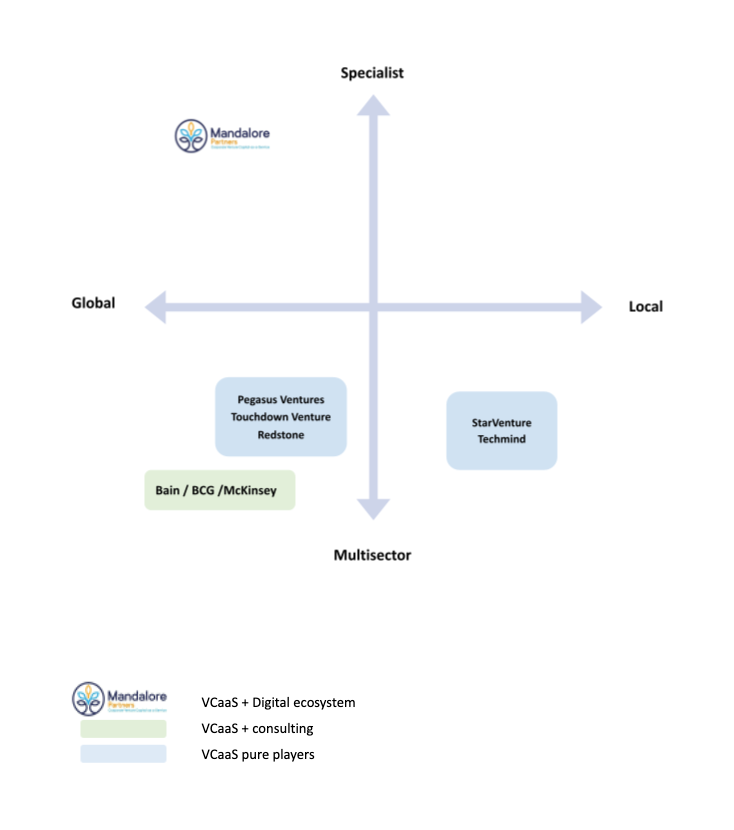
Each actor offers VC-as-a-Service abilities, some are pure players like Touchdown Ventures, some are bringing also a consulting expertise like McKinsey and Mandalore Partners is bringing a Digital Ecosystem along with its VC abilities.

There are three different categories of actors offering VC-as-a-Service abilities.

  • Pure players like Touchdown Ventures. Among this category, pure players are often multi-sector oriented and operate at a local scale like Techmind or at a global scale like Pegasus Ventures.

  • Consulting groups like Bain are bringing along their CVC abilities some of their consulting expertise. They operate at a global scale and on many sectors but mostly digital ones (TMT).

  • Mandalore Partners is a pure player but also brings its Digital Ecosystem along with its VC abilities. Mandalore has a global expertise and is specialized in Insurtech.
What ?

The objective of VC-as-a-Service is to bring VC abilities to corporations and start-ups:

Sourcing is one of the hardest abilities to acquire when a corporation wants to acquire VC skills. Indeed, it requires a lot of time and relations to build an efficient network. Using VC-as-a-Service gives corporations access to top-notch deals. VC-as-a-Service also quickly identify startups that fit within the strategic roadmap of the corporate partners thanks to previous deals and accumulated experiences.

More than Sourcing, VC-as-a-Service also brings a structure and a platform to rely on. Indeed, VC-as-a-Service funds have financial expertise, fine knowledge of the sector and contacts to find the best diligence as possible.

An efficient CVC investment is not finished when the start-up has received the funds from the company. VC-as-a-Service funds also follows the portfolio of the company and helps the start-up in its future milestone.

Using a VC-as-a-Service fund is in fact time saving and cost effective. It only takes few weeks to launch and to follow a CVC strategy for a corporation.

All along the investment process, decisions are made by the corporate which is enlighten by VC-as-a-Service fund. The fund is not making any investment alone.

Le CVC, un secteur en pleine expansion

D'après l’article paru sur TechCrunch en mars 2022. 


Le boom d’investissements en capital risque qui a marqué l’année 2021 n’a pas été uniquement le fait de fonds en capital risque traditionnels. En effet, d’autres acteurs et sources de capital ont joué un rôle clé: des nouvelles méthodes d’investissements angel et seed, jusqu’à des fonds crossover qui soutiennent des startups late stage. Et au milieu de toute cette activité frénétique et des levées records, les investisseurs corporate ont continué à développer leurs importance au sein du paysage VC. 

Corporate Venture Capital (CVC) est la méthode par laquelle des entreprises mettent en place leur propre structure d’investissement. Traditionnellement, cette démarche unit des objectifs stratégiques (M&A, accès à la technologie, partenariats) et financiers (retours sur investissement). La pondération de chacun varie en fonction de l’entreprise et du développement de leurs équipes CVC, mais il est rare de trouver des CVC qui n’ont qu’un de ces objectifs. Cela fait de leurs investissements un intéressant mélange d’investissement en capital risque classique et action stratégique de l’entreprise. Du point de vue des startups, le CVC est également très attractif. Par exemple, cela leur permet de s’adosser à un partenaire expérimenté, et donc de bénéficier de ses ressources, réseaux et expériences. La perspective d'être potentiellement racheté par le corporate offre également une sortie attrayante pour les entrepreneurs et les investisseurs. 


Les CVCs étaient exceptionnellement actifs l’année dernière, et il n’y a jamais eu autant d’acteurs. Si on analyse les données publiées par CB Insights, il est clair que 2021 fut une année charnière pour ce secteur, avec des records battus dans la plupart des indicateurs. Les CVC sont également de plus en plus présents au sein de l’espace médiatique. Par exemple, MondoDB, une startup de codage qui a fait son introduction en bourse il y a cinq ans, a mis en place son propre fond. MondoDB et d’autres startups à succès comme Coinbase sont intéressantes car elles sont actives dans le CVC avant même d’atteindre le statut d’entreprise mature et établie. Cette dynamique ne s'arrête pas là, et le CVC n’est désormais plus cantonné à une poignée de multinationales comme Axa et General Electric. Maintenant, même des entreprises privées plus petites s’y mettent, ce qui met en évidence à la fois les délais de plus en plus larges avant les IPOs, et l’abondance de fonds disponibles pour être utilisés en VC. 


Examinons maintenant les données du secteur de manière plus précise. Il y a deux indicateurs principaux pour examiner l'évolution du secteur. Tout d’abord, le nombre et la rapidité avec laquelle de nouveaux CVC sont mis en place, et le rythme auquel ceux déjà existants investissent. Si on examine le premier indicateur, il est clair que nous assistons, ces dernières années, à une expansion sans précédent du secteur. Selon CB Insights, il y a eu 221 nouvelles structures CVC, un chiffre en augmentation de 53% par rapport à 2020. Néanmoins, ce chiffre reste légèrement en deçà de l’augmentation en 2018, qui était de 259. 2021 reste tout de même la deuxième année en termes de créations depuis que nous avons des données sur les CVC. 


Une expansion rapide, ainsi que des acteurs diversifiés


Serge Tanjga, Senior Vice President chez MongoDB, remarque que, d’un point de vue technologique, les entreprises tech plus matures “mettent en place des équipes CVC car ils ont des capitaux en surplus à allouer, et parce qu'être un acteur VC aidera le positionnement de leur marque”, tandis que les entreprises tech plus jeunes “ ont tendance à lancer leur CVC pour attirer des startups qui puissent aider à aider à développer leurs produits, pour financer leurs clients existants ou supercharge des partenariats go-to-market”. Quand on analyse combien de CVCs sont mis en place, il est donc important de toujours se rappeler que ce secteur n’est pas un monolithe uniforme, mais au contraire ses acteurs ont une diversité d’objectifs. 


Il est difficile de déterminer quels types de CVC sont le plus représentés parmi le haut niveau de créations l’année dernière. Mais si on part du principe que la nouvelle “promotion” d’acteurs CVC est similaire à ses prédécesseurs, on peut prédire qu’un nombre important de fonds ont été lancés à la fois avec l’objectif “returns-first” et “strategy-first”. Si on s’interesse également aux montants investis par les CVC, on constate également une expansion constante ces dernières années, comme l’indique l’image ci-dessous, produite par CB Insights. 


Pour les startups, cela signifie que leurs options de financement sont non seulement plus larges, mais aussi que le segment “corporate” du marché est plus profond que jamais. Il est donc probable que les partenariats et investissements corporate-startup sont voués à continuer leur développement, et à concerner un segment d’entreprises de plus en plus large et varié.

Original Article:

The venture capital boom of 2021 was not built from merely traditional VC money. A host of other capital sources played a role in the global trend, from new methods of disbursing angel and seed capital to crossover funds pouring into late-stage startups. And amid all the noise, record-setting totals, and rapid-fire dealmaking, corporate venture investors were busy, investing gobs of parent-company cash into far-smaller concerns.


Corporate venture capital, or CVC for short, is the method by which wealthy businesses build their own investing arm. Traditionally, these efforts blend strategic goals (M&A, early access to technology, partnerships) and financial ones (returns). The exact mix varies by company and CVC effort, but it’s rare to find a corporate venture concern that has none of one or the other. This makes their investing an interesting blend of traditional venture and corporate opportunism.

CVCs were busy last year. New data from CB Insights makes it clear that 2021 was a colossal period for CVCs, an all-time record by some metrics and a near-record year by others. CVCs are in the news lately as well, thanks to MongoDB – a NoSQL company that went public in 2017 – putting together its own fund, an event that the technology world took note of. MongoDB joins recently public companies like Coinbase in employing corporate investor work before reaching mega-cap status. The trend goes further: We’ve even seen private companies launch their own CVCs, evidence at once of the lengthening period in which high-growth tech startups stay private and the sheer amount of capital available to pre-IPO companies.


Today, we’re exploring the data behind 2021’s CVC investing boom with commentary from Serge Tanjga, SVP Finance at MongoDB. Tomorrow, we’ll dive into the hows and whys of CVC in the current venture climate with commentary from a number of corporate investing players — and even one public company that is choosing to not build its own investing arm. Sounds good? Let’s get into the data.


How quickly is corporate venture capital investment accelerating?

There are two ways to track the growth of corporate venture capital: The pace at which new CVC concerns are set up, and the rate at which the larger CVC segment invests.

We’ll take them in order. It’s clear that more CVCs are being compiled in the current market than nearly ever before. Indeed, CB Insights data indicates that some 221 new CVCs were created in 2021, a huge 53% increase on 2020 data. However, the 2021 result was actually fractionally lower than the 259 built in 2018. That said, 2021 was the second-hottest year for which we have data when it came to new CVCs reaching the market.


Tanjga, discussing the CVC market from a technology perspective, said that more mature tech companies “tend to set up CVC arms because they have excess capital to deploy, or because being in the VC space will help with their brand positioning,” while younger technology companies “tend to start CVC efforts to attract startups to build on their product, to fund their existing customers or supercharge go-to-market partnerships.” So when we discuss just how many CVCs are being built, keep in mind that they are not a monolith when it comes to goals.


We can’t tease out a perfect split of CVC focus from the pace at which new funds were put to market last year. But if we presume that the new crop of corporate venture players is similar to those that came before it, it is safe to infer that a good number of returns-first and strategy-first CVCs were launched in 2021. For startups, that means that their set of capital funding options is not only broader than ever, but also that the corporate portion of the market is deeper than ever.

Why do we care?

La fiscalité favorable du Corporate Venture Capital (CVC) en France

De quoi s’agit-il ?

L’article 217 du CGI, entré en vigueur le 3 septembre 2016, prévoit un amortissement exceptionnel sur une durée de 5 ans des investissements des entreprises dans des PME innovantes. Chaque année, pendant 5 ans, une entreprise-investisseur peut déduire de son résultat imposable 20% du montant de l’investissement. La détention des titres doit durer au moins 2 ans.

Régi par la réglementation européenne sur les aides d’État au titre du financement des risques, ce dispositif a obtenu l’accord de la Commission européenne pour une période de 10 ans à compter de son entrée en vigueur, soit jusqu’en 2026.

Qui sont les investisseurs éligibles ?

Toutes entreprises soumises à l’IS peuvent en bénéficier.

L’investissement peut se faire :

  • soit directement par la souscription en numéraire au capital,

  • soit indirectement par la souscription en numéraire de parts ou actions de FCPR, FPCI, SLP ou SCR respectant le quota d’investissement applicable aux fonds communs de placement dans l’innovation (FCPI) (70% dans des PME innovantes, dont 40% minimum de l’actif en titres souscrits).

L’investisseur ne peut détenir plus de 20% du capital ou des droits de vote de l’entreprise innovante cible. Cette limite ne s’applique pas lorsque l’investissement indirect a eu lieu dans le cadre d’une délégation de gestion du portefeuille à une société de gestion de portefeuille et que les décisions d’investissement sont prises indépendamment par le gestionnaire du fonds. Le véhicule d’investissement doit respecter le quota précité.

Il faut enfin que l’investisseur n’aie pas déjà investi dans la même PME innovante avant l’entrée en vigueur du dispositif, et le montant de l’investissement est limité à 1% du total de son actif.

Quelles sont les PME innovantes éligibles ?

  • Il faut d’abord que l’entreprise cible soit une PME, à savoir une entreprise ayant moins de 250 salariés, un chiffre d’affaires annuel n’excédant pas €50M ou un total du bilan annuel n’excédant pas €43M, et ayant son siège dans un état membre de l’UE.

  • Puis, l’entreprise doit soit avoir réalisée des dépenses de recherche représentant au moins 10% des charges d’exploitation de l’un au moins des trois exercices précédant celui au cours duquel intervient la souscription (estimées et certifiées par un expert-comptable pour les entreprises n’ayant pas encore clos d’exercice), soit être capable de démontrer qu’elle développe ou développera dans un avenir prévisible des produits, services ou procédés neufs ou substantiellement améliorés par rapport à l’état de la technique dans le secteur considéré, et qui présentent un risque d’échec technologique ou industriel. Cette appréciation peut être effectuée par audit technique ou par une certification par un organisme chargé de soutenir l’innovation (exemple de la labellisation de BPI France).

  • Elle doit également soit n’exercer son activité sur aucun marché, soit exercer son activité sur un marché depuis moins de dix ans après sa première vente commerciale.

  • Enfin, la PME innovante ne peut pas recevoir plus de €15M d’investissements éligibles au dispositif.

Quelles perspectives pour la CVC en France ?

En 2017, première année du dispositif, l’investissement dans des entreprises éligibles a dépassé de 38% les projections du ministère de l’Économie pour atteindre €1,1Md, montant atteint également en 2020 malgré la pandémie.

La majorité des entreprises du CAC 40 dispose d’un fonds en propre ou a investi dans un fonds partagé entre plusieurs corporates. En 2020, un benchmark a recensé 49 CVCs en France.

Les secteurs d’investissement privilégiés en France sont la mobilité, la Fintech, l’Insurtech et la Medtech, selon un baromètre de 2018.

En pratique ?

Prenons l’exemple d’une SA avec €100M d’actifs souscrit des parts de FCPI pour un montant de €1M, soit 1% du total de son actif. Elle a délégué la gestion de son portefeuille à une société de gestion de portefeuille, peu importe donc si elle détient plus de 20% du capital ou des droits de vote dans l’une des entreprises innovantes cibles.

Chaque année pendant cinq ans, elle pourra déduire €200m, soit 20% de son investissement de €1M, de son résultat, réduisant ainsi son assiette imposable. Elle garde ses parts de FCPI pendant six ans, pour bénéficier aussi longtemps que possible de l’amortissement.

Our unique vision of Venture Capital as a Service

Minh Q. Tran, Founder and managing partner of Mandalore Partners and Sabine Vanderlinden, Founder and managing partner of Alchemy Crew, the research lab of Mandalore Partners, explain their vision of corporate venture capital as a service in Business Talks.

What is Corporate Venturing ?

Demystifying the world of corporate venture capital investing in insurance

By Sabine VanderLinden

With Corporate VC as a service, large established companies develop, sponsor or invest in startup companies from the earliest stages of formation to later stages of growth. They do this for the purpose of identifying new technologies to develop cutting-edge customer-driven solutions and delivering innovative products and services that can resist the effects of time. In simple terms, the startup company and the corporation will likely be in the same core area e.g., InsurTechs get backed by large insurance giants whereas a pharmaceutical firm concentrates on Life Science and HealthTech ventures. And we know in each case there may also be some overlap.

Corporate venturing as a service has some similarities to what R&D is in many industries. Not much used in insurance, but something that could bode well for larger companies if considered consistently and strategically.

The central point is that a startup company is evaluated and funded by the corporate venture capital arm of the business. This works well to shake off protocol and bureaucracy which can weigh down innovation when a parent company gets involved in these decisions.

Corporate venturing has some similarities also with Venture Capital (VC). As you would expect. There is certainly shared territory here even though some venture capital units do not like so much newbies corporate venture capital units. Venture Capitalists (VCs) are experts at the money side of things where they focus on the financial objectives, whereas the corporate venturing team draws expertise from strategy, finance, and the industry, with their fingers on the pulse of emerging trends, opportunities, and risks. The two can actually benefit each other enormously when working in tandem as we have seen with many emerging corporate funds signing up established corporate players as Limited partners.

Alchemy works upstream as an accelerator as a service and research lab, while Mandalore Partners positions itself downstream as a vc as a service and investment fund.

Alchemy Research: Enhancing People Safety

Alchemy is the research lab for Mandalore Partners.

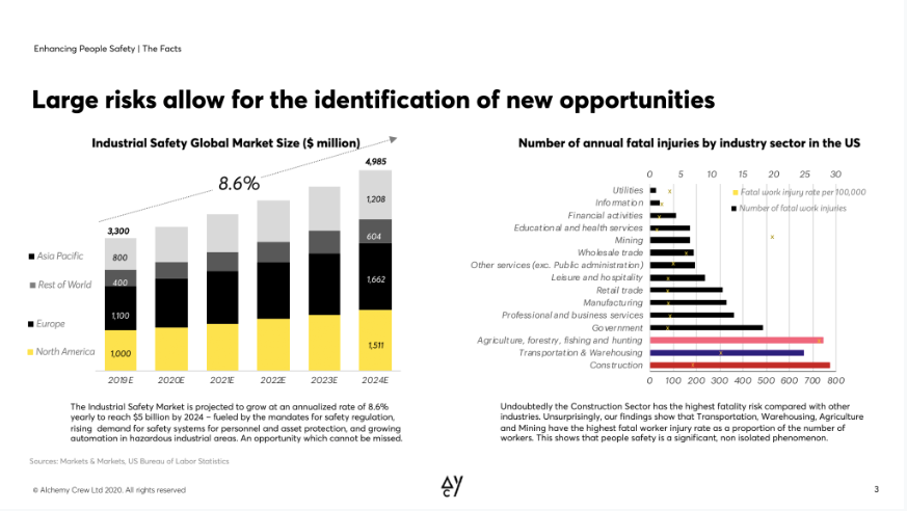
Accidents in the industrial space have always been a reality. Although their number has largely decreased since the industrial revolution and work-related accidents are much better treated, they remain a problem for companies and employees. 

Hopefully, galore new technologies are addressing that issue. Insurers are important players in that field. How can they best cater to employees needs after an accident? How can they reward good behaviour from companies leading to fewer accidents? How can more companies help reduce work-related accidents more broadly?

These are all essential questions that this report tries to assess. Below is a snapshot of the report.

For more information please contact us at research@mandalorepartners.com

Picture 1.png
2.png
3.png

Alchemy Research: The Digital Nomad

Alchemy is the research lab of Mandalore Partners. Below is the preview of our research report on the digital nomads.

The COVID-19 crisis and its consequences have shed light on a specific category of workers: the digital nomads. Although that kind of working habit has existed for some time, as they are gaining momentum, it becomes more and more important to understand and address their needs. 

How different are working conditions for digital nomads compared to regular workers? How specific are their needs? Where do digital nomads tend to establish themselves? How can global companies take advantage of this trend?

This report focuses on all these issues and tries to give a precise snapshot of the current situation and how to address best those needs in order to facilitate digital nomads’ lives but also to help insurers get a competitive advantage. 

For more information, please contact us at research@mandalorepartners.com

Picture 1.png
4.png