SME Acquisition

Retour sur INSEAD ETA Conference 2026 : Ce que le monde des Search Funds révèle aux investisseurs corporate

We attended the INSEAD Entrepreneurship Through Acquisition & Search Funds Hub (ETA) Conference 2026 in Fontainebleau as an outsider — a corporate venture capital investor, not a searcher. I left with five sharp takeaways that matter well beyond the search fund community, and a clear conviction about the role institutional corporate capital can play in the European SME acquisition landscape.

What is ETA, and why does this conference matter?

Entrepreneurship Through Acquisition (ETA) refers to the practice of raising capital to fund the search for and acquisition of a single operating company, typically a profitable SME. The searcher becomes CEO post-acquisition, operates the business for 5 to 7 years, and exits to a PE buyer or strategic acquirer.

The model was pioneered at Stanford in the 1980s. It took thirty years to cross the Atlantic in any meaningful way. Today, it is one of the fastest-growing alternative investment strategies in Europe — and the INSEAD conference, now in its third year, is its intellectual centre of gravity on this side of the world.

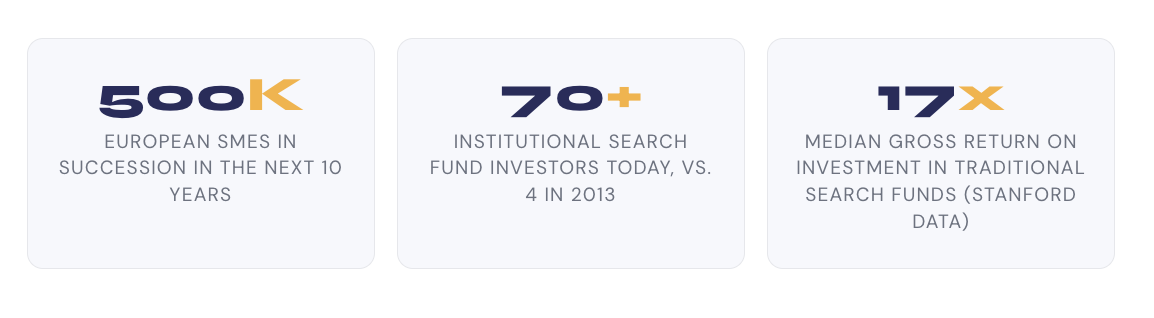
Why does it matter to corporate investors? Because 500,000 European SMEs need new ownership in the next decade. Many of them operate in financial services, insurance distribution, wealth management, and business services — sectors where institutional corporate investors have strategic skin in the game. The succession wave is not just a demographic trend; it is one of the largest structural opportunities in European private markets over the next ten years.

An asset class at an inflection point — and bifurcating fast

The day opened with research from Prof. Ivana Naumovska (INSEAD), whose work on search fund performance signals set the intellectual tone for everything that followed. Her finding is both reassuring and cautionary: the model works extraordinarily well — but only for the right people, backed by the right investors.

The traditional proxies that investors use to select searchers — elite MBA, top-tier investment banking background, partner search — are statistically meaningful, but incomplete. They fail to capture the qualities that actually determine long-term performance: resilience through the 13-month acquisition process, calibrated ambition (neither too low nor too high), genuine humility with sellers and employees, and the kind of empathy that keeps a business owner at the table through difficult negotiations.

📊 Key Research Finding

The return distribution is becoming bimodal. A minority of high-quality searcher-investor partnerships continue to generate outstanding returns. A growing majority — driven by less experienced investors chasing the asset class — are underperforming. This is the pattern of every alternative asset class that transitions from niche to mainstream.

The expansion of the investor base from a tight community of operational veterans (ex-CEOs, serial entrepreneurs, former PE operators) to a broader pool of financial investors has had a measurable impact on outcomes. Experienced investors don't just bring capital — they bring judgment on critical decisions (when to walk away from a deal, how to structure a management team, how to manage a difficult vendor relationship). Diluting that expertise has consequences.

The implication is not that the model is failing. It is that selection — of searchers, of investors, and increasingly of co-investors — matters more than ever.

The European geography: who is winning, who is emerging

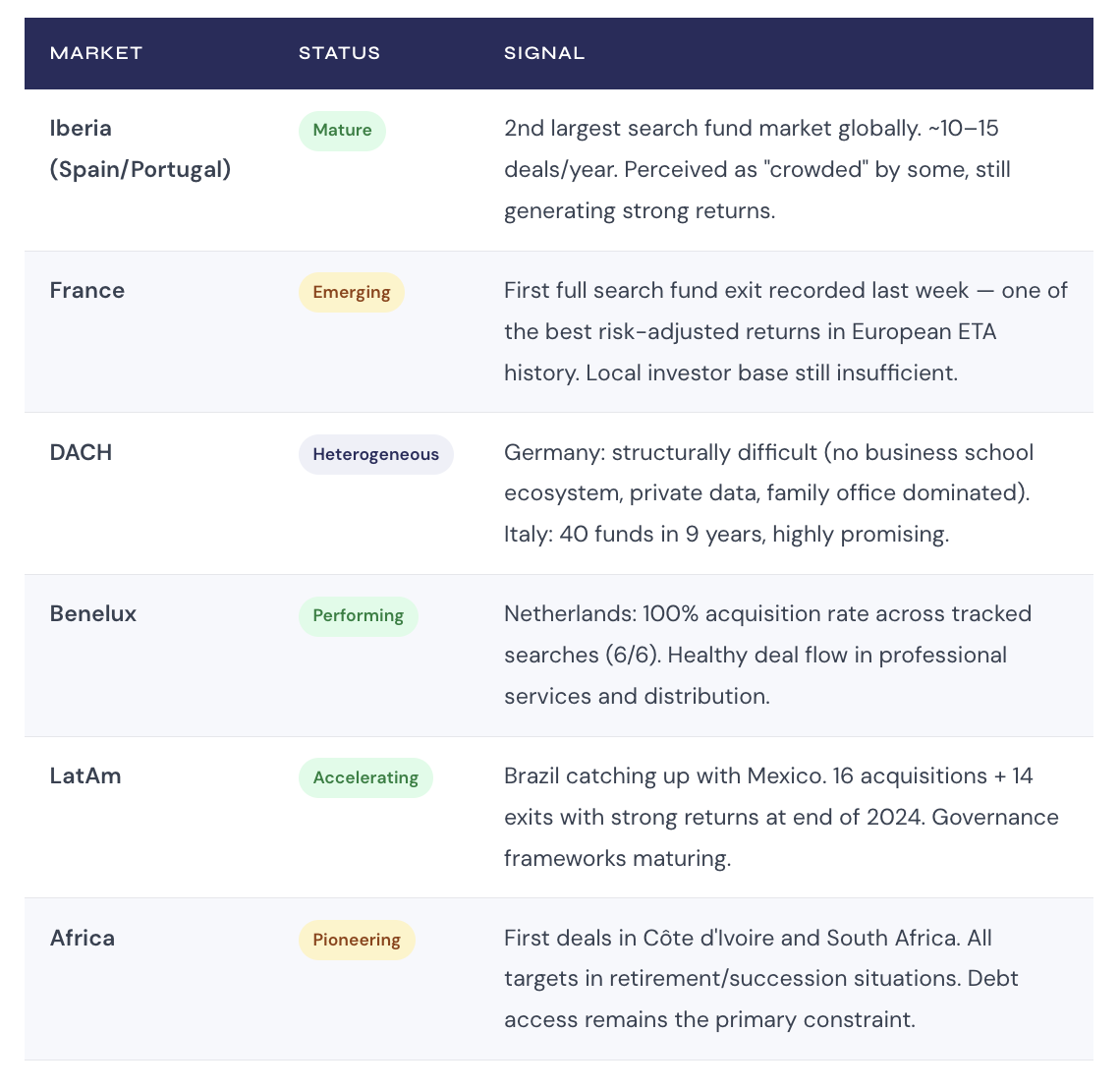
Panel 1 brought together investors from Relay Investments, Ambit Partners, JB46 Partners, Istria Capital, and Inseta Partners to map the global search fund landscape. The European picture is heterogeneous — and more interesting than the headline numbers suggest.

France's first standout search fund exit — confirmed by multiple panelists who had been involved in its structuring — is a significant milestone. It validates the model in a market that has historically been skeptical, and signals the beginning of a local LP ecosystem capable of backing more searchers at scale.

AI and the sourcing paradox: democratisation destroys differentiation

Panel 2a, dedicated to search strategies in the age of AI, featured a fascinating tension. On one hand, new tools like Bantum — a multi-agent AI platform built specifically for searchers — now allow any operator to score, rank, and outreach to thousands of SME targets in days. Bantum combines data from Northdata and multiple proprietary sources, runs AI agents in competitive "debate" to score companies across 15 dimensions, and automates outreach across email, LinkedIn, handwritten letter bots, and fax. Cost: $100–$200 per month for individual searchers.

On the other hand, when every searcher has the same tool, they arrive at the same 100 companies. The sourcing advantage that technology created has been immediately competed away.

What am I doing that's truly proprietary? The answer is never the tool. It's the relationship, the sector knowledge, and the reason the seller picks up the phone for you specifically.

— Composite of multiple panelists, Panel 2a

The operators winning in this environment are returning to fundamentals: in-person attendance at sector trade shows, direct mail campaigns, conversations at industry dinners, referrals from trusted sector networks. In Germany specifically — where company data is largely private, business school ecosystems are thin, and family offices control much of the SME ownership landscape — proprietary sourcing via genuine sector relationships remains the only reliable strategy.

💡 Implication for Corporate LPs

A strategic corporate LP who can open doors to retiring company owners — through sector credibility, personal introductions, or the implicit validation of their brand — is a sourcing advantage no algorithm can replicate. This is one of the strongest structural arguments for a corporate LP anchor in a HoldCo roll-up vehicle.

The four ETA routes: from self-funded to HoldCo roll-up

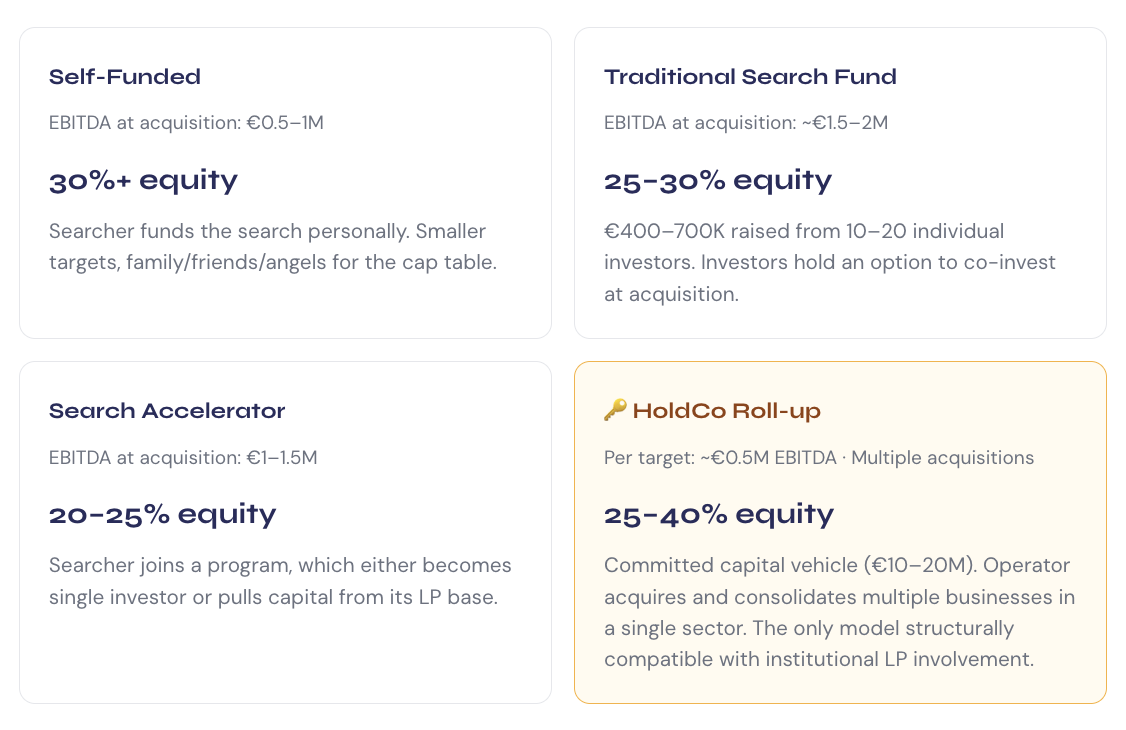
Prof. Naumovska's framework for the four ETA routes clarified a conversation that is often muddled in practice. They are not variations of the same model — they have different capital structures, different investor profiles, different risk distributions, and critically, different suitability for institutional involvement.

The HoldCo roll-up is the model that has attracted the most interest from institutional capital — and the most scrutiny. We address the risks directly in the next section.

From LOI to close: what the deal process really looks like

Panel 3b, focused on the deal process from Letter of Intent to closing, produced the most operationally dense content of the day. The panelists — all experienced searchers and operators — were unambiguous: the transaction process is where most acquisitions are won or lost, and it is overwhelmingly a people process, not a financial one.

The seller relationship is everything

The consensus across all panelists: position yourself as the person who will care for the seller's life's work, not as a financial buyer. Use lawyers to deliver difficult news during negotiations — preserving the personal relationship for the operator. Know the names of the seller's children. Have dinner with their spouse. Understand what they built and why it matters to them.

Timeline reality: searchers typically project 3 months from LOI to close. The average is closer to 6. Some deals take 13 months. After 6 to 7 months in a live process, the searcher has exhausted most of the goodwill they started with — what remains is the human relationship itself. Build it early and protect it throughout.

Investor communication discipline is a deal variable

Post-LOI investor management is not administrative — it is strategic. Send a 2-to-5-page synthesis within days of signing the LOI: what excites you, what you still need to learn, what the timeline looks like. Follow up biweekly with genuine updates. The fatal error is a two-page summary followed by three months of silence, then a 90-page data room that answers none of the original questions.

⚖️ Due Diligence Rule

The one expense you should never cut in a search fund transaction: legal counsel. Structure all other advisors on partial success fees. Work alongside advisors in real time — don't wait for the final report. And the most important principle: the worst outcome is not losing a deal. It's closing the wrong one.

⚠️ The committed capital warning every institutional investor must hear

The sharpest moment of the afternoon came from Lenka Polarova (PT Investment, 63 portfolio companies), whose assessment of the committed capital / HoldCo roll-up model was direct enough to reshape the room's sentiment on the topic.

⚠ Critical Warning — Lenka Polarova, PT Investment

The return distribution of committed capital / HoldCo roll-up vehicles resembles VC, not traditional search. Approximately 80% of operators fail. The common failure pattern: three acquisitions at €200K EBITDA each, momentum slows, the operator runs out of runway before achieving a meaningful exit path. Competing against PE funds with full infrastructure, proven playbooks, and institutional capital at scale is structurally disadvantageous for a first-time consolidator without a proven M&A track record.

This is not an argument against the model. It is an argument for extreme rigor in operator selection and thesis specification. The model works — for the right operator, in the right sector, with the right capital structure. The 20% who succeed generate the returns that make it worthwhile for investors. But 80% of the operators who attempt it do not achieve a meaningful exit.

The panel's recommended alternative for most searchers: a traditional single acquisition — targeting a company with €1.5–2M EBITDA — followed by selective tuck-in acquisitions funded by cash flow and debt after demonstrating value creation in years one through three. This approach maintains the financial leverage, operational focus, and exit clarity that make traditional search funds attractive, while allowing for inorganic growth once the operator has demonstrated capability at scale.

5 takeaways for corporate investors and institutional LPs

  • 1 - The succession wave is structural, not cyclical

    500,000 European SMEs need new ownership in the next decade. For insurance groups, banks, and mutualist institutions, many of these companies sit in their distribution ecosystems — brokers, CGPIs, wealth advisors, MGA platforms. This is not a market to observe from a distance.

  • 2 - The traditional search fund model is not designed for institutional capital

    10–20 individual investors, €0.5–2M checks, high operational engagement — this format is structurally incompatible with institutional LP governance requirements. The HoldCo roll-up vehicle with a dedicated committed capital fund is the right entry point for corporate LPs.

  • 3 - An 80% failure rate demands exceptional operator selection

    The committed capital model only works with a senior operator who has a proven M&A track record and a highly specific sector thesis. Financial sophistication is insufficient. Sourcing and operating experience in the target sector is the non-negotiable criterion.

  • 4 - Corporate LP anchor = structural competitive advantage

    In a sourcing environment where AI has eliminated data differentiation, a corporate LP who can open doors to sellers — through sector credibility, warm introductions, or commercial partnership offers — changes the economics of the roll-up. This is not soft value; it is a genuine sourcing moat.

  • 5 - Keep CVC and ETA narratives strictly separated in client conversations

    Venture capital (early-stage startups) and ETA/acquisition vehicles (mature SMEs) serve different strategic purposes, operate on different timescales, and require different governance structures. Conflating them in the same pitch creates confusion and undermines credibility with both institutional and corporate audiences.

Conclusion: a market worth watching — on the right terms

The INSEAD ETA Conference 2026 confirmed what the data has been suggesting for several years: European search funds are no longer a curiosity. They are a legitimate alternative asset class with a growing track record, an increasingly professional investor base, and a structural tailwind — the succession of half a million companies — that will sustain deal flow for a decade.

For institutional investors in insurance, banking, and asset management, the question is not whether to engage with this market. It is how, and on what terms. The HoldCo roll-up model offers the clearest structural entry point — but it demands the right operator, the right thesis, and an honest accounting of the failure risk. A corporate LP who brings more than capital — sector relationships, commercial partnerships, regulatory credibility — is not just a financial participant. They are a structural advantage embedded in the vehicle's competitive logic.

At Mandalore Partners, we structure venture and acquisition vehicles for large insurance and banking groups navigating exactly this decision. The conversation we started at Fontainebleau is one we intend to continue — with the right partners, on the right terms.