

Where Do the Founders Building the World's Largest Companies Come From?
Brain drain gets talked about a great deal. The underlying idea is simple, almost intuitive: a country trains brilliant engineers and researchers…
8 min read
Introduction
Brain drain gets talked about a great deal. The underlying idea is simple, almost intuitive: a country trains brilliant engineers and researchers, they leave to build their careers — and their companies — elsewhere, and the country of origin never recovers the investment it made in their education. The data on the founders of American unicorns tells a more interesting, and more nuanced, story: one of a circulation of talent that benefits, at least in part, several ecosystems at once — not only the one that captures the final success.
A quarter of founders trained elsewhere
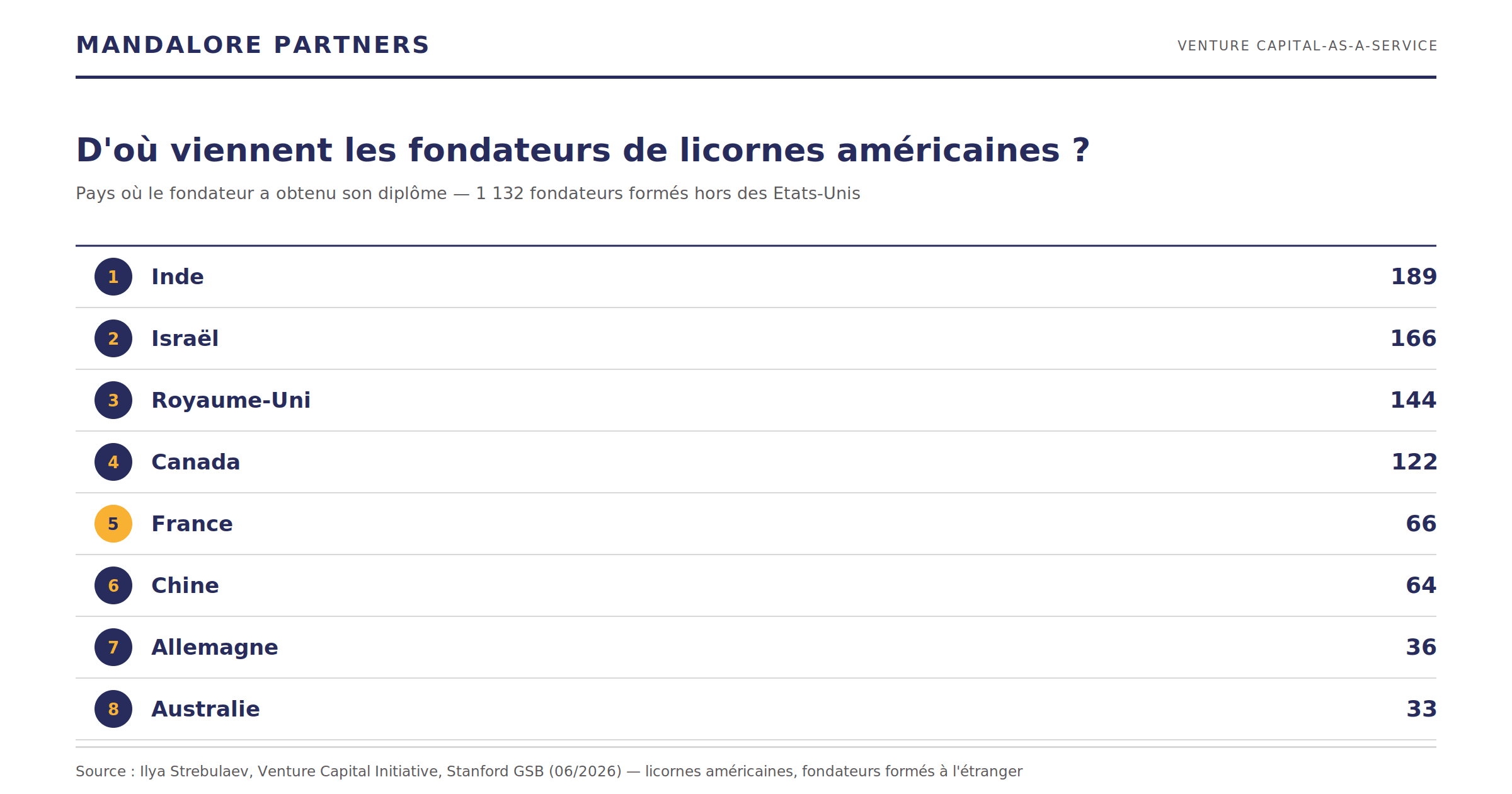
According to an analysis by Ilya Strebulaev (Venture Capital Initiative, Stanford GSB) covering the founders of American unicorns, 1,132 of them — roughly a quarter of the total — earned their degree outside the United States, across 66 different countries. The rest, 2,845 founders, were trained on American soil.
That figure alone deserves to be stated plainly: in a country with the most richly endowed university system in the world, a quarter of the founders building the most highly valued companies on the planet learned their trade elsewhere. The American unicorn machine does not feed on its own education system alone — year after year, it imports a significant share of its founder pool.
The country ranking holds a few surprises
India comes first, with 189 founders of American unicorns trained on its soil, followed by Israel (166) and the United Kingdom (144). Canada completes the extended podium with 122 founders. But it is what comes next in the ranking that speaks most directly to a European reader: France ranks 5th with 66 founders trained on its soil — ahead of Germany (36), and just behind Canada.
Other European countries appear further down the ranking: Switzerland (22), Italy (16), Denmark (14), the Netherlands (13), Portugal (12), Spain (12) and Ireland (10) all contribute, to varying degrees, to the pool of founders now building some of the largest American companies.
What this ranking reveals about each ecosystem
Each of the leading positions in this ranking is explained by a different dynamic, specific to the ecosystem in question — and the phenomenon cannot be reduced to a single cause.
India's first place reflects, above all, a matter of scale: the country trains more engineers every year than most of the other countries in the ranking combined, and it has a technology diaspora network in the United States that is unusually dense and long established, documented over several decades in research on migrant entrepreneurship in California.
Israel's second place, by contrast, owes less to scale than to density: relative to its population, Israel produces a number of startup founders with no equivalent in the ranking. That result is generally attributed to the combination of a formative technological military service — the intelligence and cyberdefence units train young talent every year to solve complex problems in small teams — and a mature local venture capital ecosystem that often serves as a springboard to the United States.
The United Kingdom, in third place, benefits from a more structural advantage: a shared language with the United States, decades of established academic exchange, and a British venture capital ecosystem that, far from being a mere antechamber to the American market, has itself produced several of Europe's biggest successes.
Canada's position, fourth, is often described in the North American business press as a textbook case of geographical and cultural proximity: the border with the United States, the shared language, and a well-regarded technical university system (Waterloo, Toronto, UBC) make for a movement of talent that many Canadian engineering and computer science graduates take as self-evident.
France's position: a signal not to be underestimated
For an ecosystem such as France, ranking 5th in the world on this criterion — ahead of economies far larger in population or in GDP, such as Germany — is a signal that deserves to be taken seriously. It confirms what can be observed elsewhere, in the rankings of the most selective mathematics and engineering programmes: the French system, carried by its grandes écoles and its engineering degrees, produces a pool of technical talent recognised internationally, capable of holding its own against technological powers of far greater size.
The question that remains open is not the capacity to train — this ranking suggests that much is already settled — but the capacity to retain that talent, or failing that, to capture part of the value it creates, wherever those founders ultimately choose to build their company. That is precisely the blind spot in the notion of "brain drain": it measures a departure, never a possible return in another form.
Circulation rather than drain: what economic research says
The subject is not a new one for research in the economics of innovation. Since the 2000s, several bodies of work — notably those conducted on the networks of Indian and Chinese engineers in Silicon Valley — have proposed replacing the concept of "brain drain" with that of "brain circulation": in many cases, talent that has gone abroad continues to reinvest in its country of origin — financially, as angel investors or venture capitalists; in human terms, by hiring or mentoring compatriots; and sometimes physically, by returning to found a second company in its home market once a first success has been consolidated abroad.
This reading does not deny the real loss that the departure of its most promising talent represents for a country. It simply invites us to measure the phenomenon over a longer horizon, and through channels of value that do not come down to where the resulting company's head office happens to sit.
What this means for ecosystems that invest in education
If the idea of circulation rather than drain is taken seriously, the consequence for public decision-makers and ecosystem players is not to try to prevent the most promising talent from leaving — an objective that is both hard to achieve and probably counterproductive — but to build the channels that make it possible to capture part of the value generated, even when the company is built elsewhere. That may take the form of alumni networks active internationally, of arrangements that make it easier to come back or to spin a second company out into the home market, or simply of a better grasp, on the part of local investors, of what becomes of their graduates once they have left.
For an investor, this ranking is also an invitation to look beyond the domestic market alone when assessing the potential of a talent pool: the relevant question is not only how many companies are created locally, but how many locally trained founders go on to build companies of global scale, wherever they choose to do so.
Frequently asked questions
Does this ranking mean that France is "losing" its best talent to the United States? The ranking shows one waypoint on a trajectory — the country where the degree was obtained — not a final verdict on where the value created ends up. Some of those 66 founders trained in France maintain active ties with the French ecosystem: investment, mentoring, networks, even a return for a second company. The available data does not allow that share to be quantified precisely, but research on the circulation of talent suggests it is far from negligible.
Should we conclude that French grandes écoles ought to push their graduates towards the United States more? Nothing in this data supports a recommendation that direct. The ranking measures an outcome observed across one generation of founders, not an optimal strategy to follow. It documents a reality — France trains profiles capable of succeeding at the highest international level — without saying whether that success would have been greater, smaller, or simply different had those founders built their company in the French market.
Is this phenomenon of talent circulation specific to the United States? No, but the American ecosystem is the one that today has the most complete and most regularly updated data on the subject, thanks in particular to the work of researchers such as Ilya Strebulaev. A comparable exercise applied to unicorns built in China, India or Europe would probably yield lessons just as rich, but it remains, to date, less publicly documented.
One limitation to keep in mind
This data relates specifically to American unicorns, and to the country where the founder obtained their degree — not to their nationality, nor to the country where they grew up, nor to unicorns founded elsewhere in the world. A founder trained in France may perfectly well come from another country, or have left France as soon as they graduated without having any particular roots there. The data measures one waypoint on a trajectory, not a belonging — an important nuance for anyone tempted to draw conclusions from it about founders' identity or nationality rather than about their educational path.
Nor does it say anything about unicorns founded outside the United States: an equivalent ranking covering European, Chinese or Indian unicorns would in all likelihood produce a quite different hierarchy of countries of origin, and remains, to this day, to be documented with the same methodological rigour.