

The new unicorn founder profile: what the data reveals
For a long time, the “typical” unicorn founder came out of a business school, had done a stint in finance or consulting, and knew how to sell a vision before even having a product…
7 min read
Introduction
For a long time, the “typical” unicorn founder came out of a business school, had done a stint in finance or consulting, and knew how to sell a vision before even having a product. That image did not come from nowhere: it fits reasonably well a generation of founders who built the great SaaS and e-commerce successes of the 2010s, where the ability to structure a commercial organisation and to raise successive funding rounds often counted for more than the technical depth of the product.
The most recent data says something else. Between the studies on founders’ academic paths and the analyses of their prior entrepreneurial experience, a different profile emerges — more scientific, more experienced, and far less homogeneous than one might think. Three datasets released in 2025 and 2026, covering large samples and transparent methodologies, make it possible to reconstruct this new profile piece by piece.
Fewer MBAs, more PhDs
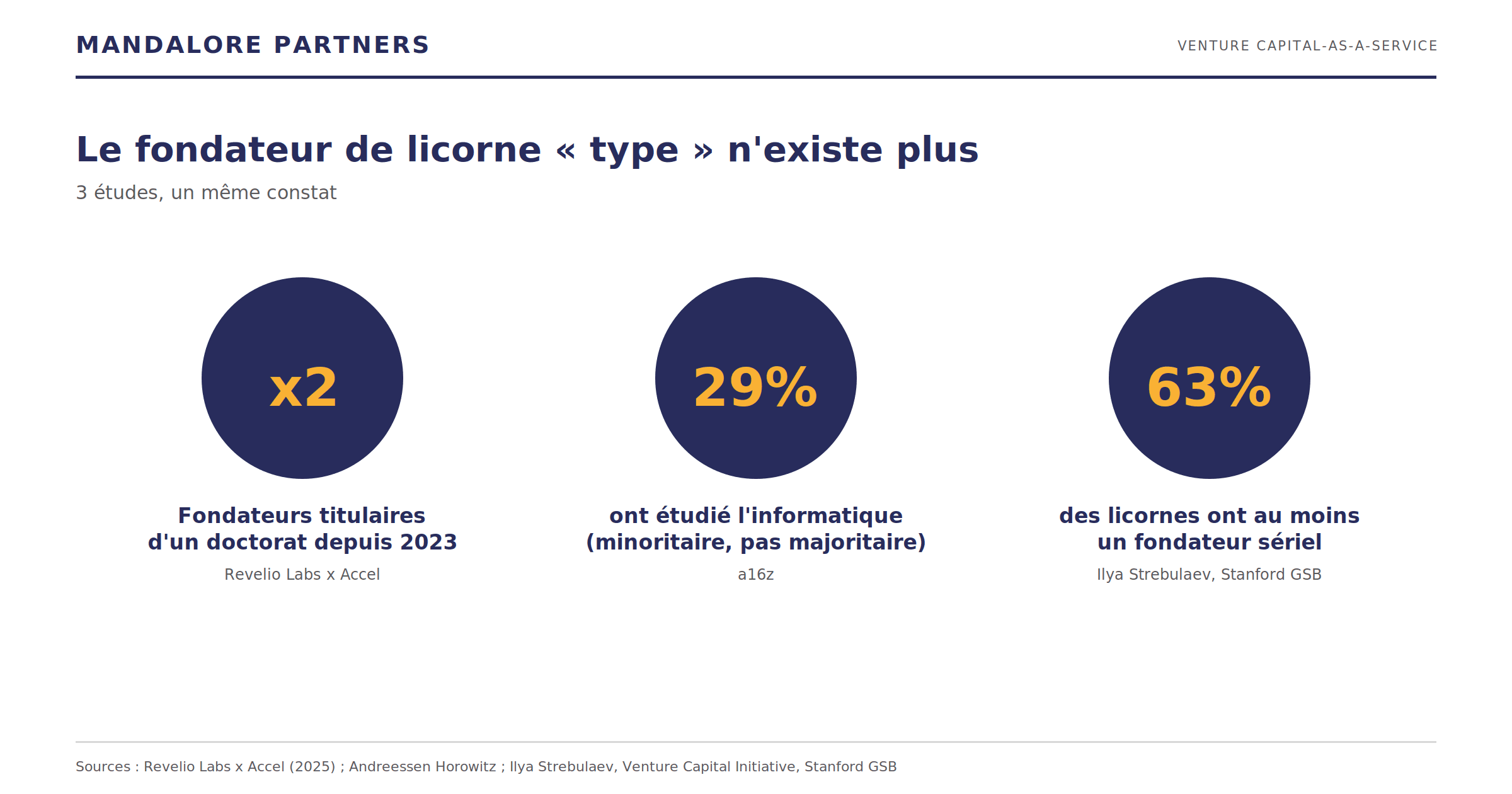
An analysis by Revelio Labs and Accel covering 290 European unicorns leaves no room for doubt: the share of unicorns founded by a doctorate holder has doubled since 2023, while the share of MBA profiles has halved over the same period. The founder pool is visibly shifting away from finance and consulting towards Big Tech and academic research.
This shift does not mean that the MBA has lost all value for a founder — it means that the barrier to turning scientific expertise into a company has come down. Researchers who, ten years ago, would have stayed in the laboratory or joined a large group now have access to the same funding, hiring and go-to-market tools as any founder from the business world.
Why this shift is happening now
Several concurrent dynamics help explain the movement, though none of them accounts for it on its own.
The first has to do with the very nature of the startups that dominate today’s unicorn landscape. Artificial intelligence, deeptech, biotech and robotics — sectors where the technical barrier is real and where competitive advantage is often built on years of prior research — occupy a growing place among new unicorns. In these categories, a doctorate is not a mere signal of seriousness: it is frequently the condition of access to understanding the problem the company is trying to solve.
The second has to do with the falling cost of starting a technology company. The cloud, open source models and no-code tools for building a first product or a first commercial interface have reduced the need for a “business” profile to carry the non-technical part of the project. A researcher can now iterate alone much further into the life cycle of their product than fifteen years ago, before even having to hire a complementary profile.
The third has to do with the growing maturity of university technology transfer arrangements and of programmes dedicated to guiding researchers towards entrepreneurship. What was an institutional exception a decade ago has become, in several major European universities and research centres, a structured and documented path.
What they actually studied
Andreessen Horowitz’s data on American unicorns founded between 2010 and 2024 adds an important nuance to this “PhD versus MBA” reading. Computer science does come first among fields of origin, but with only 29% of founders — well under half. The rest is spread between economics and finance (23.8%), engineering other than computer science (11.5%), natural and life sciences (10.9%), social and behavioural sciences (9.5%), humanities, arts and design (9.4%), and finally mathematics, statistics and data science (5.9%).
In other words, the majority of American unicorn founders did not train in computer science. The common denominator between them is therefore not the discipline studied, but what they did with it afterwards. A founder coming from the social sciences or the humanities is not a statistical accident: they represent nearly one founder in ten, an order of magnitude comparable to that of mathematics and data science, a discipline nevertheless regarded as an obligatory step in tech’s collective imagination.
This distribution calls for a finer reading of the subject: it is probably not the discipline itself that predicts a founder’s success, but the ability to transpose a rigorous method of analysis — whether it comes from engineering, from economics or from the social sciences — to a business problem. Computer science remains over-represented relative to its weight in the general graduate population, but it is far from being a necessary condition.
Experience counts more than one thinks — but not in the way one imagines
The third strand of data, produced by the researcher Ilya Strebulaev (Venture Capital Initiative, Stanford GSB), concerns founders’ prior entrepreneurial experience. Of 4,357 American unicorn founders analysed between 1997 and 2019, 43% had already created at least one company before their unicorn, and 63% of unicorns counted at least one “serial” founder in their founding team.
The most instructive detail in this research is not the overall percentage, but its distribution. Among the 1,876 serial founders identified, 1,173 — nearly two out of three — had tried only once before their unicorn. Only 166 had launched three, and only 51 had launched five or more. The typical path is therefore neither an accumulation of attempts nor a succession of failures overcome: it is a first attempt, followed by success.
This distribution has a direct implication for anyone assessing a founding team on the basis of its track record: the number of previous attempts is not, in itself, a strong signal. A founder who has created five companies is not statistically closer to a unicorn than a founder who has created only one and is building their second today. What seems to count more is the very existence of a first experience — the learning it produced — rather than its repetition.
What this data changes, in concrete terms
Taken together, these three studies sketch a unicorn founder profile appreciably different from the received image: more likely to have a scientific or research background, rarely from a single type of curriculum, and often — though not systematically — through a first entrepreneurial attempt before success.
For anyone assessing founding teams, the practical consequence is simple: the classic academic or professional pedigree remains one signal among others, but it explains less and less of the variance between the teams that succeed and those that fail. The discipline studied, the number of previous attempts, the professional origin — none of these criteria taken in isolation predicts success. It is their combination, and above all what the team has made of it, that counts.
For founders themselves, particularly those from academia or research who are still hesitating to take the plunge, this data sends a reassuring signal: not having gone through a business school or a role in finance is no longer a structural obstacle. The market for funding, hiring and support has adapted to this new generation of profiles, and continues to do so.
Frequently asked questions
Is an MBA a disadvantage when founding a unicorn? No. The data shows a rebalancing of the founder pool, not a disqualification of MBA profiles. The share of MBA founders has declined in relative terms, but unicorns continue to be founded by profiles from finance and consulting, particularly in sectors where complex sales and organisational structuring remain decisive.
Is this trend the same across every sector? The available data does not allow this point to be settled precisely: the studies cited cover all the unicorns in their sample, without systematic detail by sector. It is reasonable to suppose, without this being demonstrated here, that the shift towards PhD profiles is more marked in technically intensive sectors.
Do you have to have been an entrepreneur already to succeed with a unicorn? No, again. Strebulaev is explicit on this point: prior entrepreneurial experience helps statistically, but 57% of the American unicorn founders in the sample had never created a company before. Everyone’s first attempt is, by definition, a first attempt.
Limits and methodological caution
The three studies cited do not cover the same geographic perimeter: the Strebulaev and Andreessen Horowitz data covers American unicorns, while the Revelio Labs x Accel data covers European unicorns. The comparisons made in this article are thematic — they set side by side trends observed separately — and are not a single statistic directly comparable from one sample to the other. A reader wanting a strictly European or strictly American conclusion across all three dimensions (discipline, doctorate, prior experience) will still have to wait for a study that covers the three at once, on the same perimeter.