

Venture Building vs Traditional Venture Capital: Understanding the Key Differences
Venture building and venture capital share a common goal — bringing high-growth companies into being — but they rest on fundamentally different logics…
4 min read
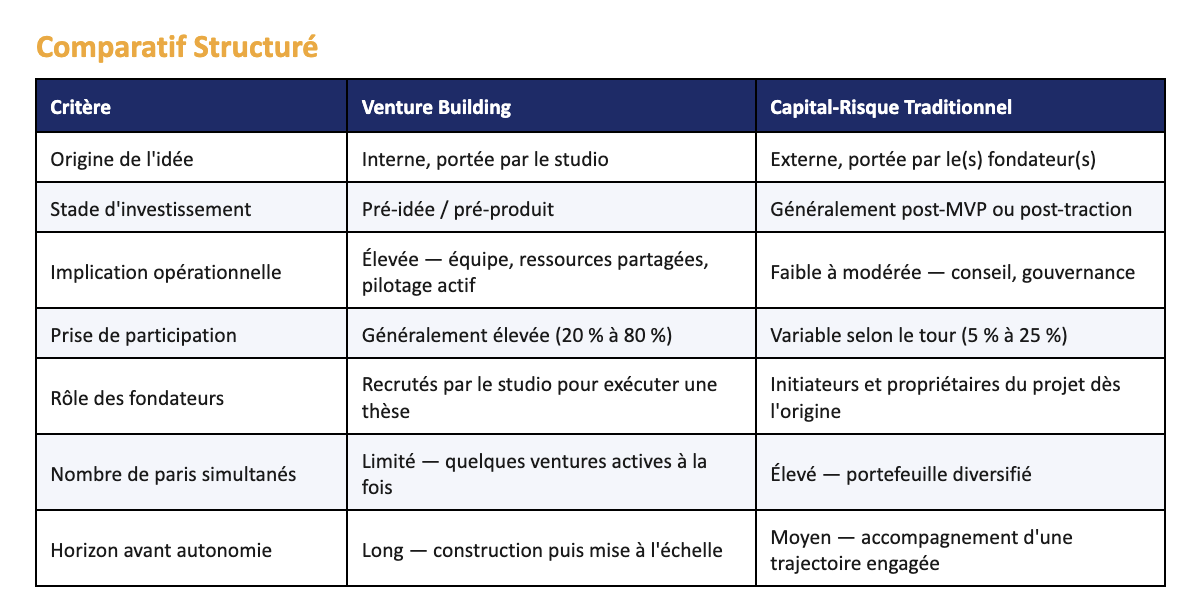
Venture building and venture capital share a common goal — bringing high-growth companies into being — but they rest on fundamentally different logics. Confusing the two models often leads to badly calibrated expectations, whether you are an entrepreneur looking for funding or an investor thinking through your capital allocation. This article sets out the structural differences between venture building and traditional venture capital, and helps you identify which model best fits your situation.
Two Models, Two Philosophies
Traditional venture capital rests on a logic of selection: funds identify companies that are already in motion — a team, an idea, sometimes early traction — and provide capital in exchange for a minority stake, with a generally advisory role (a board seat, strategic counsel).
Venture building rests on a logic of construction: the studio initiates the project itself, recruits the founding team and gets directly involved in operational execution, well beyond an advisory role. The company does not exist before the studio steps in — in a sense, it is the studio's direct output.
Risk and Return Profile
Traditional venture capital rests on a power law: most of a fund's investments fail or stall, while a minority of exceptional successes generates the bulk of the portfolio's return. This approach assumes broad diversification across the number of bets.
Venture building follows a different logic: by reducing execution risk through strong operational supervision, the studio seeks to improve the average success rate of each venture, even if that means launching fewer of them at the same time. That does not eliminate risk — it simply moves it: less execution risk, but greater concentration on each bet.
Which Model for Which Entrepreneur or Investor Profile?
For an entrepreneur
If you already have a strong idea and want to retain maximum independence over the direction of your company, traditional venture capital remains the natural path. If, on the other hand, you are looking for structured operational supervision and pooled resources from day one, and you are willing to join a project already framed by a studio, venture building can be a relevant entry point.
For an investor
Traditional venture capital allows for more scalable and diversified capital deployment, with limited involvement in day-to-day management. Venture building demands deeper commitment — time, people, governance — in exchange for greater control over execution and, potentially, more significant stakes in each company created.
Hybrid Models Are Emerging
The boundary between the two models is blurring. Many venture capital funds are now developing internal "venture building" arms to secure a proprietary flow of opportunities, while some studios raise external funds to finance their ventures at greater scale, moving closer to the classic mechanics of venture capital.
It is precisely in this hybrid space that models such as Venture Capital-as-a-Service (VCaaS) come into their own: rather than setting the two logics against each other, they bring professional infrastructure — investor sourcing, structuring of the raise, investor relations management — that is equally available to startups coming out of a venture builder and to those funded by classic venture capital.
Frequently Asked Questions
Can a venture builder also raise venture capital?
Yes. Many studios structure dedicated funds, sometimes called "studio funds", to finance their own ventures, which lets them deploy more capital without relying solely on their own resources.
Is venture building reserved for institutional investors?
No, but setting up a studio — hiring, shared resources, playbooks — requires substantial means, which explains why most venture builders are backed by private investors, family offices or corporate groups.
Is a founder "recruited" by a studio really a founder?
Legally, and often economically, yes: entrepreneurs recruited by a studio generally hold equity in the venture they lead, structured progressively as the company advances in its development.
How does an investor assess a venture builder before allocating capital to it?
The criteria include the success rate of previous ventures, the quality and repeatability of internal playbooks, the team's sector expertise, and the strength of the pipeline of new ideas.
Conclusion
Venture building and traditional venture capital are not competing models, but two different answers to the same question: how do you bring high-potential companies into being while keeping risk under control? The first bets on operational execution and internal construction; the second, on selection and diversification. Understanding these differences allows every entrepreneur and investor to choose the path most consistent with their objectives and their resources.
To go further on the subject, see our full guide "What Is Venture Building?" and our article "The Venture Building Process Step by Step".